Skip to content
Ochre Editions
ArtArtistsCollectionsGalleriesDrops
SearchSign inCart (0)
The galleries · Time and place

The 19th century

Works made in the 19th century, anywhere in the world.

731 works · hang 4354 ·

Share The 19th century, in the galleries

The rooms are imagined; every work on their walls is real.

Walk this roomRehang this room

Section 1, north wall

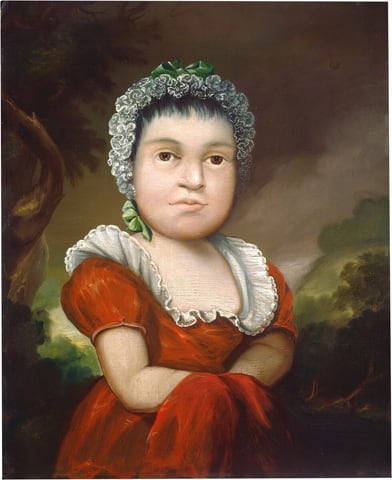
  1. A pale-skinned child wearing a short-sleeved red dress and a white bonnet stands before a shadowy green forest under dark clouds in this vertical portrait painting. The child’s over-large head is out of scale with the rest of her body. She looks toward us with brown eyes in her wide, round-jawed face. She has a broad nose, and her pale lips are set in a line. Her lace bonnet lines her black hair like frothy seafoam and is tied with spring-green bows at the top and under her right ear, to our left. The low neckline of her crimson dress is lined with a wide white ruffle. Red fabric covers her hands, which are gathered in front of her waist. Gray clouds sweep over the hazy green forest in the background. A gnarled tree grows up the left side of the painting, framing the girl.
    Portrait of a ChildEdward Hicks, c. 1840Courtesy National Gallery of Art, Washington
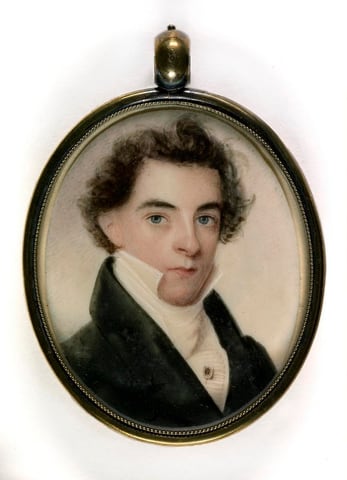
  2. John Gadsby, Jr., by Anson Dickinson, ca. 1829
    John Gadsby, Jr.Anson Dickinson, ca. 1829Courtesy of the Smithsonian American Art Museum
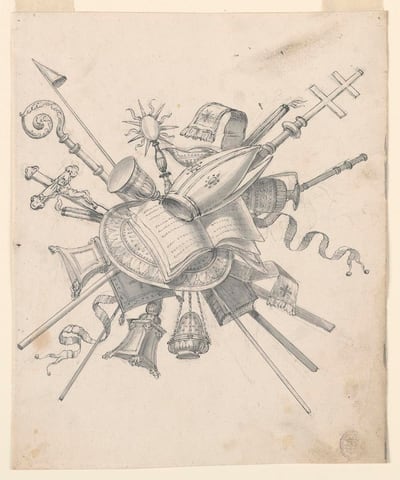
  3. TROPHY WITH ECCLESIASTICAL OBJECTS
    Trophy with Ecclesiastical ObjectsRomolo Achille Liverani, 1830–1850Courtesy of Cooper Hewitt, Smithsonian Design Museum
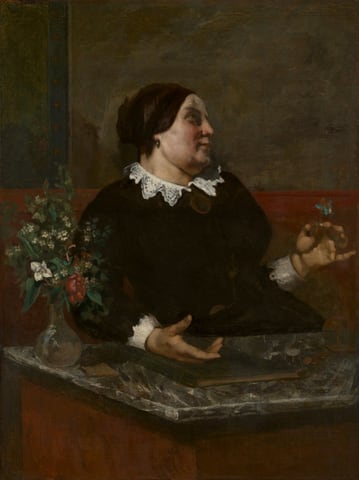
  4. Dark portrait of older woman in black dress with lace collar, flowers.
    Mère GrégoireGustave Courbet, 1855, reworked 1857–59Courtesy of the Art Institute of Chicago

Section 1, south wall
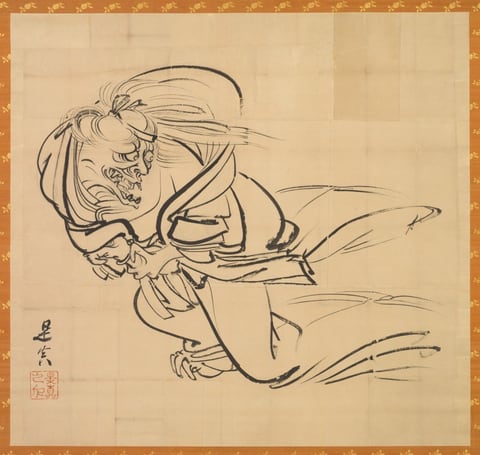
  1. Sketch of Ibaraki-dōji, by Shibata Zeshin, c. 1840
    Sketch of Ibaraki-dōjiShibata Zeshin, c. 1840Courtesy of the Cleveland Museum of Art
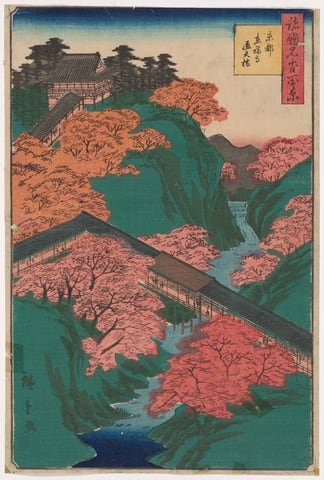
  2. A work made of color woodblock print.
    Tsuten-kyo Bridge, Tofuku Temple, Kyoto (Kyoto Tofukuji Tsutenkyo bashi) from the series “One Hundred Famous Views in the Various Provinces (Shokoku meisho hyakkei)”Utagawa Hiroshige II, 1859Courtesy of the Art Institute of Chicago
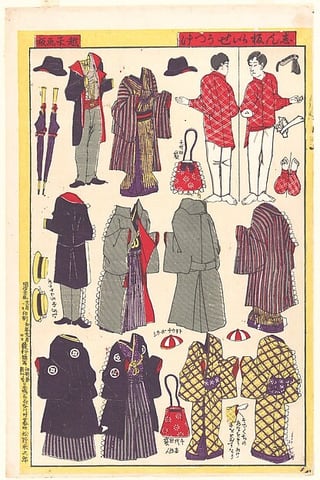
  3. Paper Doll Clothing, 1897–98
    Paper Doll ClothingUnrecorded Japanese maker, 1897–98Courtesy of The Metropolitan Museum of Art

Section 2, south wall
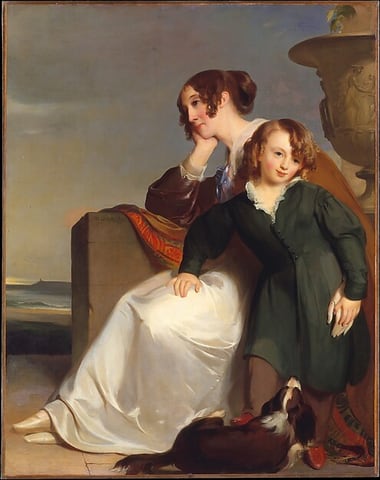
  1. Mother and Son, by Thomas Sully, 1840
    Mother and SonThomas Sully, 1840Courtesy of The Metropolitan Museum of Art
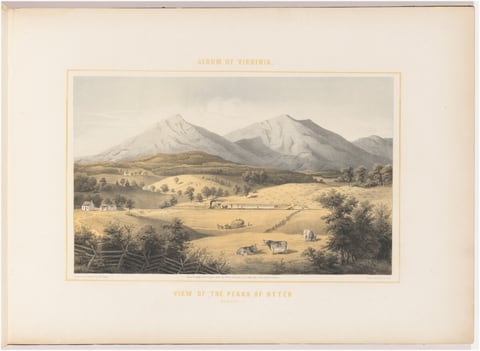
  2. The image shows a landscape with a valley leading towards two mountain peaks known as the Peaks of Otter. The horizon is low, with the mountains dominating the scene. The brushwork is smooth and delicate, and the color palette consists of muted earth tones, greens, and soft blues. In the foreground, there are cattle grazing in a field with a wooden fence, and a couple of houses among trees to the left. Further back, there are open fields with horses and agricultural activities, leading to a dense tree line at the base of the mountains.
    View of the Peaks of OtterWoldemar Rau, 1858Courtesy National Gallery of Art, Washington
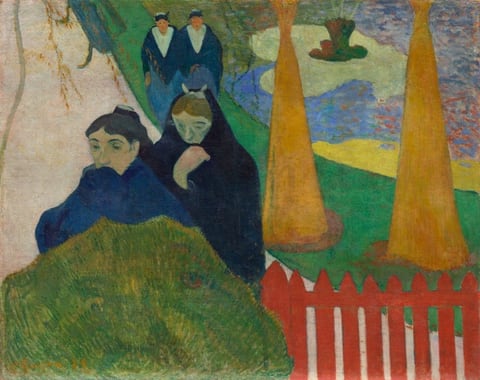
  3. Painting of four women with blue shawls walking near red fence.
    Arlésiennes (Mistral)Paul Gauguin, 1888Courtesy of the Art Institute of Chicago

Section 2, north wall
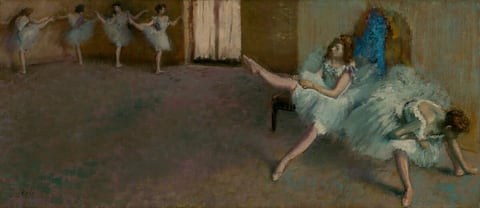
  1. In a dance studio, two ballerinas wearing knee-length tutus and ballet slippers sit on a bench and stretch to our right while four more pose at the back of the space, to our left, in this long, horizontal painting. The scene and dancers are loosely painted so many features are indistinct. All the women have light skin and dark brown hair. Each pale, robins’ egg-blue costume has a low-cut, tightly fitting, sleeveless bodice and a full skirt. Dabs of off white, teal, and blue suggest flowers lining the deep U of the neckline at the front and down the back of each bodice. Closest to us and nearly brushing the edges of the lower right corner of the canvas, one dancer sits on the end of a wooden bench and leans down between her legs, her feet widely planted. She rests her torso on an elbow folded onto one knee as she reaches for her left foot, farther from us, with her other hand. Her hair is pulled up and her face, looking downward, is deep in shadow. Sitting behind her on the bench, to our left, a second dancer lifts her right leg, toe pointing, as she pulls on her pale pink tights. Her other leg stretches straight, pointed toe brushing the floor, in front of her. This woman’s hair hangs loose around her shoulders. The pair is brightly lit from a source to our right, and an arched area of electric blue and mustard yellow behind them is difficult to interpret. The floor, which takes up about two-thirds of the composition, is painted with dabs of teal blue, pale fuchsia pink, and caramel brown. It leads us back to the upper left corner of the painting where four more four ballerinas stand in a line. The pair to our left stands with their backs to us, facing the wall with their right legs raised to shoulder height, toes pointed. The pair to our right faces us. They also stand with their right legs raised, creating a wide angle with their standing legs. All four ballerinas bend their arms gently at the elbow, and some tip their heads toward the raised legs. The rightmost dancer is illuminated by a pair of French doors at the back corner, at the top center of the painting. The wall behind the bench is streaked with mint green over honey brown, and the wall at the back of the room is leather brown. The visible, soft brushstrokes give the image a blurred, ethereal appearance in the dimmed studio. The artist signed the painting in the lower left corner, “Degas.”
    Before the BalletEdgar Degas, 1890/1892Courtesy National Gallery of Art, Washington
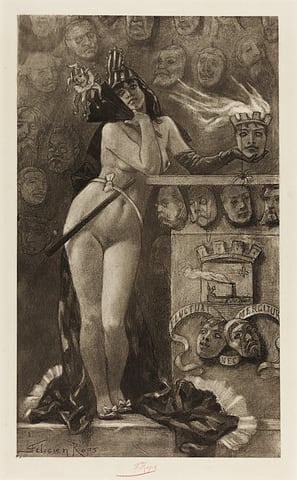
  2. A work made of photogravure in dark brown retouched with soft varnish (vernis mou), roulette and blue handcoloring on thick cream wove paper.
    Modern MasksFélicien Rops, 1889Courtesy of the Art Institute of Chicago
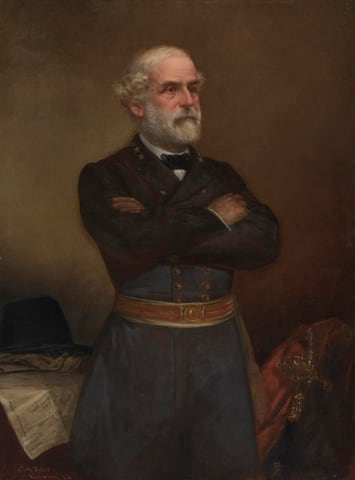
  3. Artist: John Adams Elder, Sitter: Robert Edward Lee, Current owner: National Portrait Gallery, Smithsonian Institution
    Robert Edward LeeJohn Adams Elder, 1876Courtesy of the National Portrait Gallery, Smithsonian Institution
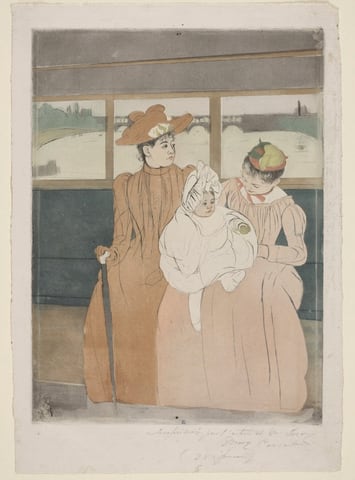
  4. In the Omnibus, by Mary Cassatt, 1890–91
    In the OmnibusMary Cassatt, 1890–91Courtesy of the Cleveland Museum of Art

Section 3, north wall
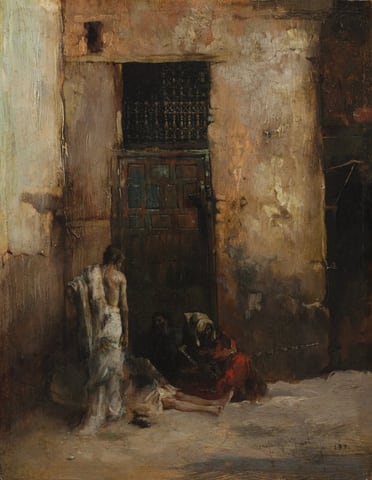
  1. Beggars by a Door, by Mariano Fortuny, 1870
    Beggars by a DoorMariano Fortuny, 1870Courtesy of the Cleveland Museum of Art
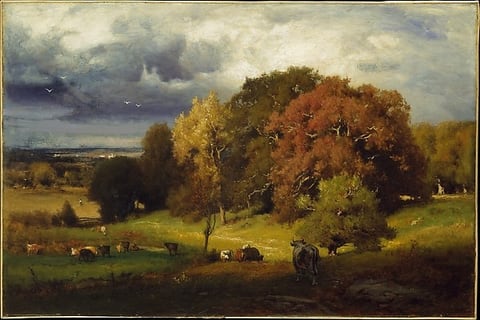
  2. Autumn Oaks, by George Inness, ca. 1878
    Autumn OaksGeorge Inness, ca. 1878Courtesy of The Metropolitan Museum of Art

Walk on

  • The 19th century, room 2
  • More by George Inness 5 works
  • More Realism 41 works
Ochre Editions

The world's museums, on your wall. Every work here is a reproduction of a public-domain original, credited to the museum that holds it.

Shop

All artCollectionsLimited dropsPrints and framing

Help

Find an orderShippingReturnsVerify a certificate

About

About Ochre EditionsMuseum creditsFor agentsDevelopers

Legal

Terms of UseTerms of SaleLimited Editions and CertificatesPrivacy PolicyCookie PolicyAcceptable Use PolicyAgent & API TermsCopyright and DMCA PolicyPrinting Your Own PhotoVulnerability Disclosure PolicyAccessibility StatementOpen-Access Credits
© 2026 Ochre EditionsPrices in US dollars. Prints ship within the United States.