Skip to content
Ochre Editions
ArtArtistsCollectionsGalleriesDrops
SearchSign inCart (0)
The galleries · Time and place

18th-century France

Works made in France in the 18th century.

75 works · hang 9309 ·

Share 18th-century France, in the galleries

The rooms are imagined; every work on their walls is real.

Walk this roomRehang this room

Section 1, north wall

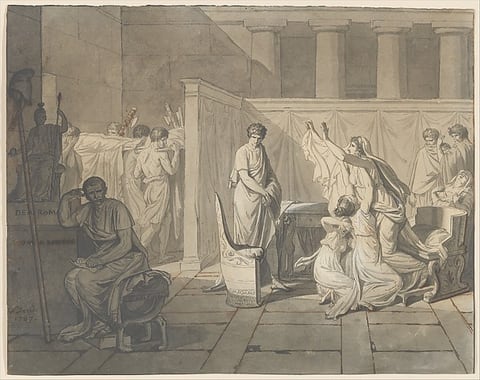
  1. The Lictors Bringing Brutus the Bodies of his Sons, by Jacques-Louis David, 1787
    The Lictors Bringing Brutus the Bodies of his SonsJacques-Louis David, 1787Courtesy of The Metropolitan Museum of Art
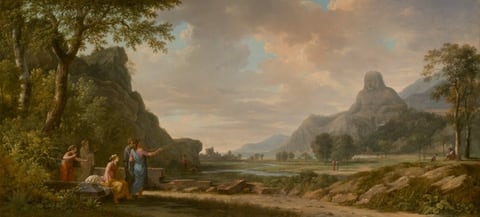
  2. A work made of oil on canvas.
    Mount Athos Carved as a Monument to Alexander the GreatPierre Henri de Valenciennes, 1796Courtesy of the Art Institute of Chicago
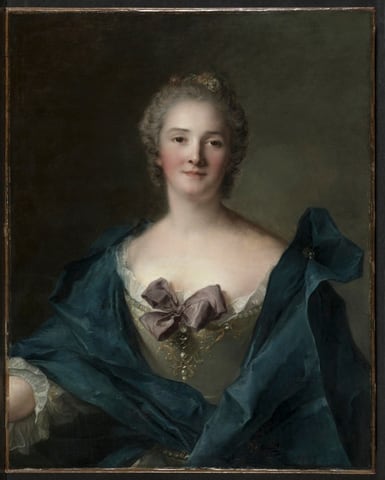
  3. Portrait of a Woman, by Jean-Marc Nattier, c. 1748
    Portrait of a WomanJean-Marc Nattier, c. 1748Courtesy of the Cleveland Museum of Art
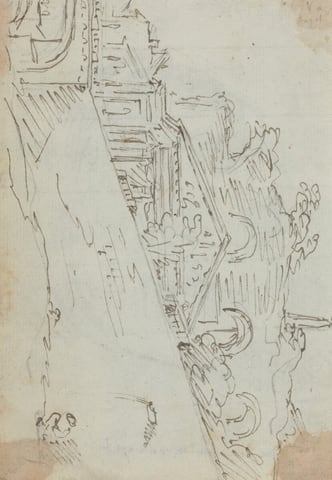
  4. The image shows a sketch of an architectural scene with structures lining a road or pathway. The horizon is not clearly defined, and the sketch focuses on architectural details. The drawing features loose, freehand lines outlining buildings and trees, with classical elements like columns and entablatures. The color palette is monochromatic, with light parchment and dark ink strokes creating contrast. Close-up details are lightly shaded for depth, while distant details are less defined. The composition is open and airy, emphasizing architectural features over precision.
    Ancient Ruins on the Bank of the TiberAugustin Pajou, 1752/1756Courtesy National Gallery of Art, Washington

Section 1, south wall
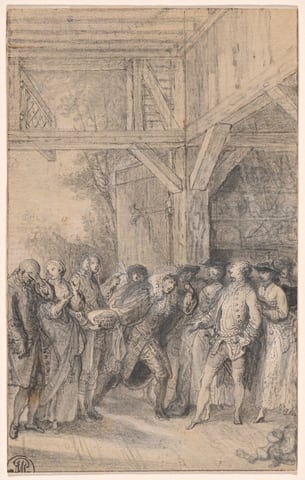
  1. A work made of graphite and pen and black ink, with touches of opaque, white watercolor on cream laid paper.
    Farmer Requesting Permission to Marry a Nobleman's DaughterGabriel de Saint-Aubin, 1761Courtesy of the Art Institute of Chicago
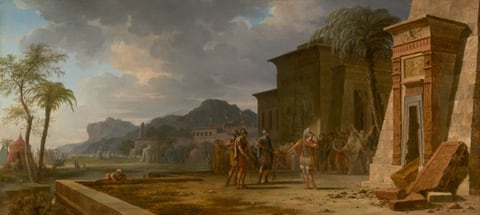
  2. A work made of oil on canvas.
    Alexander at the Tomb of Cyrus the GreatPierre Henri de Valenciennes, 1796Courtesy of the Art Institute of Chicago
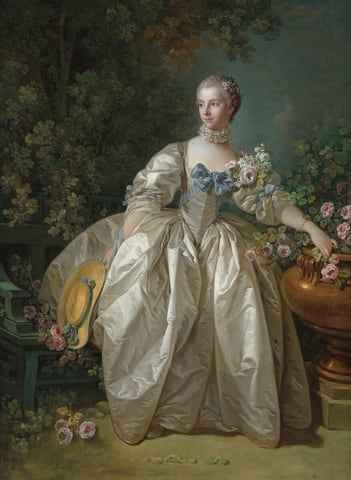
  3. A young woman with light skin stands in a garden, wearing a voluminous, full-length, silvery, shimmering gown in this vertical portrait painting. Her body faces us, as she looks into the distance to our left. She has rosy cheeks, gray-green eyes under gently arched, light brown brows, and her coral-pink, thin, closed lips curve in a slight smile. Her ash-brown hair is pulled back and adorned with tiny shell-pink and azure-blue flowers along the left side top of head, to our right. A pleated lace ruffle encircles her smooth neck. Her gown is parchment white where the light glints off the stiff fabric and is silvery gray in the shadows, creating a silk-like sheen. The dress is cut low across the chest, fits tightly around her narrow waist, and has puffy sleeves tied at the elbows with topaz-blue bows. Another blue bow is tied at her chest, and the ends wrap around her back along her waist. A corsage at her left shoulder, to our right, is a profusion of white flowers around a pale pink rose. In her other hand, to our left, she holds a straw hat with a shallow crown and a wide brim, trimmed with sky-blue ribbon. The arm holding the hat is nearly engulfed in the deep folds of her full skirt. She holds a pink rose in her other hand, which rests on the lip of a shiny, copper-colored urn filled with pink flowers and delicate green leaves. On that wrist she wears a bracelet with four strands of white pearls holding a cameo. She stands on a pale, dirt ground. A teal-blue bench in the lower left corner of the painting is tucked into sage-green shrubbery. Sprigs of pink roses are strewn across the seat and on the ground. The woman is framed to either side with olive and celery-green trees and vegetation, which blend into the hazy distance beyond her head.
    Madame BergeretFrançois Boucher, possibly 1766Courtesy National Gallery of Art, Washington
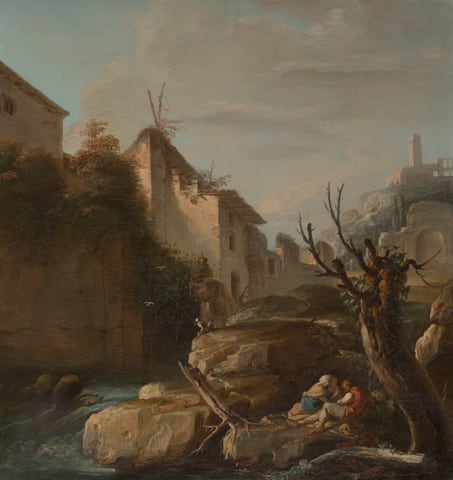
  4. A work made of oil on canvas.
    Appenine LandscapeFrançois Le Moyne, c. 1730Courtesy of the Art Institute of Chicago

Section 2, south wall
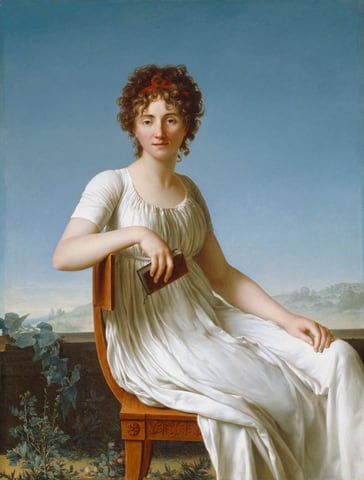
  1. A work made of oil on canvas.
    Portrait of Constance PipeletJean Baptiste François Désoria, 1797Courtesy of the Art Institute of Chicago
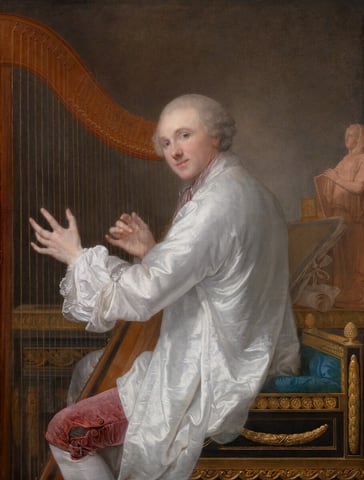
  2. A pale-skinned man sits facing our left as he plays a harp while turning his face to smile at us in this vertical portrait painting. He looks out the corners of his light blue eyes under arched, gray brows. He has a rounded nose, pale pink lips, and a round face. Gray hair is brushed back from his high forehead and curls around his ears. His long fingers rest on the strings of the harp, and the ends of strings curl like wind-loosened strands of hair along the top edge. The man wears a pale mauve-purple cravat, and his snow-white, long-sleeved chemise is untucked and loose around his thighs. The cuff we see is open and folded back over a bright white shirt edged with lace. His dusky rose-pink breeches are unbuttoned at the knee over white stockings. The square-seated chair on which he sits is carved with garlands and floral patterns, which are gilded gold. The seat itself is topaz blue, and it has a low back. A similarly ornamented and gilded table along the back of the room holds a portfolio and roll of papers, the tooled and gilded spines of books, and a statuette to the right. The pale pinkish-orange statuette shows a woman holding a tablet and wearing a long, loose robe and head covering. Her body angles to our left and she looks off in that direction. The wall behind the table is mottled with smoky shades of gray and tan.
    Ange Laurent de La Live de JullyJean Baptiste Greuze, probably 1759Courtesy National Gallery of Art, Washington
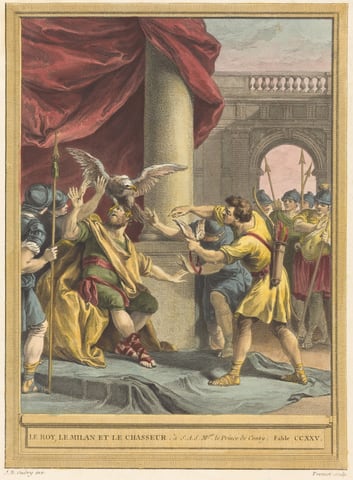
  3. This is a painting of a king, a hawk, and a hunter in a classical architectural setting with columns and arches. In the image, a figure in royal clothing is seated beneath draped red fabric, facing a man in hunting attire holding a bird. A hawk perches on the royal figure's head, wings spread, while the hunter reaches toward the hawk. Surrounding them are other figures in armor, holding spears and shields. The style is reminiscent of classic European paintings with themes of mythology or allegory.
    Le roi, le milan, et le chasseur (The King, the Kite, and the Hunter)Benoît-Louis Prévost, published 1759Courtesy National Gallery of Art, Washington
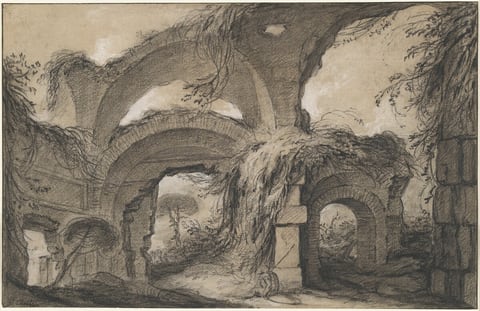
  4. The image shows an ancient ruin with arches and crumbling stonework surrounded by overgrown vegetation. The horizon is slightly elevated, emphasizing the towering remnants of the architecture. Expressive brushstrokes and textures are notable, especially in the vines and leaves on the stone. The color palette is subdued, mainly earthy tones and black, creating contrast and suggesting openings into the distance, enhancing the old, abandoned feel of the ruins.
    Arches of the Larger Baths at Hadrian's VillaCharles Michel-Ange Challe, c. 1748Courtesy National Gallery of Art, Washington

Section 2, north wall
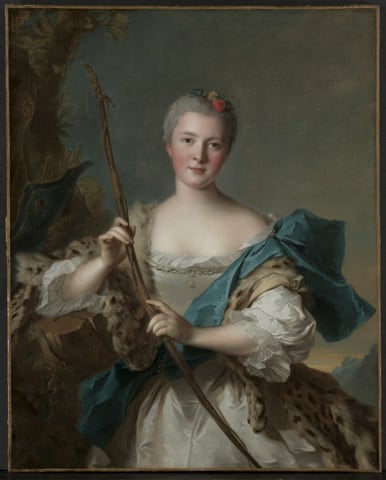
  1. Portrait of a Woman as Diana, by Jean-Marc Nattier, 1752
    Portrait of a Woman as DianaJean-Marc Nattier, 1752Courtesy of the Cleveland Museum of Art
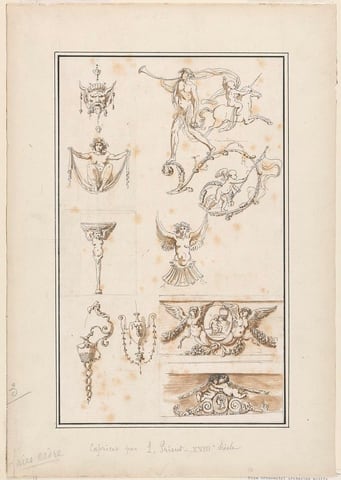
  2. DESIGNS FOR ORNAMENTAL ARABESQUE MOTIFS
    Designs for Ornamental Arabesque MotifsEtienne de Lavallée-Poussin, 1770Courtesy of Cooper Hewitt, Smithsonian Design Museum
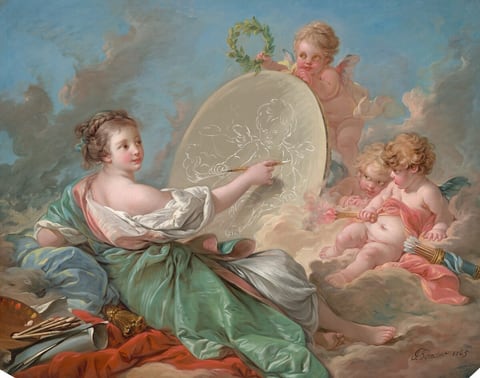
  3. A young woman draws on an oval surface with white chalk while three winged, baby-like putti gather nearby, all on a bank of pale pink clouds in this horizontal painting. The woman and putti have pale, rosy skin, flushed cheeks, and hazel-brown eyes. To our left, the woman reclines with her upper body propped up on her far elbow, which rests on a steel-blue cushion as her legs stretch out to our right. Her light brown hair is braided and wrapped across the top of her head. She wears a loose, seafoam-green robe over a billowing ivory-white garment that has slipped off the shoulder closer to us. A round paint palette with brushes sticking out of its thumb hole and a roll of blue and white paper sit in the lower left corner, behind the woman. The woman and the objects are on a red cloth. In front of the woman is a rounded surface, perhaps a canvas, on which she draws. She holds up a gold-colored stylus with her right hand, closer to us, with a pointed piece of white chalk in one end and black chalk in the other. The canvas is taller than her head, so the child-like putto she draws on it is life-sized. The three nude putti on the far side of the canvas have copper or golden-blond, curly hair, flushed, rounded cheeks, short wings in white or peacock blue, pudgy torsos, and dimpled limbs. One putto, presumably the one the woman draws, sits back on the bank of clouds with a carnation-pink sash across his chest. He pulls his chin back and looks at her from under his eyebrows. He holds a gold-colored torch with a pink flame in one hand, and the other hand rests near a cylindrical quiver of arrows. Another putto peeks around the side of the canvas, and the third stands and props the canvas up. That third putto holds up a wreath of laurel leaves up over the canvas, above the woman’s drawing hand. The bank of clouds is parchment-brown with muted pink and blue highlights against a vivid blue sky. The artist signed and dated the lower right, “F Boucher – 1765.”
    Allegory of PaintingFrançois Boucher, 1765Courtesy National Gallery of Art, Washington
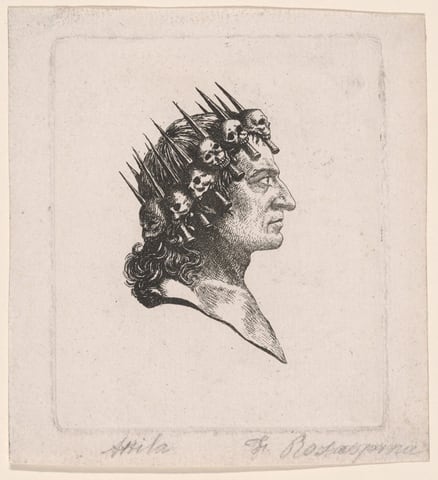
  4. A work made of etching in black on ivory laid paper.
    Portrait of Le Roi MaratViller, c. 1795Courtesy of the Art Institute of Chicago

Walk on

  • 18th-century France, room 2
  • Viller's contemporaries 8 works
  • More Neoclassicism 109 works
Ochre Editions

The world's museums, on your wall. Every work here is a reproduction of a public-domain original, credited to the museum that holds it.

Shop

All artCollectionsLimited dropsPrints and framing

Help

Find an orderShippingReturnsVerify a certificate

About

About Ochre EditionsMuseum creditsFor agentsDevelopers

Legal

Terms of UseTerms of SaleLimited Editions and CertificatesPrivacy PolicyCookie PolicyAcceptable Use PolicyAgent & API TermsCopyright and DMCA PolicyPrinting Your Own PhotoVulnerability Disclosure PolicyAccessibility StatementOpen-Access Credits
© 2026 Ochre EditionsPrices in US dollars. Prints ship within the United States.