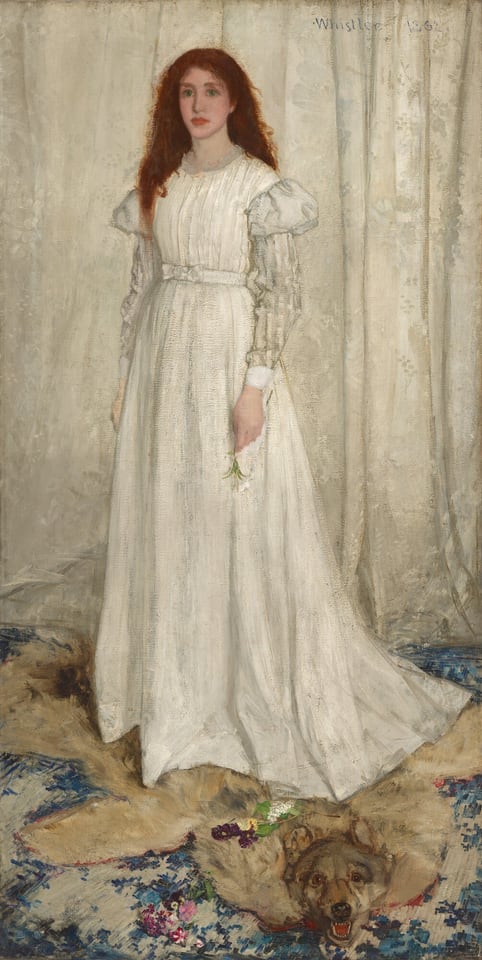
Symphony in White, No. 1: The White Girl1861-1863, 1872
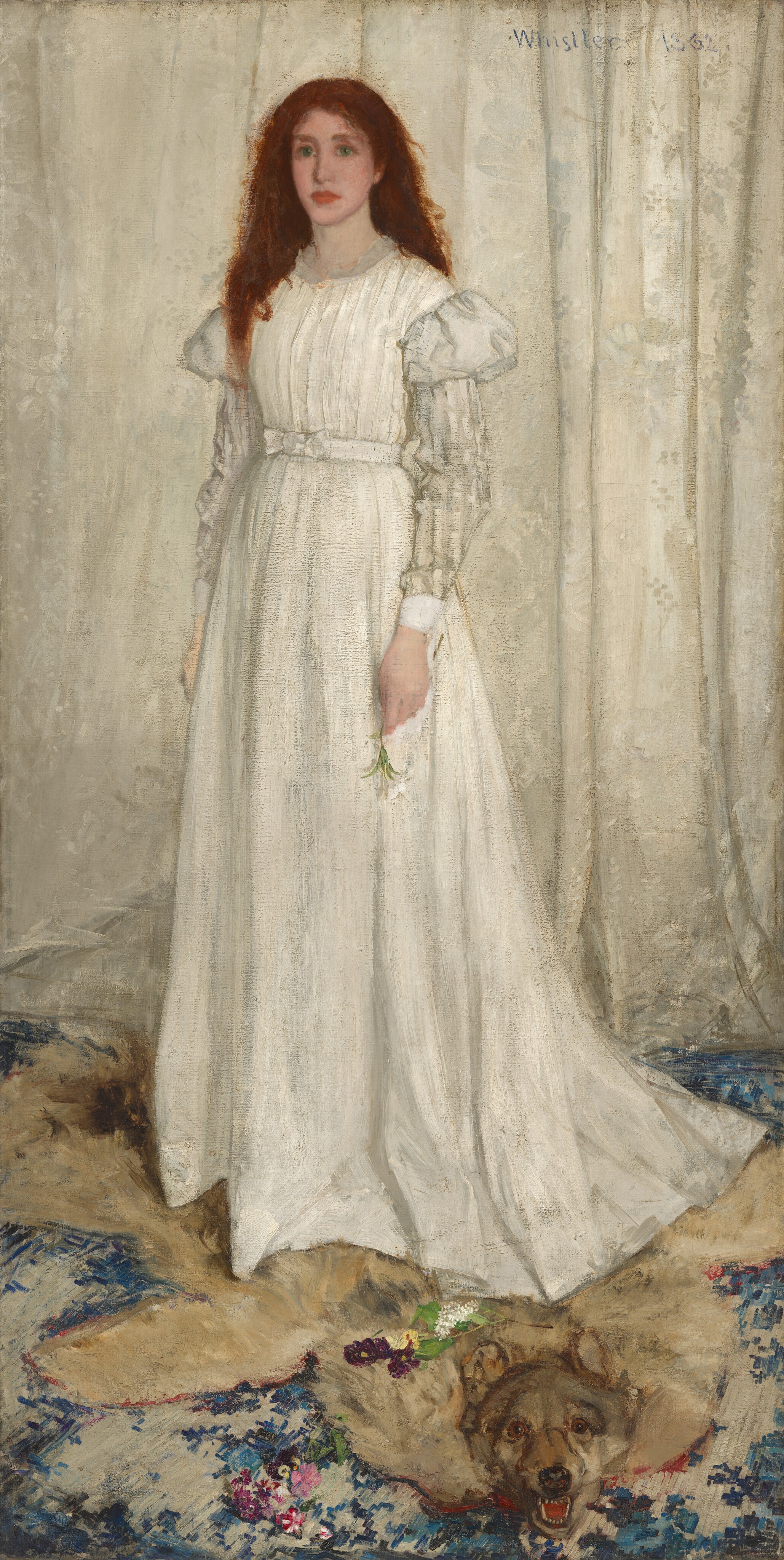
A young woman in a long white dress stands against a white curtain, a lily drooping from her hand and flowers scattered on the animal-skin rug at her feet, whose snarling head stares out at us. More about this work
About this work
A young woman in a long white dress stands against a white curtain, a lily drooping from her hand and flowers scattered on the animal-skin rug at her feet, whose snarling head stares out at us. The model was Joanna Hiffernan, Whistler’s companion. Turned down by the Royal Academy and then by the Paris Salon of 1863, the painting caused a sensation at the Salon des Refusés that year, where critics puzzled over its meaning. For Whistler it was a study in white on white, an arrangement of tones rather than a story, a principle he underlined by later retitling it Symphony in White, No. 1.
Written by Ochre Editions.
What you’re looking at
A young woman with pale, peachy skin, wearing a long, flowing white dress, stands in front of a white curtain in this vertical portrait painting. Her auburn-red hair cascades down over and behind her shoulders. She looks to our left with green eyes, and her pink, full lips are closed. Her dress has puffed shoulders above a white-on-white striped pattern on the long sleeves. She stands on an animal pelt; it is not clear whether it is a wolf or a bear. The pelt spans the width of the painting and overlaps a blue patterned carpet. The animal’s mouth gapes to show sharp teeth. Its glassy eyes are wide open, and it seems to look at us. The edges of the animal skin are red. The woman holds a white lily by her side in her left hand, while yellow and purple flowers lie scattered on the pelt.
Description from the National Gallery of Art.
How it was made
- Oil paint
- Pigment ground in a drying oil, usually linseed. It dries slowly, so painters could blend on the canvas, build up thin translucent glazes, and rework a picture over weeks. Canvas replaced wooden panels in the 1500s because it is lighter and can be rolled.
James McNeill Whistler
American, 1834–1903 · Born in Lowell, Massachusetts; died in London.
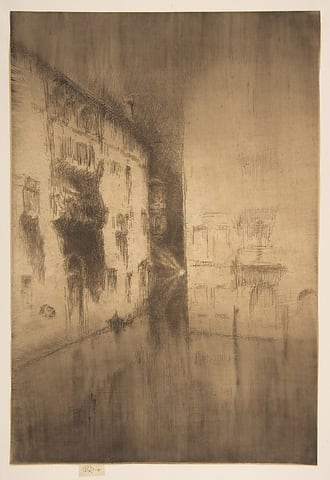
Whistler spent part of his boyhood in Russia, left West Point without graduating and trained as a painter in Paris before settling in London in 1859. He held that a picture was an arrangement of colour and form, and named his works symphonies, harmonies and nocturnes; a hostile review of one nocturne led to his 1878 libel suit against John Ruskin. He was equally committed to etching, and in his Venice plates of 1879–80 he left films of ink on the copper to suggest water and dusk.
Written by Ochre Editions.
Rights and the museum’s record
Public domain. The National Gallery of Art has dedicated this image to the public domain under CC0, so anyone may copy, adapt and use it, for any purpose, without asking. Our prints and files are reproductions made from the museum’s image; the museum doesn’t endorse them.
- Object number
- 1943.6.2
- Credit
- Courtesy National Gallery of Art, Washington
- Type
- Painting
- Licence
- CC0 1.0 Universal
- Museum record
- See it on the museum’s site
Report this work
More by James McNeill Whistler
All their works
Close in colour