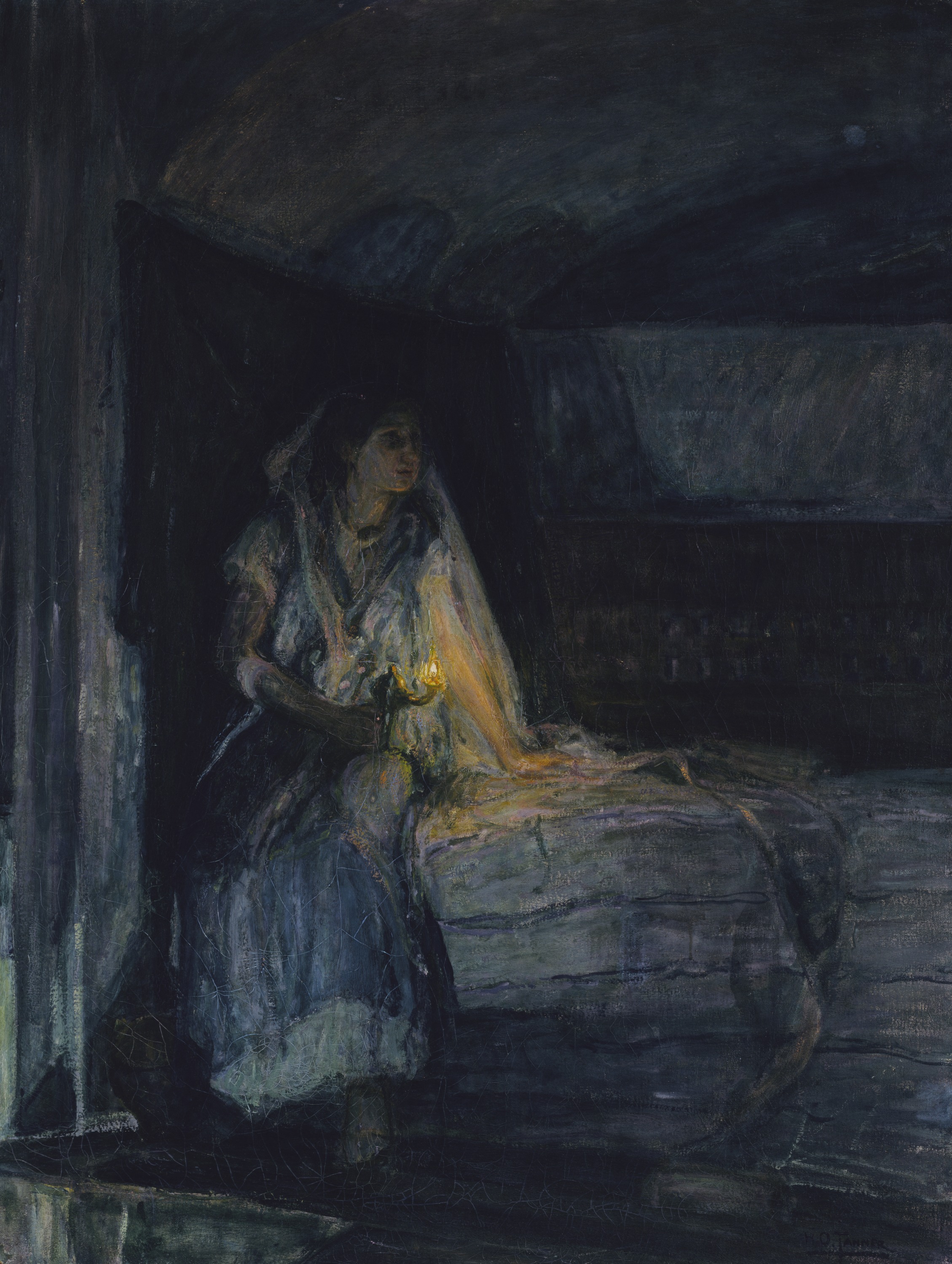
Maryca. 1914
Henry Ossawa Tanner saw Mary, mother of Jesus, as a symbol of faith and fortitude. He painted many images of her and created this particular work during a difficult and trying time in his life. More about this work
About this work
Henry Ossawa Tanner saw Mary, mother of Jesus, as a symbol of faith and fortitude. He painted many images of her and created this particular work during a difficult and trying time in his life. In 1914, the year his mother died, the outbreak of World War I forced his family to flee France for England. In this scene, Mary awaits the arrival of the angel who will tell her that she bears the Son of God. The glowing lamp, a symbol of God’s presence, adds mystery and suspense to the painting.
Text from the Smithsonian American Art Museum.
How it was made
- Oil paint
- Pigment ground in a drying oil, usually linseed. It dries slowly, so painters could blend on the canvas, build up thin translucent glazes, and rework a picture over weeks. Canvas replaced wooden panels in the 1500s because it is lighter and can be rolled.
Henry Ossawa Tanner
born Pittsburgh, PA 1859-died Paris, France 1937
Rights and the museum’s record
Public domain. The Smithsonian American Art Museum has dedicated this image to the public domain under CC0, so anyone may copy, adapt and use it, for any purpose, without asking. Our prints and files are reproductions made from the museum’s image; the museum doesn’t endorse them.
- Object number
- 1991.102
- Credit
- Courtesy of the Smithsonian American Art Museum
- Type
- Painting
- Department
- Painting and Sculpture
- Licence
- CC0 1.0 Universal
- Museum record
- See it on the museum’s site