Books and Scholars’ Accoutrementslate 1800s
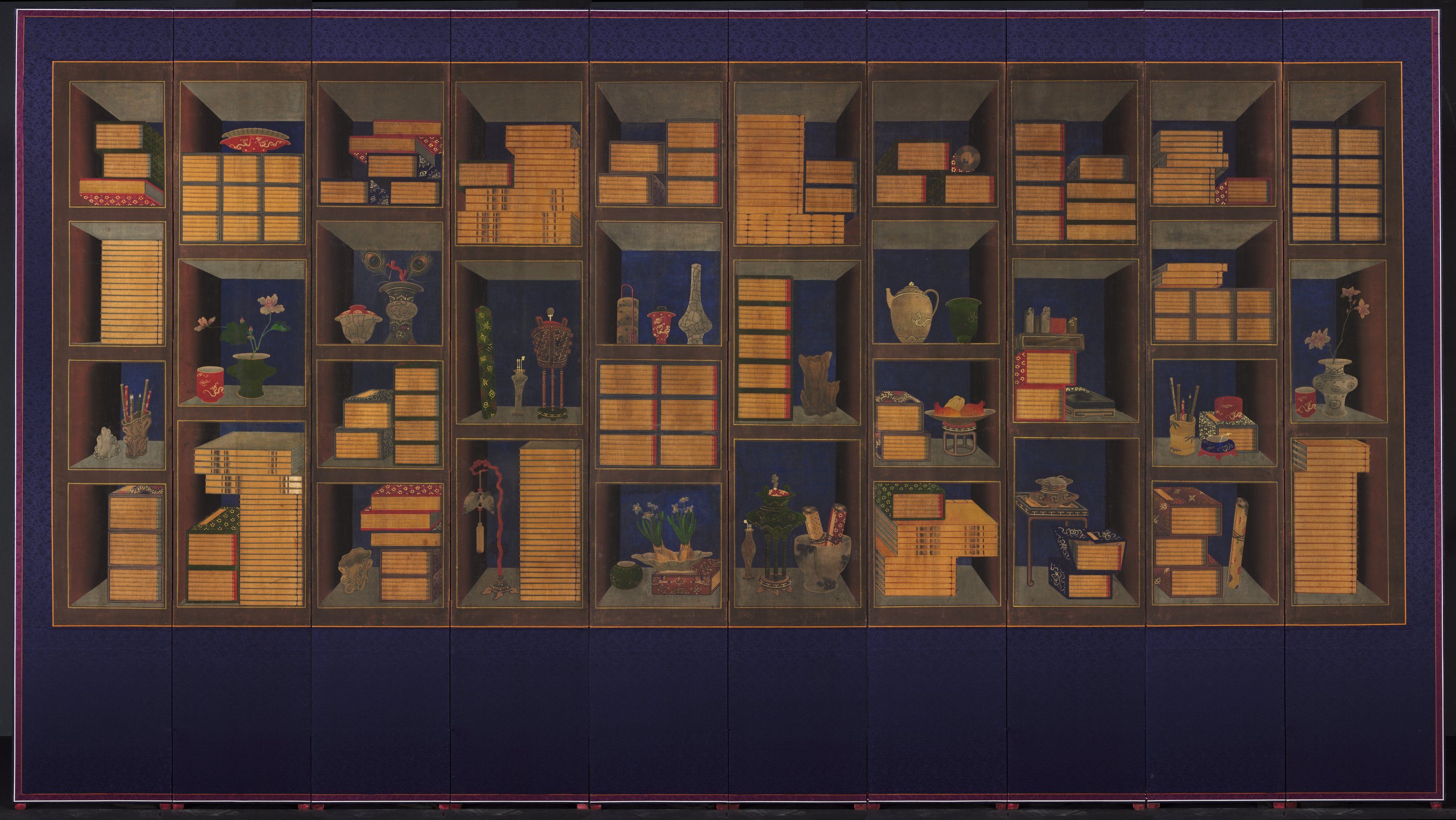
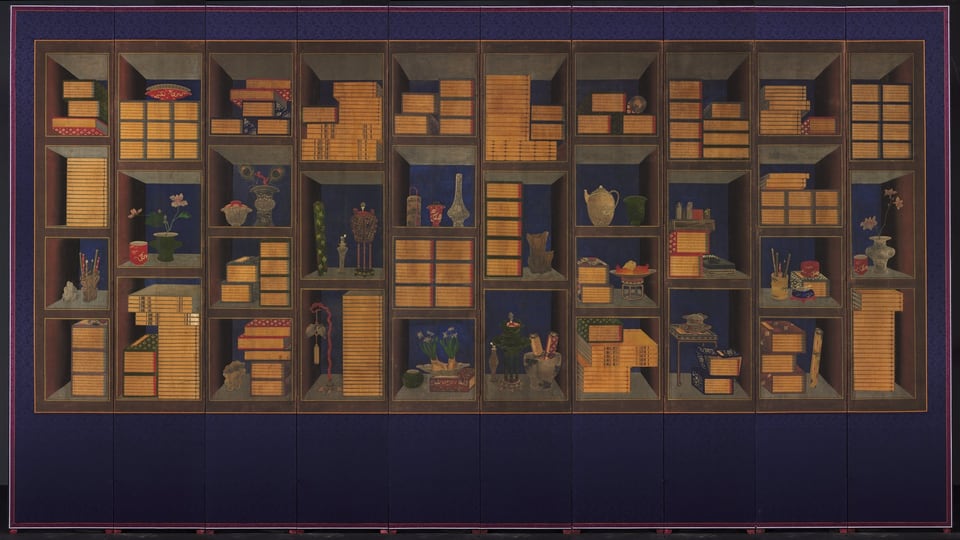
First produced around the second half of the eighteenth century, chaekgado (literally, “pictures of bookshelves”) flourished throughout the 1800s as a royal emblem. More about this work
About this work
First produced around the second half of the eighteenth century, chaekgado (literally, “pictures of bookshelves”) flourished throughout the 1800s as a royal emblem. And soon this pictorial genre became a popular furnishing item for aristocrats' elegant studies. The third panel from the right bears a hidden seal that reveals the artist: Yi Taek-gyun, a prominent court artist active in the late 1800s.
Text from the Cleveland Museum of Art.
How it was made
- Folding screen
- Panels joined by paper hinges, so the screen stands by itself in a zigzag. The picture runs across every panel, and screens were often made in pairs.
- Ink and colour on silk
- Silk was sized with glue and alum so it would hold a crisp brushline, and mineral colours were built up in thin layers. The sheen of the weave still shows through.
Yi Taek-gyun
Korean, 1808–after 1883
Rights and the museum’s record
Public domain. The Cleveland Museum of Art has dedicated this image to the public domain under CC0, so anyone may copy, adapt and use it, for any purpose, without asking. Our prints and files are reproductions made from the museum’s image; the museum doesn’t endorse them.
- Object number
- 2011.37
- Credit
- Courtesy of the Cleveland Museum of Art
- Type
- Painting
- Department
- Korean Art
- Licence
- CC0 1.0 Universal
- Museum record
- See it on the museum’s site