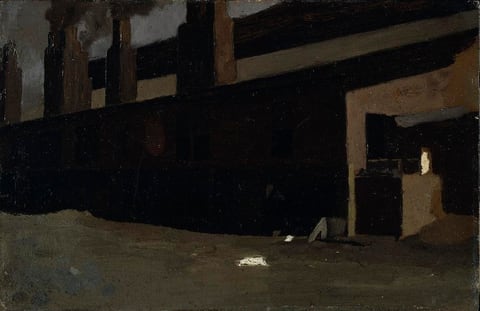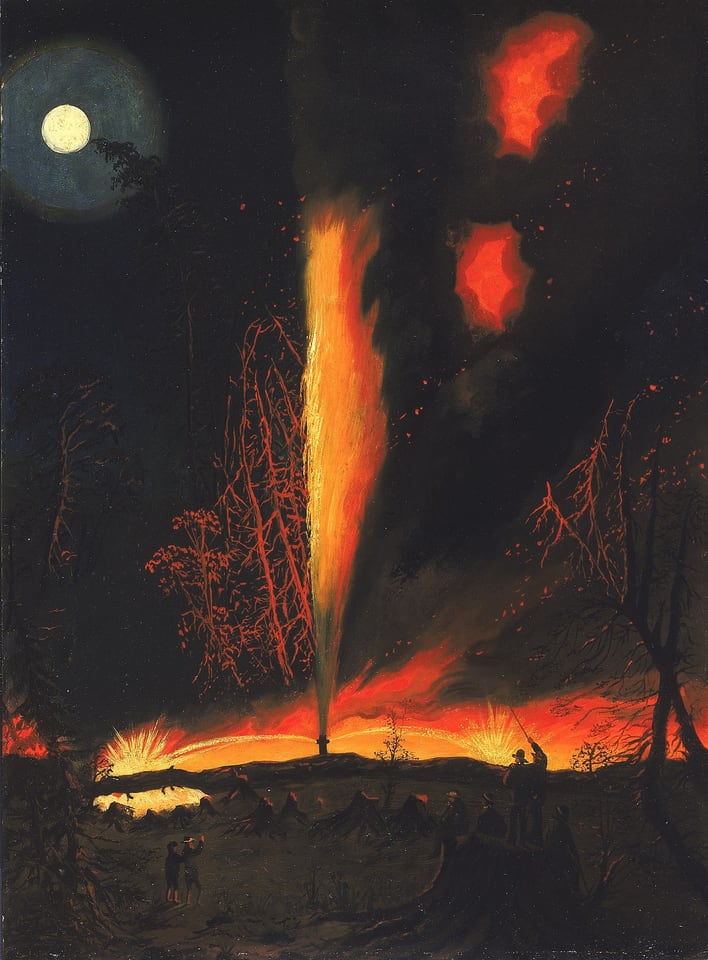
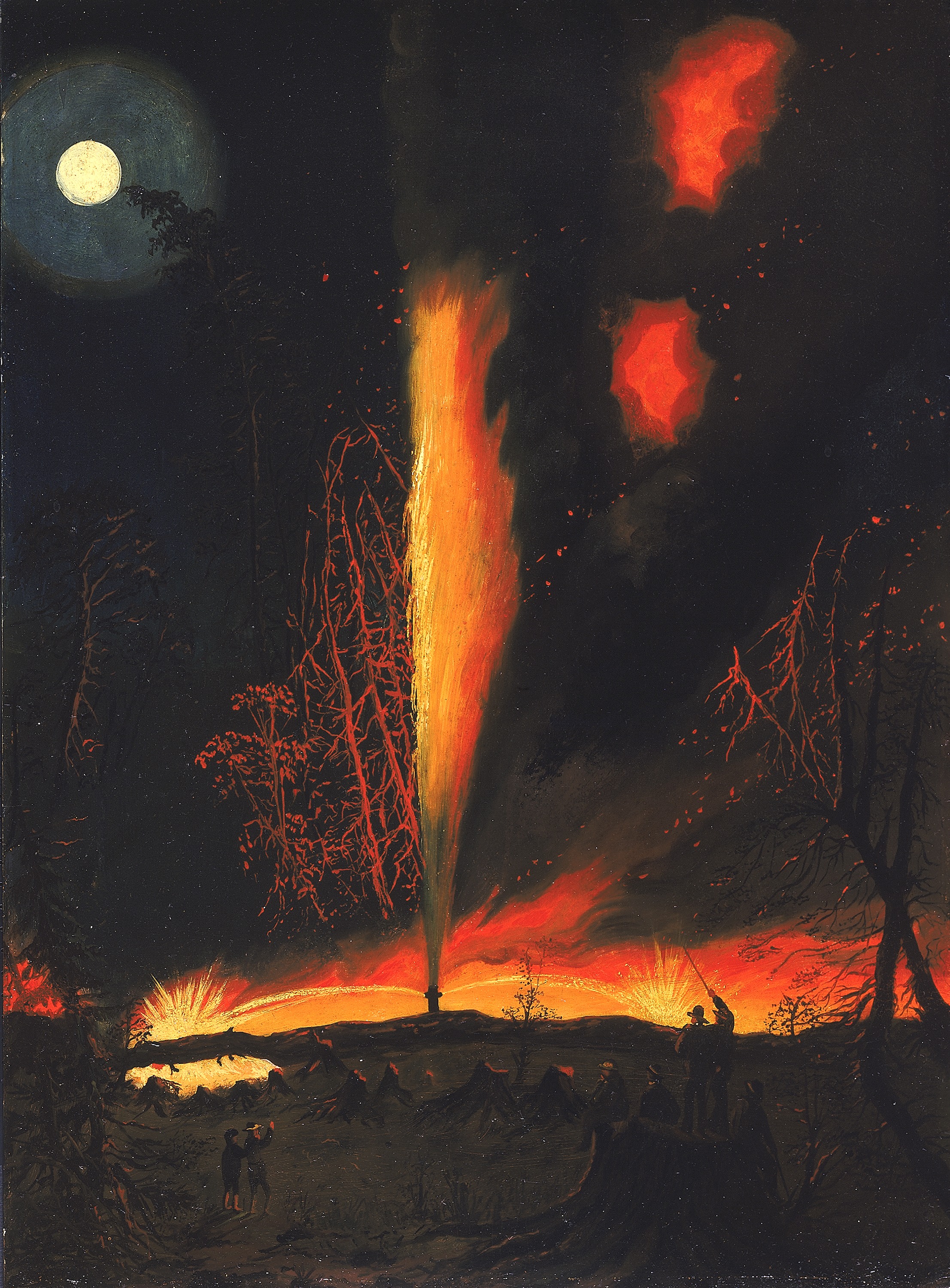
Burning Oil Well at Night, near Rouseville, Pennsylvaniaca. 1861
Rouseville, Pennsylvania, lay within a few miles of Titusville and Pithole City, two of the most famous boomtowns in Pennsylvania ’s oil fields. More about this work
About this work
Rouseville, Pennsylvania, lay within a few miles of Titusville and Pithole City, two of the most famous boomtowns in Pennsylvania ’s oil fields. From 1859 until after the Civil War, new gushers brought investors, cardsharps, saloons, and speculators into these rural settlements. As quickly as they grew, however, the towns collapsed, often from the effects of fires like the one shown here. In the 1860s, American industrialist John D. Rockefeller (1839-1937) was in the thick of this oil boom, maneuvering to establish the Standard Oil Company. Rockefeller’s investments in railroads and refineries would make him one of America’s richest men, long after the wildcatters in the Pennsylvania fields had gone bust.
Text from the Smithsonian American Art Museum.
How it was made
- Oil paint
- Pigment ground in a drying oil, usually linseed. It dries slowly, so painters could blend on the canvas, build up thin translucent glazes, and rework a picture over weeks. Canvas replaced wooden panels in the 1500s because it is lighter and can be rolled.
James Hamilton
born near Belfast, Ireland 1819-died San Francisco, CA 1878
Rights and the museum’s record
Public domain. The Smithsonian American Art Museum has dedicated this image to the public domain under CC0, so anyone may copy, adapt and use it, for any purpose, without asking. Our prints and files are reproductions made from the museum’s image; the museum doesn’t endorse them.
- Object number
- 1977.50
- Credit
- Courtesy of the Smithsonian American Art Museum
- Type
- Painting
- Department
- Painting and Sculpture
- Licence
- CC0 1.0 Universal
- Museum record
- See it on the museum’s site
Report this work
Close in colour