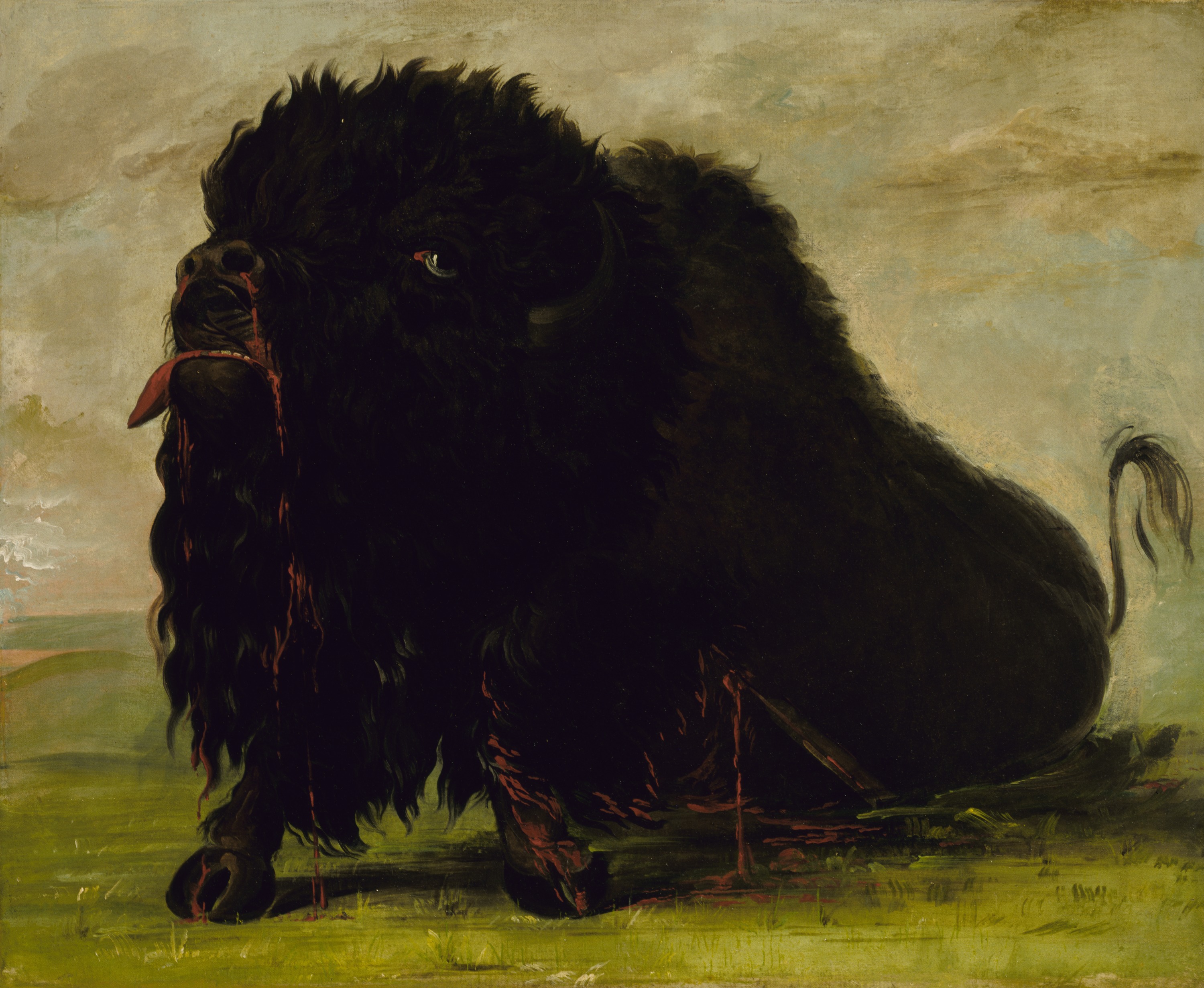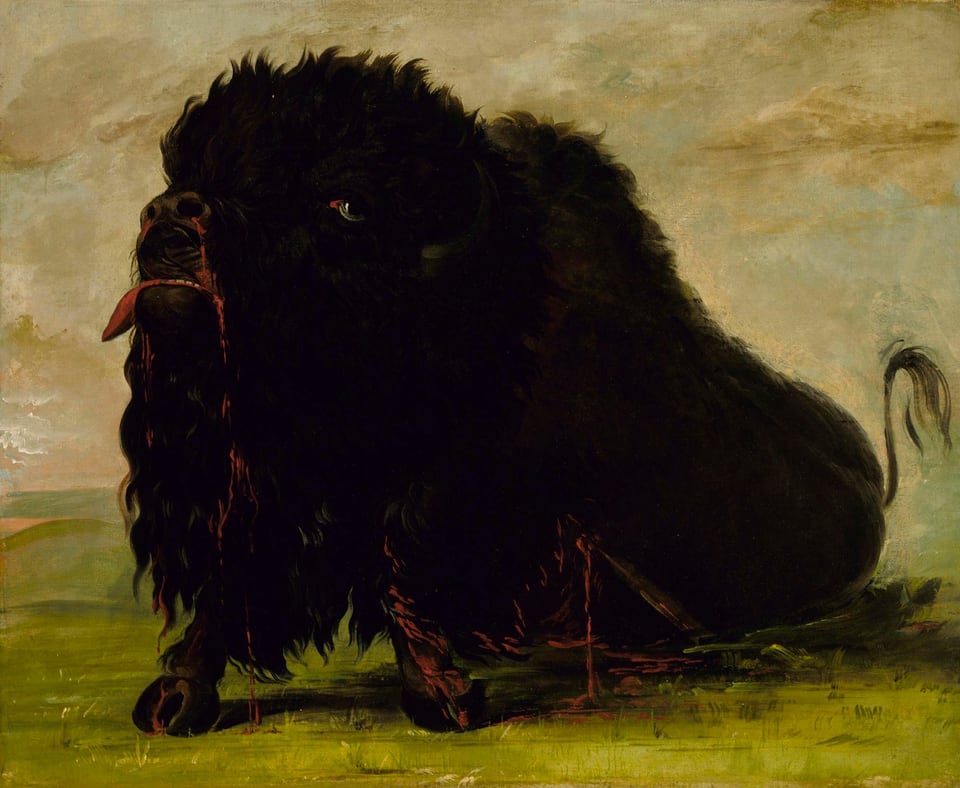
Dying Buffalo, Shot with an Arrow1832-1833
“The American bison, or . . More about this work
About this work
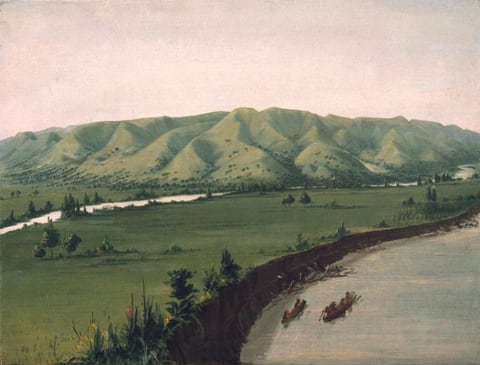
“The American bison, or . . . buffalo, is the largest of the ruminating animals that is now living in America; and seems to have been spread over the plains of this vast country, by the Great Spirit, for the use and subsistence of the red men, who live almost exclusively on their flesh, and clothe themselves with their skins . . . The buffalo bull often grows to the enormous weight of 2000 pounds, and shakes a long and shaggy black mane, that falls in great profusion and confusion over his head and shoulders; and oftentimes falling down quite to the ground. The horns are short, but very large, and have but one turn, i.e. they are a simple arch, without the least approach to a spiral form, like those of the common ox, or of the goat species.” George Catlin made this sketch on the Upper Missouri in 1832. (Catlin, Letters and Notes, vol. 1, no. 31, 1841; reprint 1973)
Text from the Smithsonian American Art Museum.
How it was made
- Oil paint
- Pigment ground in a drying oil, usually linseed. It dries slowly, so painters could blend on the canvas, build up thin translucent glazes, and rework a picture over weeks. Canvas replaced wooden panels in the 1500s because it is lighter and can be rolled.
George Catlin
born Wilkes-Barre, PA 1796-died Jersey City, NJ 1872
Catlin gave up the law to paint, first as a portraitist in Philadelphia, and from 1830 made a series of journeys west from St Louis to record the peoples of the Plains. On a steamboat trip up the Missouri in 1832 he painted hundreds of portraits and scenes of daily life and landscape. He toured his “Indian Gallery” through the eastern cities and Europe, and his illustrated books made these images widely known.
Written by Ochre Editions.
Rights and the museum’s record
Public domain. The Smithsonian American Art Museum has dedicated this image to the public domain under CC0, so anyone may copy, adapt and use it, for any purpose, without asking. Our prints and files are reproductions made from the museum’s image; the museum doesn’t endorse them.
- Object number
- 1985.66.407
- Credit
- Courtesy of the Smithsonian American Art Museum
- Type
- Painting
- Department
- Painting and Sculpture
- Licence
- CC0 1.0 Universal
- Museum record
- See it on the museum’s site