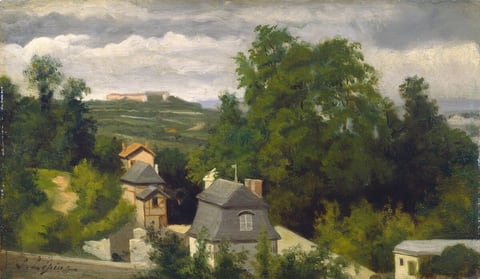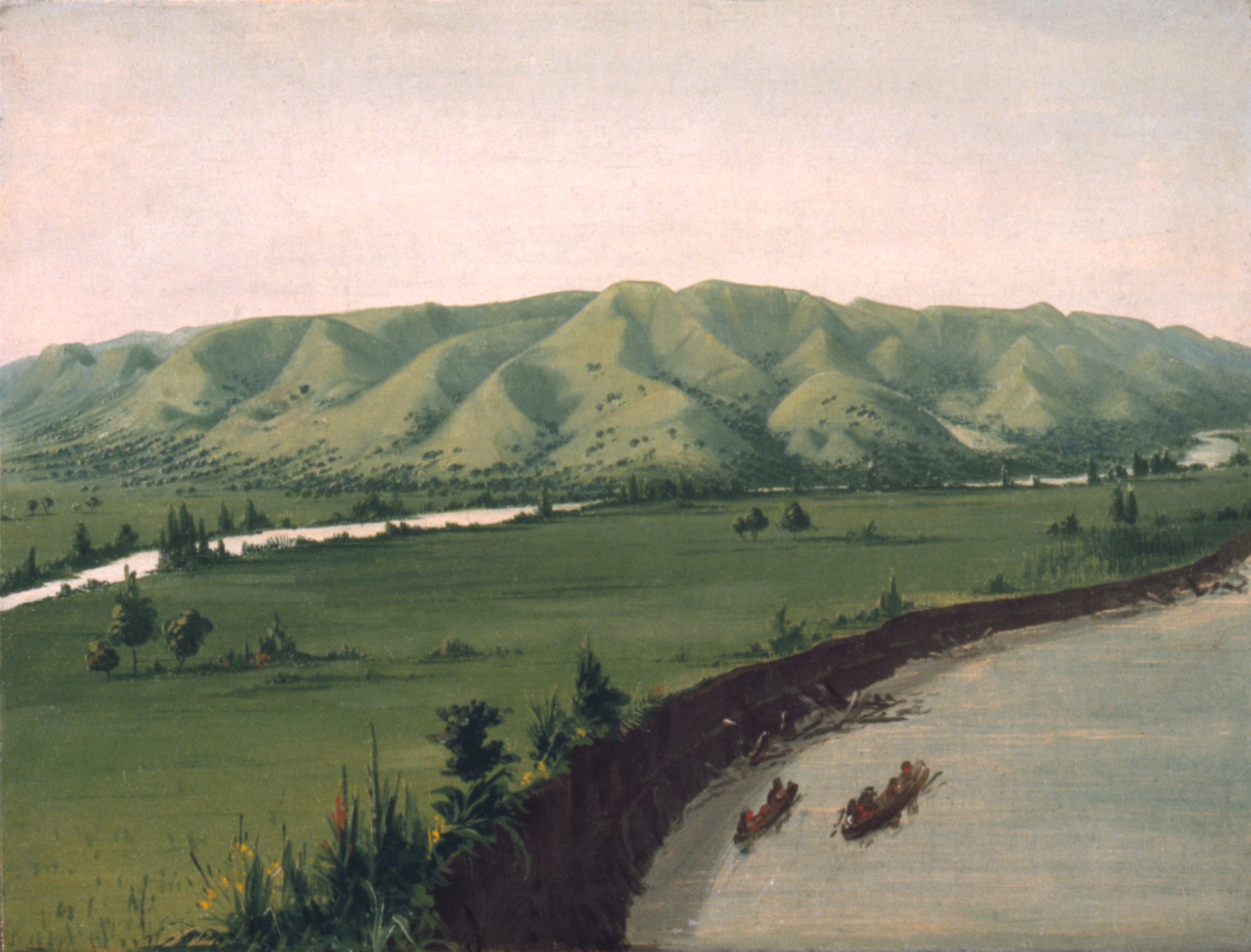
Nishnabottana Bluffs, 1070 Miles above St. Louis1832
George Catlin journeyed up the Missouri River in 1832. More about this work
About this work
George Catlin journeyed up the Missouri River in 1832. “I often landed my skiff,” he recalled, “and mounted the green carpeted bluffs whose soft grassy tops, invited me to recline, where I was at once lost in contemplation. Soul melting scenery that was about me! A place where the mind could think volumes; but the tongue must be silent that would speak, and the hand palsied that would write.” (Catlin, Letters and Notes, vol. 2, no. 32, 1841; reprint 1973)
Text from the Smithsonian American Art Museum.
How it was made
- Oil paint
- Pigment ground in a drying oil, usually linseed. It dries slowly, so painters could blend on the canvas, build up thin translucent glazes, and rework a picture over weeks. Canvas replaced wooden panels in the 1500s because it is lighter and can be rolled.
George Catlin
born Wilkes-Barre, PA 1796-died Jersey City, NJ 1872
Catlin gave up the law to paint, first as a portraitist in Philadelphia, and from 1830 made a series of journeys west from St Louis to record the peoples of the Plains. On a steamboat trip up the Missouri in 1832 he painted hundreds of portraits and scenes of daily life and landscape. He toured his “Indian Gallery” through the eastern cities and Europe, and his illustrated books made these images widely known.
Written by Ochre Editions.
Rights and the museum’s record
Public domain. The Smithsonian American Art Museum has dedicated this image to the public domain under CC0, so anyone may copy, adapt and use it, for any purpose, without asking. Our prints and files are reproductions made from the museum’s image; the museum doesn’t endorse them.
- Object number
- 1985.66.385
- Credit
- Courtesy of the Smithsonian American Art Museum
- Type
- Painting
- Department
- Painting and Sculpture
- Licence
- CC0 1.0 Universal
- Museum record
- See it on the museum’s site