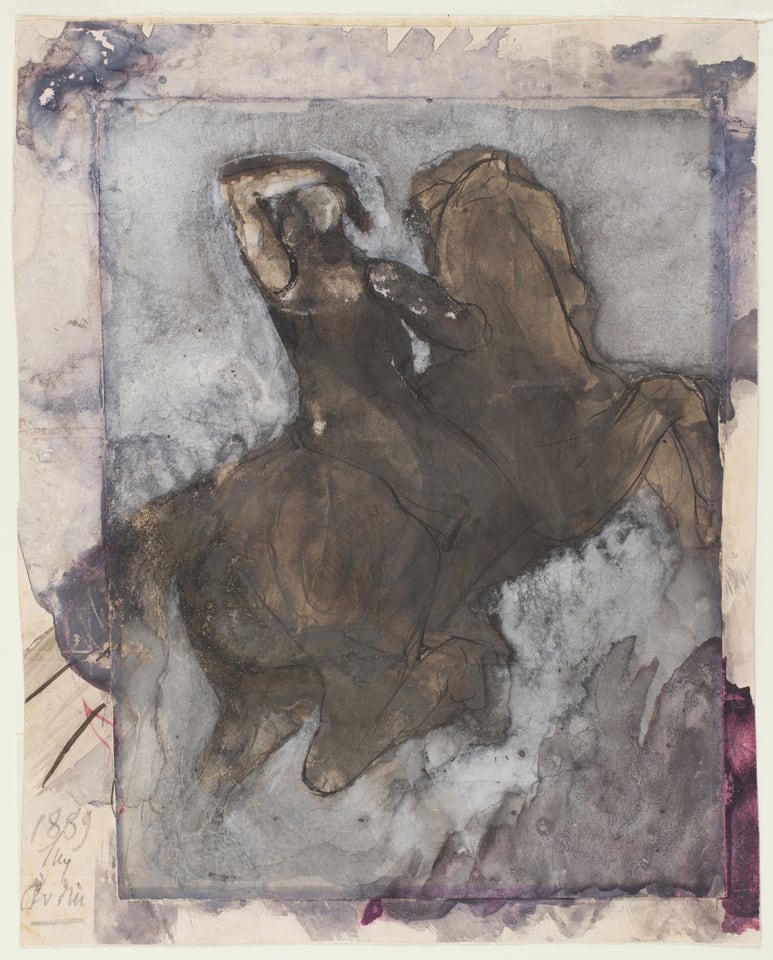
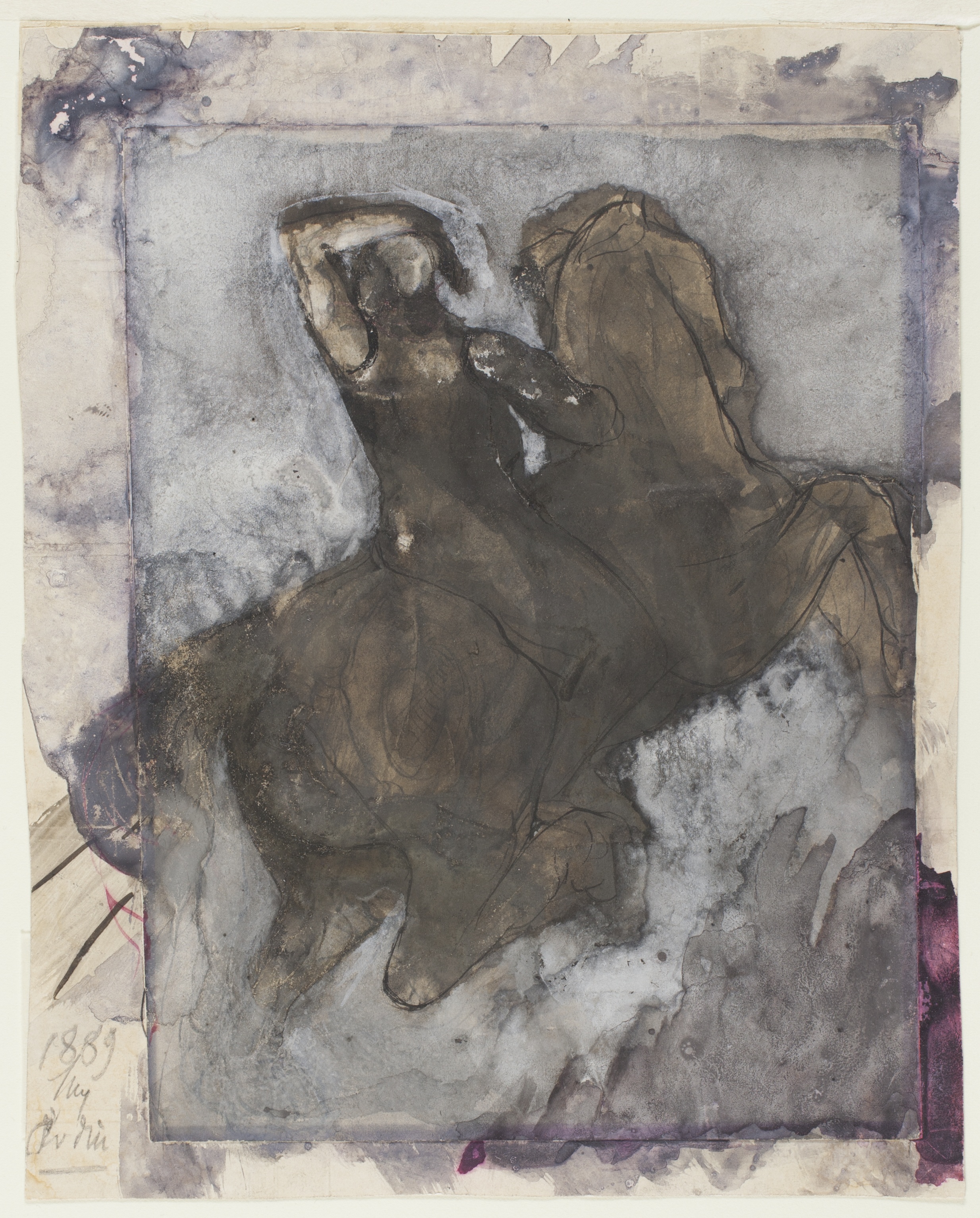
Horseman (recto); Horse and Rider (verso)1889
Auguste Rodin painted this in 1889, aged 49. It is now at the Art Institute of Chicago. More about this work
About this work
A work made of gouache, with pen and brown and black ink and traces of magenta ink (faded), over graphite (recto), and graphite (verso) on cream wove paper, tipped onto cream wove paper.
Description from the Art Institute of Chicago.
Auguste Rodin painted this in 1889, aged 49. It is now at the Art Institute of Chicago.
How it was made
- Opaque watercolour
- Watercolour made opaque with white or chalk and laid in flat, even layers. Persian and Indian painters ground their colours from minerals, applied them with the finest brushes and burnished the finished page.
- Graphite
- Pencil. Graphite has been used for drawing since the 1500s; in 1795 Nicolas-Jacques Conté mixed it with clay, so its hardness could be graded.
- Pen and ink
- Drawn with a quill or reed pen, often with wash added by brush to model light and shadow.
Auguste Rodin
French, 1840–1917
Rights and the museum’s record
Public domain. The Art Institute of Chicago has dedicated this image to the public domain under CC0, so anyone may copy, adapt and use it, for any purpose, without asking. Our prints and files are reproductions made from the museum’s image; the museum doesn’t endorse them.
- Object number
- 1949.580
- Credit
- Courtesy of the Art Institute of Chicago
- Type
- Drawing and Watercolor
- Department
- Prints and Drawings
- Licence
- CC0 1.0 Universal
- Museum record
- See it on the museum’s site
Report this work
Close in colour