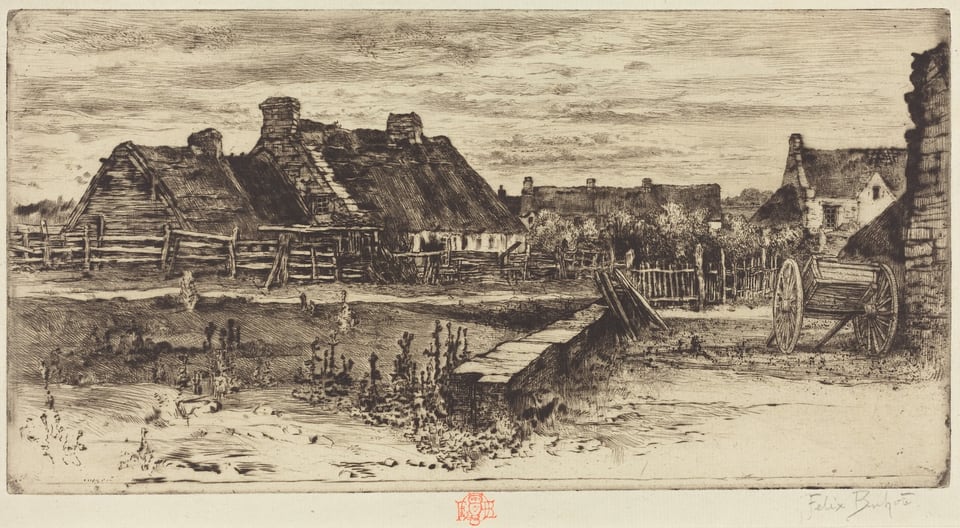
Les Grandes Chaumières1881
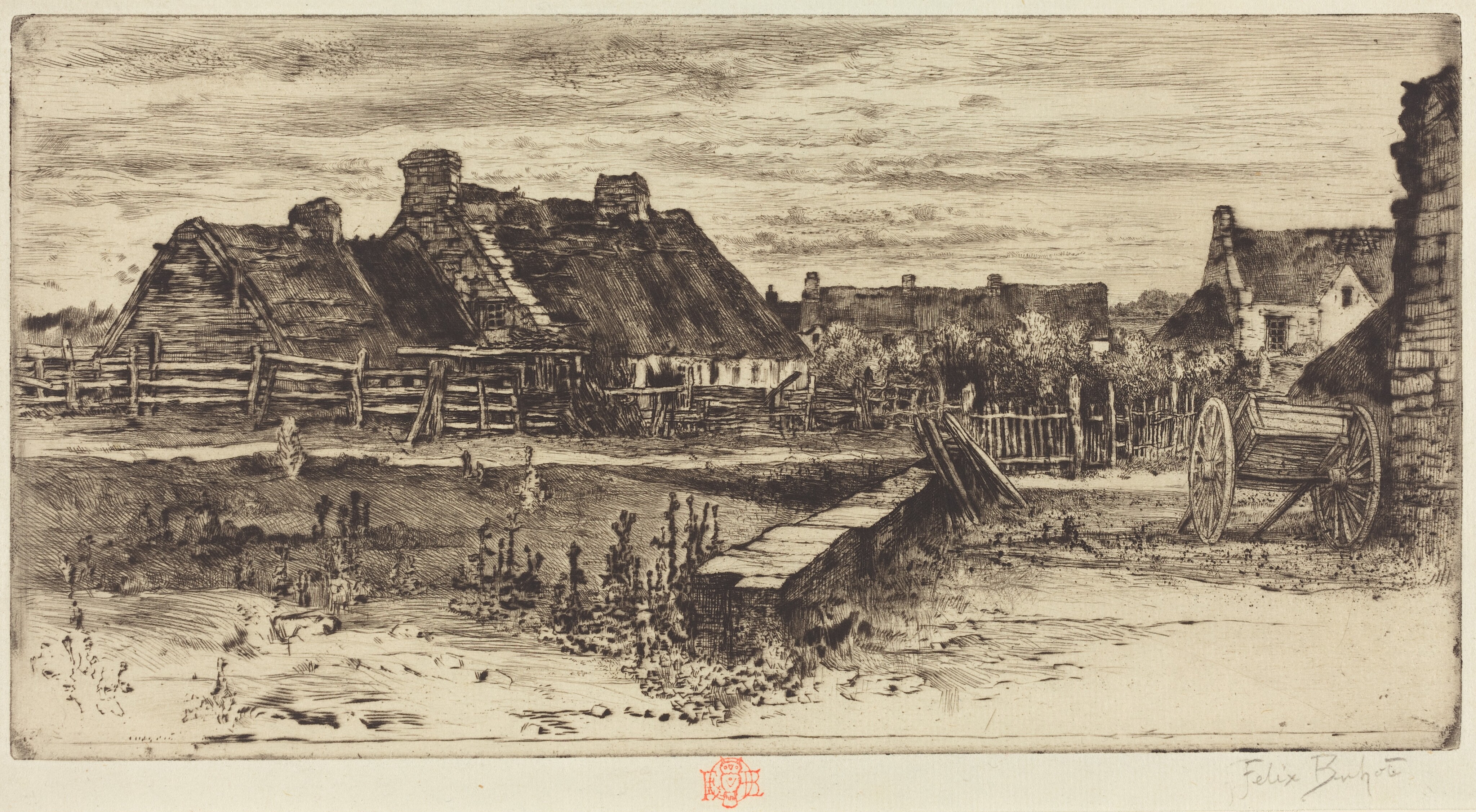
Thatched cottages, wooden fences and a cart beside a low wall make up this quiet village scene, etched and drypointed by Félix Buhot in 1881. More about this work
About this work
Thatched cottages, wooden fences and a cart beside a low wall make up this quiet village scene, etched and drypointed by Félix Buhot in 1881. Buhot, from Valognes in Normandy, was one of the most inventive printmakers of the French etching revival, known for atmospheric effects and for printing on old or unusual papers, as here on antique laid paper, to enrich the tone of his impressions. The dense, varied lines give the thatch and vegetation a soft, textured surface.
Written by Ochre Editions.
What you’re looking at
The image depicts a rustic village scene featuring thatched-roof cottages, wooden fences, and a low horizon with rooftops and chimneys. The etching showcases detailed brushstrokes capturing various textures, with a monochromatic sepia color palette. A stone or wooden wall leads into the scene, alongside grassy vegetation. The cottages create a sense of enclosure, with trees and other structures in the background. A cart is placed near the wall.
Description from the National Gallery of Art.
How it was made
- Drypoint
- Lines scratched straight into the plate with a needle throw up a ridge of metal, the burr, which holds ink and prints a soft, furred line. The burr wears down, so early impressions are the richest.
- Etching
- The artist draws with a needle through a waxy coating on a copper plate, and acid bites the exposed lines. The plate is then inked, wiped and printed under pressure, so the line keeps the freedom of drawing.
- Laid paper
- Handmade on a mould of close-set wires, which leave fine parallel lines you can see when the sheet is held to the light.
Félix-Hilaire Buhot
French, 1847–1898
Buhot was a leading figure of the French etching revival of the 1870s and 1880s. He made atmospheric views of Paris, London and Normandy, often in rain, snow or fog, combining etching with drypoint, aquatint and other techniques to suggest weather and light. He is known for his “symphonic margins”, small sketches around the main image that comment on it, and he experimented with papers and inks for each impression.
Written by Ochre Editions.
Rights and the museum’s record
Public domain. The National Gallery of Art has dedicated this image to the public domain under CC0, so anyone may copy, adapt and use it, for any purpose, without asking. Our prints and files are reproductions made from the museum’s image; the museum doesn’t endorse them.
- Object number
- 2006.68.54
- Credit
- Courtesy National Gallery of Art, Washington
- Type
- Licence
- CC0 1.0 Universal
- Museum record
- See it on the museum’s site
Report this work
More by Félix-Hilaire Buhot
All their works
Close in colour