Skip to content
Ochre Editions
ArtArtistsCollectionsGalleriesDrops
SearchSign inCart (0)
The galleries · Style galleries

The French eighteenth century

Fêtes, portraits and still lifes from the France of the Regency and Louis XV.

35 works · hang 7200 ·

Share The French eighteenth century, in the galleries

The rooms are imagined; every work on their walls is real.

Walk this roomRehang this room

First room, north wall

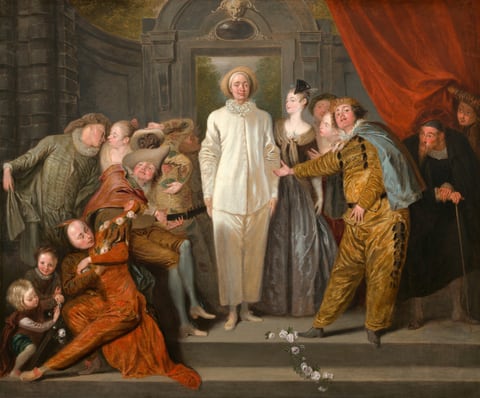
  1. A man wearing loose, ivory-white clothing stands flanked by two groups of people in this horizontal painting. All the people have pale or peachy skin except for one person, who may have a brown mask. The man in the center, representing the character Pierrot, stands facing us with his hands by his sides. He has slightly bulging eyes, a bulbous nose, ruddy cheeks, and his full pink lips slightly smile. He wears a straw hat pushed back on his high forehead and a narrow ruffled collar around his neck. His shirt has long, voluminous sleeves and a row of small white buttons down the front. The pants are baggy and end abruptly above his white-stockinged ankles over white slippers. The fabric seems to have a sheen. In the shallow space behind him, a stone wall curves toward us to either side of a doorway that leads to a park-like setting. A crimson-red curtain is pulled to our right. Pierrot stands on the top of two steps, and the people to either side are arranged along the stage or the step that runs close to the bottom edge of the canvas. A spray of white flowers drapes down the front of the steps to our right of center. The group to our left has eight men, women, and children. Closest to us and in the lower left corner, a young man wearing a tomato-red jester’s costume trimmed with bells sits on the steps as he twists and looks back at the scene behind him. He holds a scepter or puppet in the shape of a doll-like jester. Two children gather at his feet. One weaves stems of white flowers together, and the other looks at us, smiling. Just above them another cleanshaven young man sits holding a lute in his lap. He wears a brick-red coat, brown breeches, and slate-blue stockings over crossed legs. He leans back and looks up and to our left, his round cheeks flushed. At the back of this group, two people wear tan-colored costumes covered in muted green and pink diamond shapes, and one might wear a brown mask. That person’s pink lips, black mustache and eyebrows, and black dots for eyes appear painted onto a hard, molded surface. The group of six people to our right stand on the same level as Pierrot. At the front of that group, a heavyset young man wears a gold-colored costume trimmed with black and a waist-length, Wedgewood-blue cape. He faces us but looks to our right as he leans back with one arm extended toward Pierrot. Beyond him are two woman and another person shown only from the neck up. The woman closest to Pierrot wears a pewter-gray gown with a scooped neckline. To the right of the man in gold is an old man with a long beard, wearing a black skullcap and cloak. He leans on a short staff and turns his head to look at the group. The last person on the far right is shown from the neck up and stands before the red curtain hanging from the upper right.
    The Italian ComediansAntoine Watteau, probably 1720Courtesy National Gallery of Art, Washington
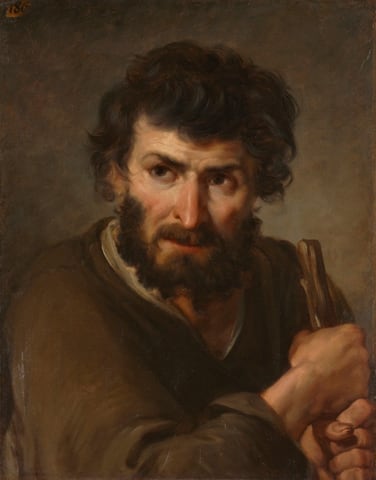
  2. Study of a Shepherd, 1700s
    Study of a ShepherdUnrecorded French maker, 1700sCourtesy of the Cleveland Museum of Art
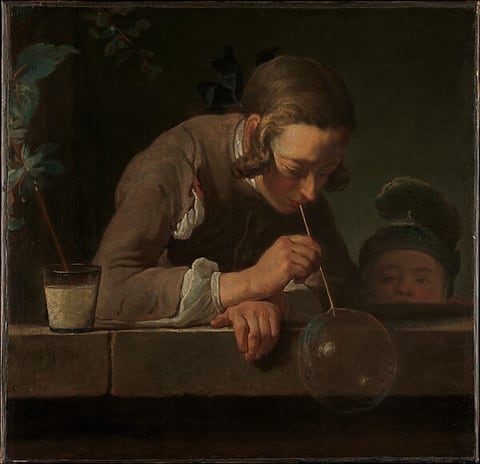
  3. Soap Bubbles, by Jean Siméon Chardin, ca. 1733–34
    Soap BubblesJean Siméon Chardin, ca. 1733–34Courtesy of The Metropolitan Museum of Art

First room, south wall
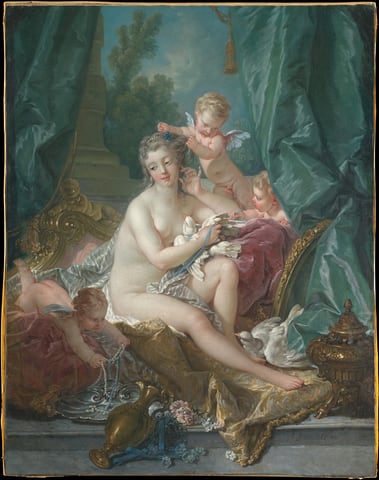
  1. The Toilette of Venus, by François Boucher, 1751
    The Toilette of VenusFrançois Boucher, 1751Courtesy of The Metropolitan Museum of Art
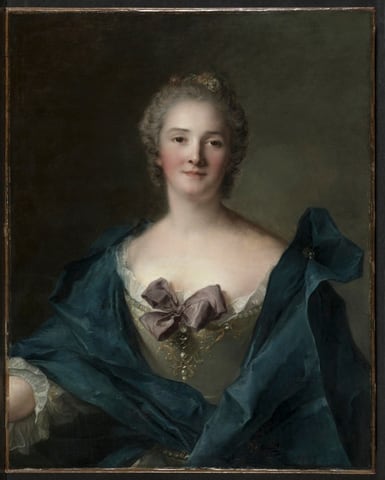
  2. Portrait of a Woman, by Jean-Marc Nattier, c. 1748
    Portrait of a WomanJean-Marc Nattier, c. 1748Courtesy of the Cleveland Museum of Art
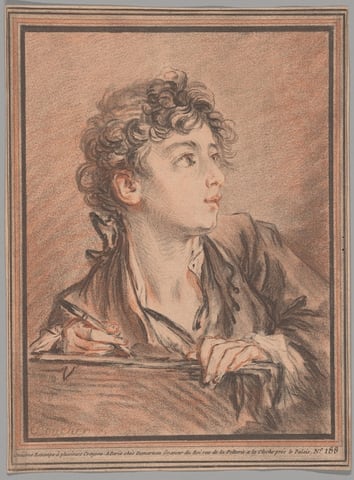
  3. A work made of crayon manner engraving in red and black on cream laid paper.
    The Young DraftsmanGilles Demarteau, 1750/70Courtesy of the Art Institute of Chicago

Second room, south wall
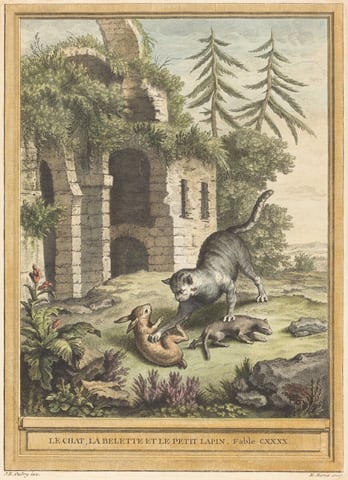
  1. This is a painting of animals in front of a ruined structure. The painting features a cat, a weasel, and a small rabbit gathered on a patch of grass. The cat has its paw over the rabbit, with the weasel observing. They are in front of an ancient stone structure surrounded by vegetation. In the background are trees against a sky. The foreground has detailed foliage and flowers.
    Le chat, la balette et le petit lapin (The Cat, the Weasel, and the Rabbit)Martin Marvie, published 1756Courtesy National Gallery of Art, Washington
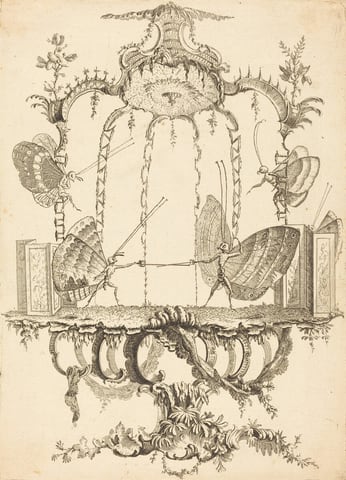
  2. This is a drawing of anthropomorphic butterflies engaged in a duel with fencing swords. The butterflies have human-like bodies with wings resembling cloaks or capes. They stand on an ornate structure featuring decorative architectural elements like columns with floral and leaf motifs. Above them are arches, canopies, and hanging vines, creating a theatrical setting. The drawing combines fantasy and nature elements, showcasing elegance and imagination.
    Le Duel (The Duel)Charles Germain de Saint-Aubin, in or after 1756Courtesy National Gallery of Art, Washington
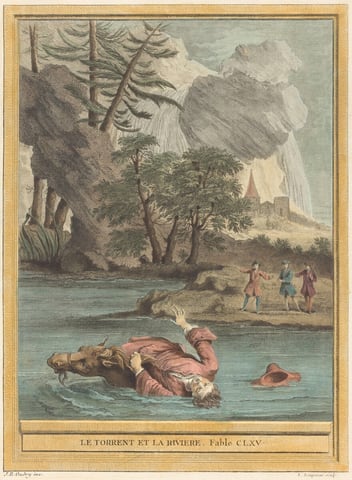
  3. The image shows a man in a red coat in a river, holding on to a horse. A hat floats nearby. Three figures in 18th-century clothing stand on a rocky riverbank looking concerned. In the background, there are trees, a castle-like structure, and large clouds. The brushstrokes are detailed, capturing movement and textures. The color palette includes muted tones like earthy browns, greens, soft blue, and subtle reds.
    Le torrent et la riviere (The Torrent and theRiver)Louis-Simon Lempereur, published 1756Courtesy National Gallery of Art, Washington
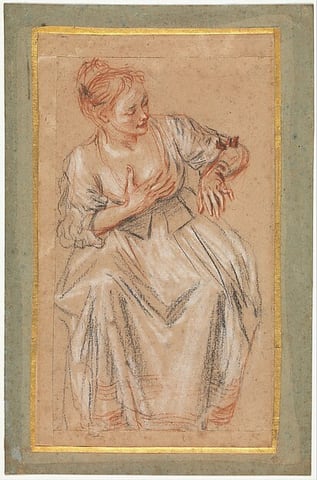
  4. Seated Woman, by Antoine Watteau, 1716–17
    Seated WomanAntoine Watteau, 1716–17Courtesy of The Metropolitan Museum of Art

Second room, north wall
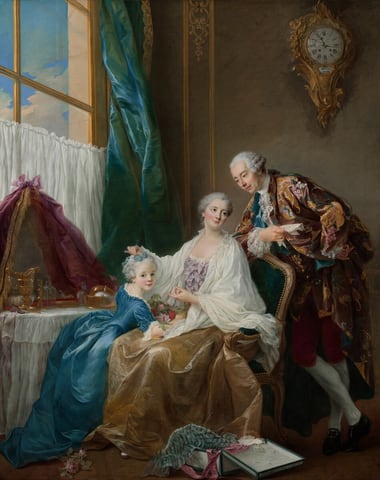
  1. A woman sitting in an upholstered chair near a vanity table touches the hair of the little girl leaning against her lap to our left, as a man leans onto the back of her chair to our right in this vertical portrait painting. The people all have pale skin, flushed cheeks, and their pale gray hair is pulled back and curled. Their pink lips curve in slight smiles, and light glinting off of much of the fabric suggests they wear satin or silk. The woman’s body is angled to our left, toward the girl, but she turns her head back to look up over her other shoulder with gray eyes. A voluminous, cream-white cloth drapes over her shoulders and lap, over a bodice covered in lilac-purple bows and ribbons. Her gold satin skirt falls around her feet. The little girl leans onto one arm on the woman’s lap as she turns to look at us with pale blue eyes. The girl’s forget-me-not-blue dress has a fitted bodice, elbow-length sleeves over white cuffs, a long, full skirt, and white ruffles along the collar. The woman holds blue flowers in the girl’s hair, and the girl’s forearm wraps around a bundle of pink and red flowers in the woman’s lap. The chair is upholstered in teal blue and has a gold frame and a row of gold nail heads along the padded back and arm. The man leans one forearm against the back of the chair as he looks down at the girl. In that hand, he holds a folded piece of paper with writing. He wears a loose jacket decorated with gold pagodas, pink and yellow flowers, and spruce-green leaves against a brown background. Foamy white lace falls back from his cuffs and hangs down from the high white collar of his undershirt. He wears brick-red, knee-length britches, white stockings, and black shoes with silver buckles. His other hand is planted against his hip, and one ankle is crossed in front of the other. A vanity draped with a white cloth sits on the far side of the woman and girl, along the left edge of the painting. It holds gold and glass vessels and boxes, and a rounded mirror at the back is draped with dark pink cloth. The lower half of a window behind the vanity is covered by a white cloth, and the panes continue beyond the top of the canvas. A teal-blue curtain hangs along the right edge of the window, at the corner of the room. A clock with a gold case of swirling, carved designs hangs high on the peanut-brown wall behind the man. On the floor near the chair, blue and white striped tissue paper, a rose-pink ribbon, and a strand of pearls drape over the edges of an open box. Writing along the front edge of the lid of the box reads, “Fs. Drouais. Ce 1 avril. 1756.” A pink rose lies near the girl’s feet, to our left.
    Family PortraitFrançois Hubert Drouais, 1756Courtesy National Gallery of Art, Washington
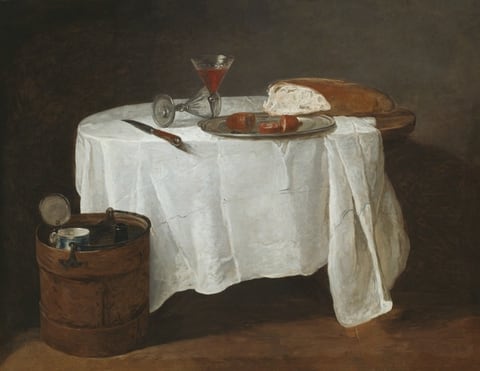
  2. A work made of oil on canvas.
    The White TableclothJean Siméon Chardin, c. 1731–32Courtesy of the Art Institute of Chicago

Third room, north wall
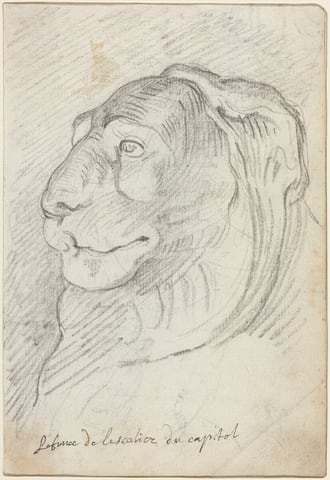
  1. This is a detailed sketch of a lion's head, positioned to show its profile. The drawing features the lion's broad nose, rounded mouth, large eye, and flowing mane. The facial features are depicted with various curves and lines. The sketch is on textured paper with pencil shading creating variations in the background. Handwritten text at the bottom reads "Leone de l'Escalier du capitol."
    Lion's Head from the Capitoline StaircaseAugustin Pajou, 1752/1756Courtesy National Gallery of Art, Washington
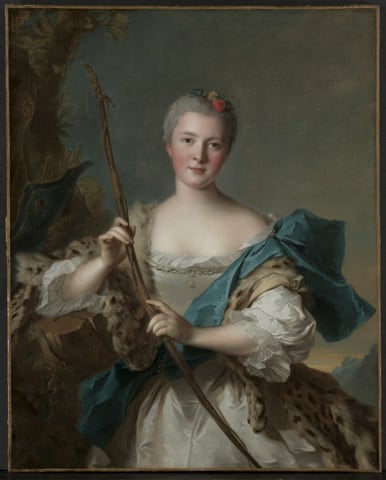
  2. Portrait of a Woman as Diana, by Jean-Marc Nattier, 1752
    Portrait of a Woman as DianaJean-Marc Nattier, 1752Courtesy of the Cleveland Museum of Art
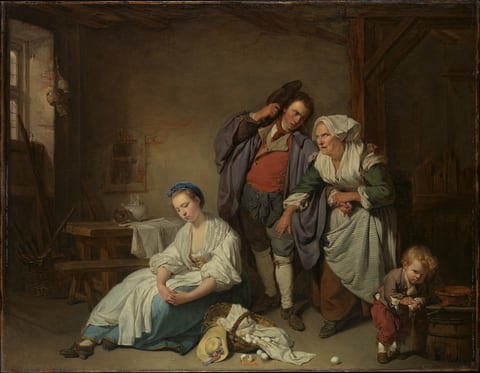
  3. Broken Eggs, by Jean Baptiste Greuze, 1756
    Broken EggsJean Baptiste Greuze, 1756Courtesy of The Metropolitan Museum of Art
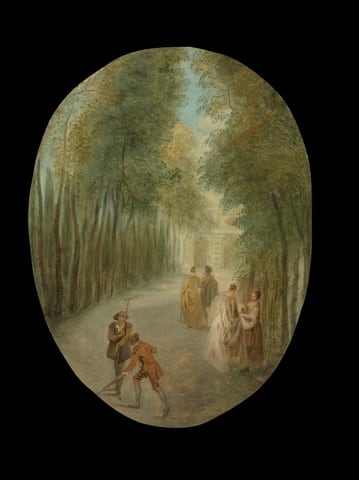
  4. Spring, by Jean-Baptiste Pater, c. 1720–36
    SpringJean-Baptiste Pater, c. 1720–36Courtesy of the Cleveland Museum of Art

Walk on

  • The French eighteenth century, room 2
  • Jean-Baptiste Pater's contemporaries 8 works
  • 18th-century France 75 works
Ochre Editions

The world's museums, on your wall. Every work here is a reproduction of a public-domain original, credited to the museum that holds it.

Shop

All artCollectionsLimited dropsPrints and framing

Help

Find an orderShippingReturnsVerify a certificate

About

About Ochre EditionsMuseum creditsFor agentsDevelopers

Legal

Terms of UseTerms of SaleLimited Editions and CertificatesPrivacy PolicyCookie PolicyAcceptable Use PolicyAgent & API TermsCopyright and DMCA PolicyPrinting Your Own PhotoVulnerability Disclosure PolicyAccessibility StatementOpen-Access Credits
© 2026 Ochre EditionsPrices in US dollars. Prints ship within the United States.