Skip to content
Ochre Editions
ArtArtistsCollectionsGalleriesDrops
SearchSign inCart (0)
The galleries · Time and place

The 20th century

Works made in the 20th century, anywhere in the world.

189 works · hang 959 ·

Share The 20th century, in the galleries

The rooms are imagined; every work on their walls is real.

Walk this roomRehang this room

Section 1, north wall

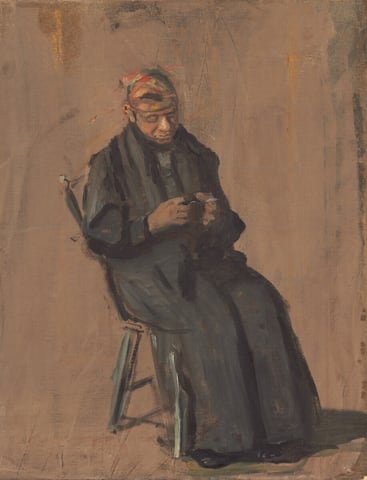
  1. This painting shows a person seated on a stool or chair, wearing a long, dark-blue robe or gown. They are slightly turned toward the right, looking downward at something they hold in their hands, and their head is covered with a cloth or cap. The background is textured with earthy tones, mostly tan with some patches of yellow ochre and gray.
    The ChaperoneThomas Eakins, c. 1908Courtesy National Gallery of Art, Washington
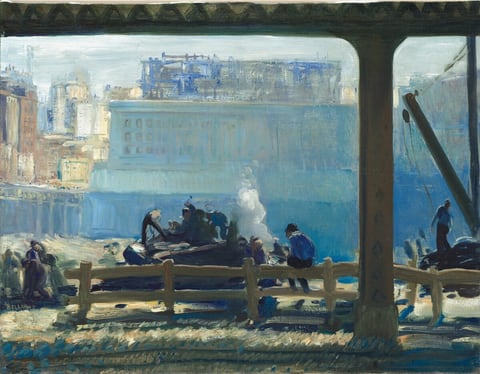
  2. From under an elevated train track, we look at a cluster of people hammering and working on the far side of a wooden fence, all against a silvery-blue building that fills most of the background in this horizontal painting. The scene is loosely painted mostly in tones of hazy and saturated blues, so many of the details are indistinct. About a quarter of the way in from the right edge of the composition, a thin iron column holds up the train platform. The column nearly spans the height of the painting, and the track it supports runs across the top edge of the canvas. At the foot of the column, along the bottom edge, are two parallel tracks embedded in an area otherwise painted with short, diagonal strokes in topaz blue, olive green, and straw yellow. Just beyond the tracks, the split-rail wooden fence runs across most of the painting, though there is an opening at the left edge of the canvas. A man sits with his back to us on the railing to our right of center. He wears a dark cap, a lapis-blue shirt, and navy-blue pants. Several men work on or near a mound-shaped form, perhaps a piece of machinery, just beyond the fence, near the center of the painting. One man holds a hammer high overhead while another reaches down or strikes the mound with his feet planted wide. More people work together to our left, and a man to our right stands near a crane. The people and these areas are painted with broad strokes and touches of cobalt blue, charcoal gray, khaki brown, and a few swipes of shell pink and bright white. A puff of white smoke billows up behind the central group, before the land drops precipitously away. The chasm is painted with shimmering tones of aquamarine and cerulean blue. A sky-blue, rectangular building perches at the far edge. A few windows are outlined in royal blue to our left but the rest of the building is loosely painted with long, vertical strokes so no architectural details can be made out. Behind this structure are more city buildings, suggested with strokes of muted rust red, parchment and bright white, and cobalt blue. The ice-blue sky fills the band between the top of the buildings and the train track running overhead. The artist signed his name near the lower left corner, “BELLOWS.”
    Blue MorningGeorge Bellows, 1909Courtesy National Gallery of Art, Washington
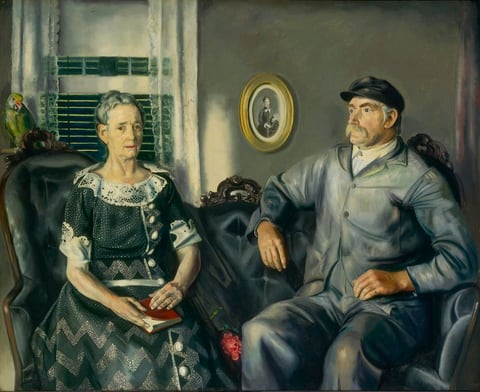
  3. Mr. and Mrs. Phillip Wase, by George Bellows, 1924
    Mr. and Mrs. Phillip WaseGeorge Bellows, 1924Courtesy of the Smithsonian American Art Museum

Section 1, south wall
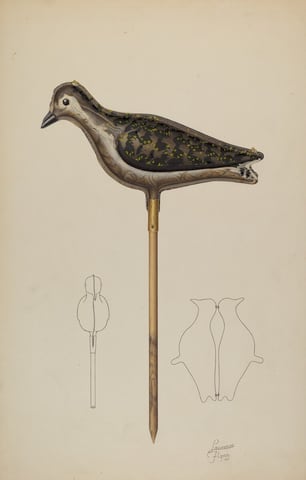
  1. The image shows a painted decoy of a bird mounted on a wooden stake. The decoy has intricate details with spots of yellow and green on top of a dark body. The colors are naturalistic with brown, black, yellow, white, and beige. In the lower left section of the image, there are two line drawings of a bird.
    Snipe DecoyLawrence Flynn, 1941Courtesy National Gallery of Art, Washington
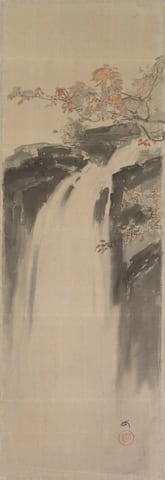
  2. Waterfall, by Yoshida Hiroshi, 1924
    WaterfallYoshida Hiroshi, 1924Courtesy of the Cleveland Museum of Art
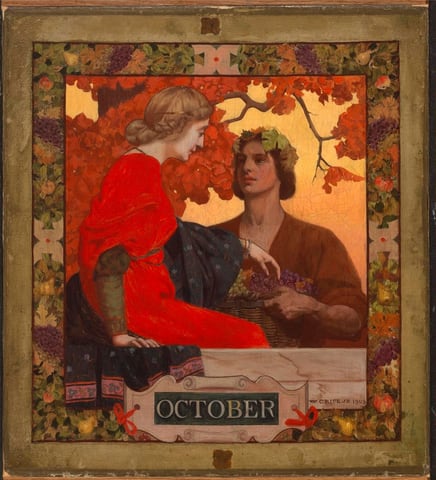
  3. October (cover illustration for Harper's Magazine), by William Clarke Rice, 1903
    October (cover illustration for Harper's Magazine)William Clarke Rice, 1903Courtesy of the Smithsonian American Art Museum
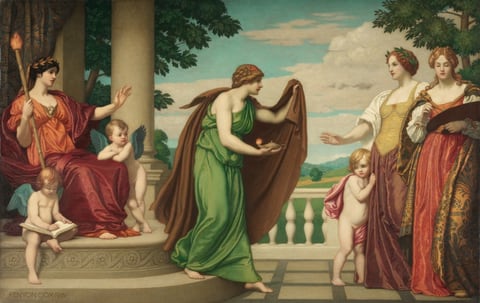
  4. Tradition, by Kenyon Cox, 1916
    TraditionKenyon Cox, 1916Courtesy of the Cleveland Museum of Art

Section 2, south wall
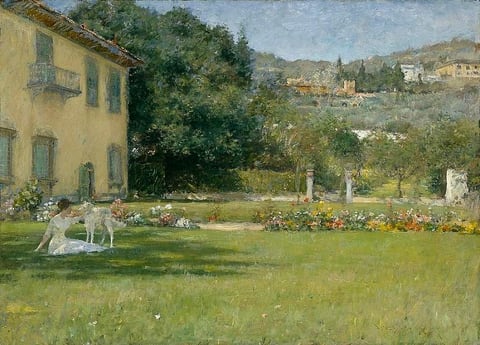
  1. William Merritt Chase
    Good FriendsWilliam Merritt Chase, (c. 1909)Courtesy of the Hirshhorn Museum and Sculpture Garden, Smithsonian Institution
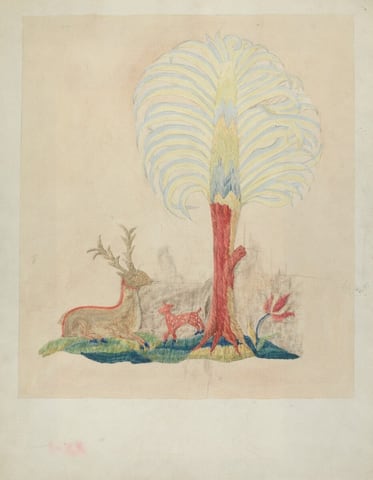
  2. This is a painting of two deer under a tree. The larger deer has antlers and is resting next to a smaller deer. They are depicted with red and brown strokes. The background shows a patch of earth and grass in green and blue. Beside the deer is a tree with colorful leaves or a feather-like structure and a red trunk. A pink flower is near the tree's base. The background is neutral. This painting is in the style of Henri Rousseau.
    Crewel EmbroideryHelen Dana, 1935/1942Courtesy National Gallery of Art, Washington
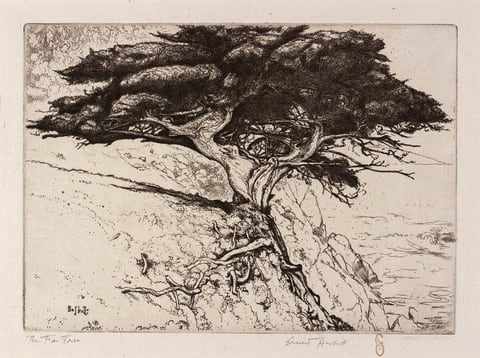
  3. The Fan Tree, by Ernest Haskell, ca. 1915
    The Fan TreeErnest Haskell, ca. 1915Courtesy of the Smithsonian American Art Museum
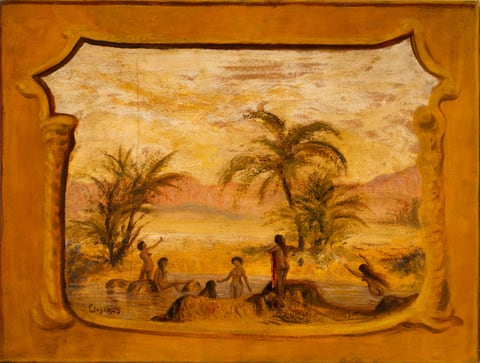
  4. Louis Eilshemius
    Samoan SceneLouis M. Eilshemius, 1908Courtesy of the Hirshhorn Museum and Sculpture Garden, Smithsonian Institution

Section 2, north wall
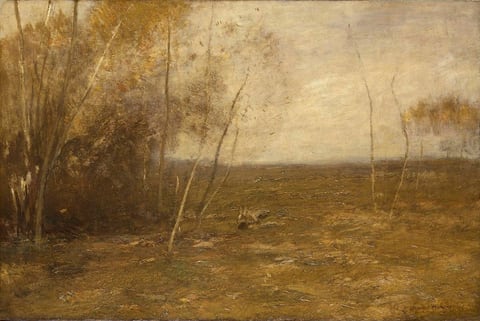
  1. The Sprout Lot, by J. Francis Murphy, 1915
    The Sprout LotJ. Francis Murphy, 1915Courtesy of the Smithsonian American Art Museum
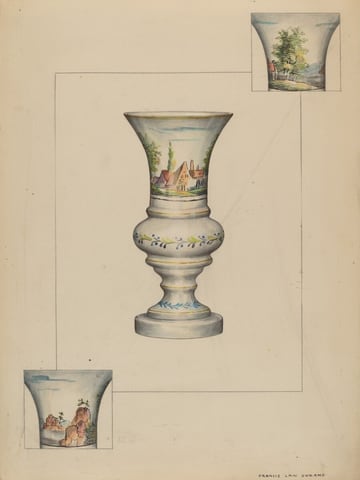
  2. The image shows a large, intricately designed vase with a bulbous base and flared top at the center. The vase is decorated with painted scenes of a town or village. The color scheme includes shades of blue, green, brown, and touches of yellow and red. Surrounding the vase are two smaller detailed sections showing close-ups of the painted scenes on it. The main vase image is enclosed within a boxed outline on the page.
    Fire Lighter VaseFrancis Law Durand, 1935/1942Courtesy National Gallery of Art, Washington
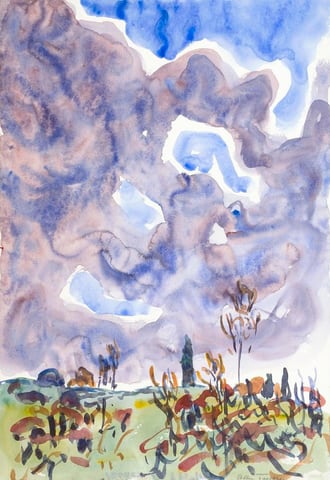
  3. Watercolor no. 31, Landscape with Clouds, by Allen Tucker, ca. 1930
    Watercolor no. 31, Landscape with CloudsAllen Tucker, ca. 1930Courtesy of the Smithsonian American Art Museum

Section 3, north wall
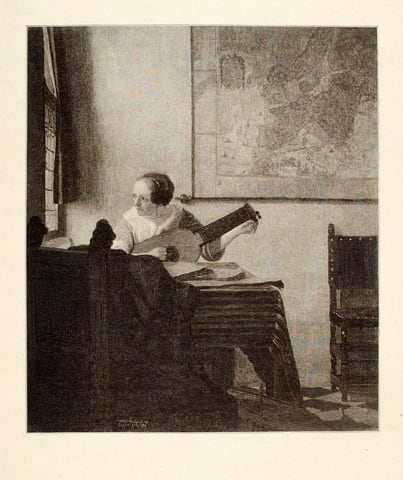
  1. Lady with the Lute, by Henry Wolf, 1909
    Lady with the LuteHenry Wolf, 1909Courtesy of the Smithsonian American Art Museum
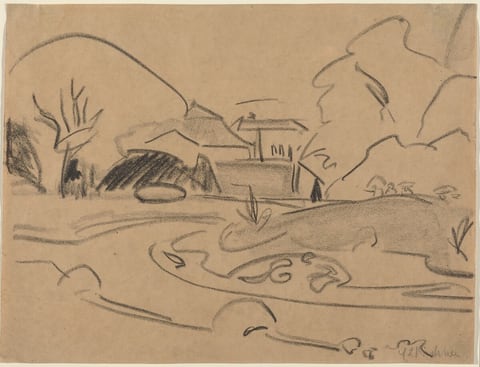
  2. The image shows a landscape drawing with buildings, trees, and a winding path or water feature. The drawing is done in black charcoal on brownish background paper, creating a monochromatic color palette.
    Footpaths and Pavilion in the Dresden Grosser GartenErnst Ludwig Kirchner, c. 1909Courtesy National Gallery of Art, Washington

Walk on

  • The 20th century, room 2
  • More by Ernst Ludwig Kirchner 3 works
  • More Early modernism 68 works
Ochre Editions

The world's museums, on your wall. Every work here is a reproduction of a public-domain original, credited to the museum that holds it.

Shop

All artCollectionsLimited dropsPrints and framing

Help

Find an orderShippingReturnsVerify a certificate

About

About Ochre EditionsMuseum creditsFor agentsDevelopers

Legal

Terms of UseTerms of SaleLimited Editions and CertificatesPrivacy PolicyCookie PolicyAcceptable Use PolicyAgent & API TermsCopyright and DMCA PolicyPrinting Your Own PhotoVulnerability Disclosure PolicyAccessibility StatementOpen-Access Credits
© 2026 Ochre EditionsPrices in US dollars. Prints ship within the United States.