Skip to content
Ochre Editions
ArtArtistsCollectionsGalleriesDrops
SearchSign inCart (0)
The galleries · Time and place

The 20th century

Works made in the 20th century, anywhere in the world.

189 works · hang 8191 ·

Share The 20th century, in the galleries

The rooms are imagined; every work on their walls is real.

Walk this roomRehang this room

Section 1, north wall

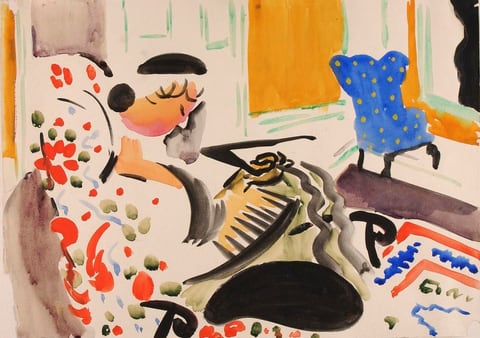
  1. Calligraphic Interior, by H. Lyman Saÿen, ca. 1915
    Calligraphic InteriorH. Lyman Saÿen, ca. 1915Courtesy of the Smithsonian American Art Museum
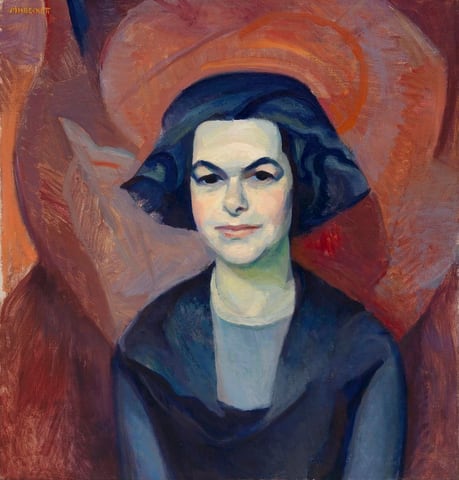
  2. Artist: Marion H. Beckett, Sitter: Theresa Helburn, Current owner: National Portrait Gallery, Smithsonian Institution
    Theresa HelburnMarion H. Beckett, 1922Courtesy of the National Portrait Gallery, Smithsonian Institution
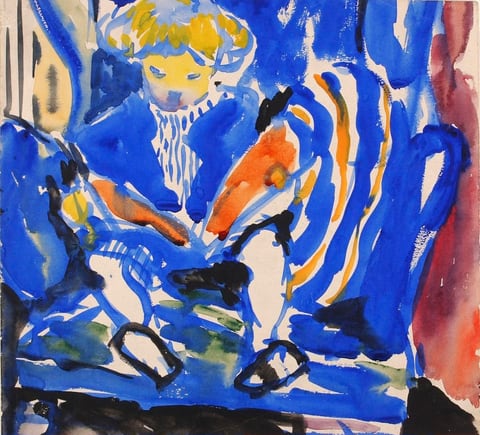
  3. Child Reading, by H. Lyman Saÿen, 1915-1918
    Child ReadingH. Lyman Saÿen, 1915-1918Courtesy of the Smithsonian American Art Museum
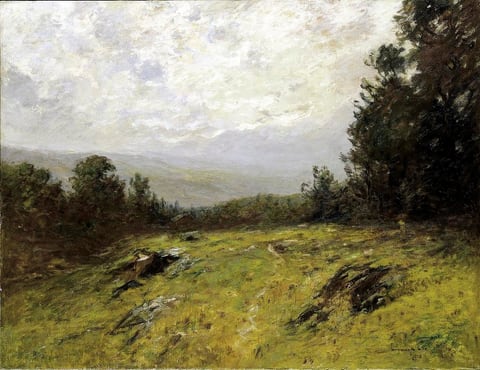
  4. Hillside, by Edward Gay, 1908
    HillsideEdward Gay, 1908Courtesy of the Smithsonian American Art Museum

Section 1, south wall
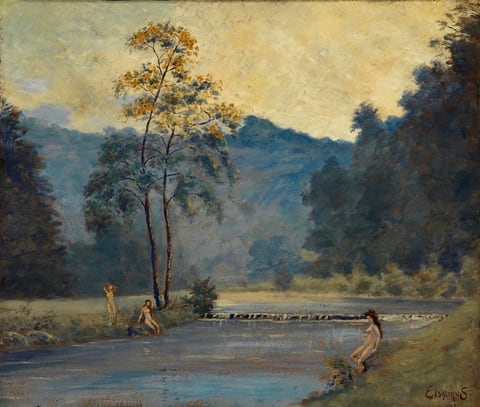
  1. Three Girls and River, by Louis M. Eilshemius, 1907
    Three Girls and RiverLouis M. Eilshemius, 1907Courtesy of the Smithsonian American Art Museum
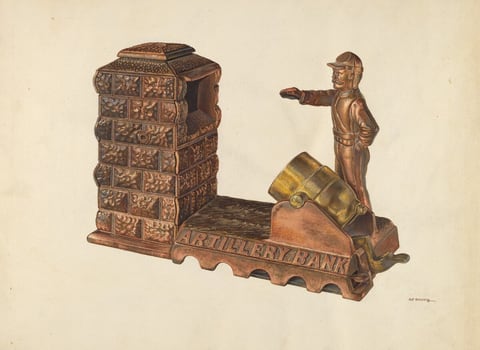
  2. The image displays a vintage mechanical bank with a brick-patterned tower on the left and a soldier figure on the right, prepared to operate a cannon. The color scheme is mainly earthy tones including brown, bronze, and hints of gold, creating a retro metallic appearance. The label "ARTILLERY BANK" is engraved on the base in front of the cannon.
    Mechanical Artillery BankAlf Bruseth, c. 1940Courtesy National Gallery of Art, Washington
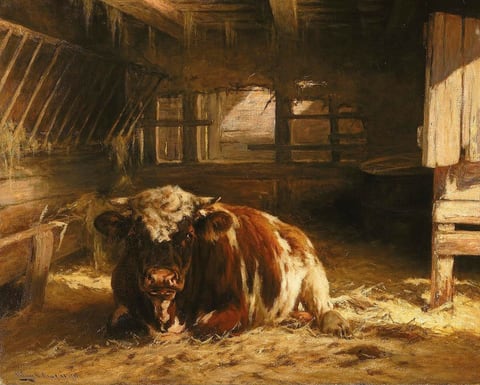
  3. My Day at Home, by William H. Howe, 1906
    My Day at HomeWilliam H. Howe, 1906Courtesy of the Smithsonian American Art Museum
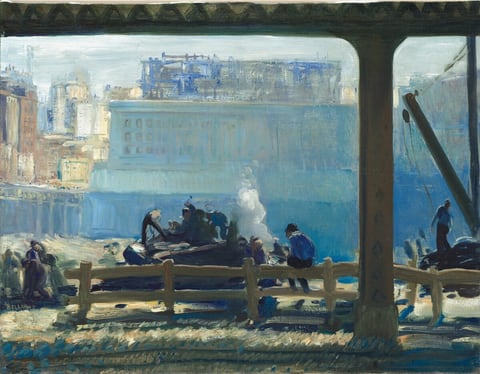
  4. From under an elevated train track, we look at a cluster of people hammering and working on the far side of a wooden fence, all against a silvery-blue building that fills most of the background in this horizontal painting. The scene is loosely painted mostly in tones of hazy and saturated blues, so many of the details are indistinct. About a quarter of the way in from the right edge of the composition, a thin iron column holds up the train platform. The column nearly spans the height of the painting, and the track it supports runs across the top edge of the canvas. At the foot of the column, along the bottom edge, are two parallel tracks embedded in an area otherwise painted with short, diagonal strokes in topaz blue, olive green, and straw yellow. Just beyond the tracks, the split-rail wooden fence runs across most of the painting, though there is an opening at the left edge of the canvas. A man sits with his back to us on the railing to our right of center. He wears a dark cap, a lapis-blue shirt, and navy-blue pants. Several men work on or near a mound-shaped form, perhaps a piece of machinery, just beyond the fence, near the center of the painting. One man holds a hammer high overhead while another reaches down or strikes the mound with his feet planted wide. More people work together to our left, and a man to our right stands near a crane. The people and these areas are painted with broad strokes and touches of cobalt blue, charcoal gray, khaki brown, and a few swipes of shell pink and bright white. A puff of white smoke billows up behind the central group, before the land drops precipitously away. The chasm is painted with shimmering tones of aquamarine and cerulean blue. A sky-blue, rectangular building perches at the far edge. A few windows are outlined in royal blue to our left but the rest of the building is loosely painted with long, vertical strokes so no architectural details can be made out. Behind this structure are more city buildings, suggested with strokes of muted rust red, parchment and bright white, and cobalt blue. The ice-blue sky fills the band between the top of the buildings and the train track running overhead. The artist signed his name near the lower left corner, “BELLOWS.”
    Blue MorningGeorge Bellows, 1909Courtesy National Gallery of Art, Washington

Section 2, south wall
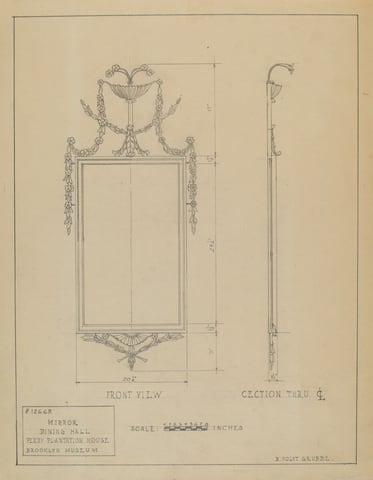
  1. This is a drawing of a decorative mirror. It presents a detailed design of an ornate mirror with two views: a front view and a sectional view. The mirror frame is embellished with elaborate motifs, including scrolls and floral elements. The sectional view shows the mirror's depth and structural details, indicating attention to construction. Measurements are included in inches, with title and notes providing context on the mirror's location and purpose as part of interior furnishings.
    MirrorB. Holst-Grubbe, 1935/1942Courtesy National Gallery of Art, Washington
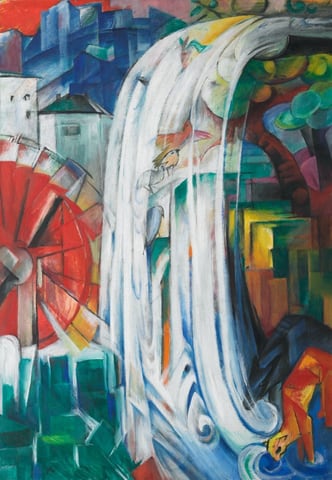
  2. Vibrantly colored geometric painting of a central white and blue waterfall with birds visible through it. A stylized red jungle cat and black wild boar drink at bottom right. Red water wheel at left, angular blue and white cityscape top at left, tree top at right.
    The Bewitched MillFranz Marc, 1913Courtesy of the Art Institute of Chicago
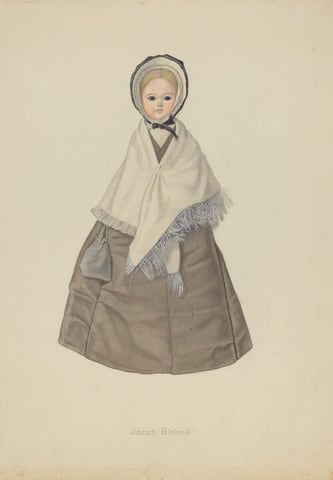
  3. The image depicts a young person standing upright with distinct facial features including rounded cheeks, a small mouth, and large eyes. They are wearing a brown dress with a cream-colored shawl, a bonnet with dark trim, and a pouch hanging from their left side. The background is plain and cream-colored.
    Quaker DollJacob Gielens, 1935/1942Courtesy National Gallery of Art, Washington
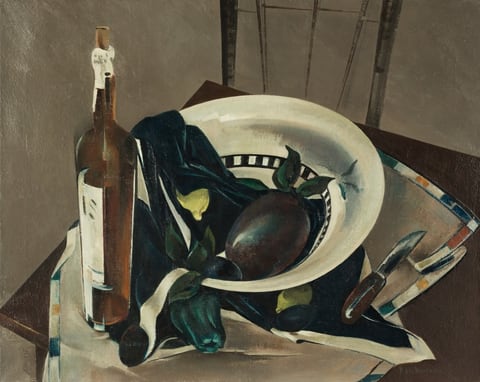
  4. Still Life, by Preston Dickinson, c. 1924
    Still LifePreston Dickinson, c. 1924Courtesy of the Cleveland Museum of Art

Section 2, north wall
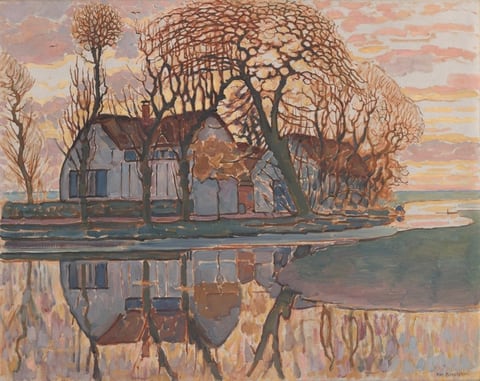
  1. A work made of oil on canvas.
    Farm near DuivendrechtPiet Mondrian, c. 1916Courtesy of the Art Institute of Chicago
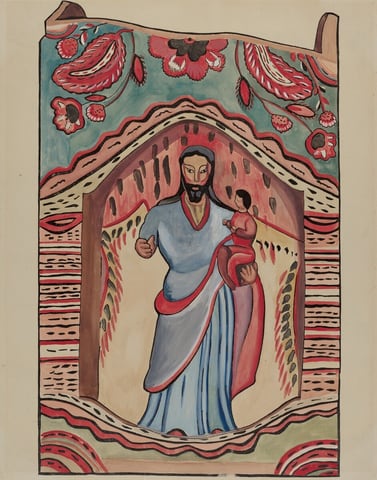
  2. This is a painting of stylized figures within an ornate frame. The artwork features two central figures that are reminiscent of a traditional religious iconography but rendered in a simplified and almost cartoonish form. The larger figure is draped in blue with red accents, while a smaller figure is held in one hand, enrobed in red. The background is decorated with a variety of patterns including an arch-like structure with wavy designs and lines, all outlining the central figures. The outer sections feature floral patterns with bold, contrasting colors of red, black, and teal. The use of thick outlines and vivid colors suggests a playful and decorative approach to the portrayal of the figures, drawing inspiration possibly from folk art traditions.
    St. JosephE. Boyd, 1936Courtesy National Gallery of Art, Washington
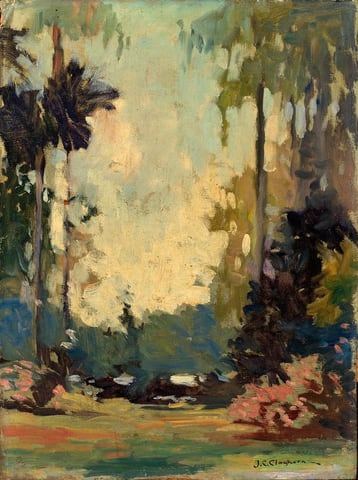
  3. A Florida Park, by Joseph C. Claghorn, before 1935
    A Florida ParkJoseph C. Claghorn, before 1935Courtesy of the Smithsonian American Art Museum
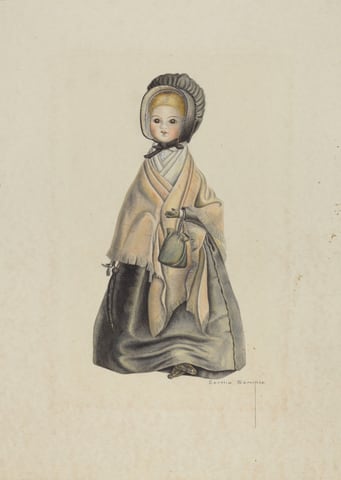
  4. The image displays a full-body illustration of a person standing upright. They have a delicate and round face with rosy cheeks and small, pink lips. Their eyes are large and expressive, and they have light-colored hair peeking out from under a bonnet. The person's attire consists of a long, dark skirt and a light-colored shawl draped over their shoulders. They wear a hooded cloak tied with a bow at the neck, and hold a small bag in their left hand. The background is plain with a light-colored texture. The artwork is a painted illustration with visible fine lines and shading to enhance details of the clothing and facial features.
    Quaker DollBertha Semple, 1935/1942Courtesy National Gallery of Art, Washington

Walk on

  • The 20th century, room 2
  • Bertha Semple's contemporaries 8 works
  • More American folk and design 90 works
Ochre Editions

The world's museums, on your wall. Every work here is a reproduction of a public-domain original, credited to the museum that holds it.

Shop

All artCollectionsLimited dropsPrints and framing

Help

Find an orderShippingReturnsVerify a certificate

About

About Ochre EditionsMuseum creditsFor agentsDevelopers

Legal

Terms of UseTerms of SaleLimited Editions and CertificatesPrivacy PolicyCookie PolicyAcceptable Use PolicyAgent & API TermsCopyright and DMCA PolicyPrinting Your Own PhotoVulnerability Disclosure PolicyAccessibility StatementOpen-Access Credits
© 2026 Ochre EditionsPrices in US dollars. Prints ship within the United States.