Skip to content
Ochre Editions
ArtArtistsCollectionsGalleriesDrops
SearchSign inCart (0)
The galleries · Time and place

The 20th century

Works made in the 20th century, anywhere in the world.

189 works · hang 3280 ·

Share The 20th century, in the galleries

The rooms are imagined; every work on their walls is real.

Walk this roomRehang this room

Section 1, north wall

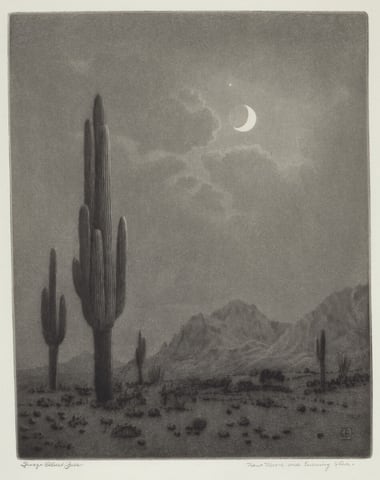
  1. This print depicts a grayscale desert landscape with a prominent saguaro cactus to the left. In the background, rocky mountains are visible in the darkness. The sky shows a crescent moon and a bright star through an opening in the soft gray clouds. Sparse desert vegetation is faintly visible on the ground, and more cacti can be seen in the distance.
    New Moon and Evening StarGeorge Elbert Burr, c. 1932Courtesy National Gallery of Art, Washington
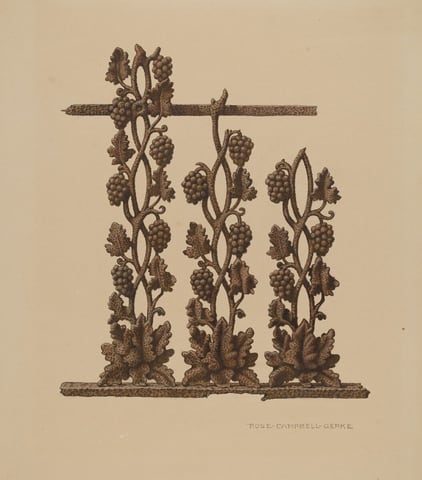
  2. The image depicts an iron sculpture with grapevine motifs. The color scheme is primarily brown, with a textured appearance. The grapevine design is arranged vertically and includes grape clusters and leaves. The sculpture is mounted on a base and includes an iron bar at the top. The artist's signature "ROSE CAMPBELL GERKE" is visible in the lower right corner of the image.
    FenceRose Campbell-Gerke, c. 1940Courtesy National Gallery of Art, Washington
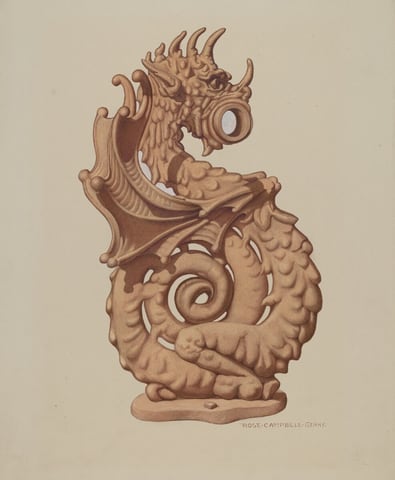
  3. The sculpture depicts a mythical creature resembling a dragon. It has a long spiraled body and an intricate head with spiky protrusions. The sculpture is a warm brown color. The dragon has bat-like wings, an open mouth, detailed texture with scales, and is standing on a small base.
    FenceRose Campbell-Gerke, c. 1941Courtesy National Gallery of Art, Washington
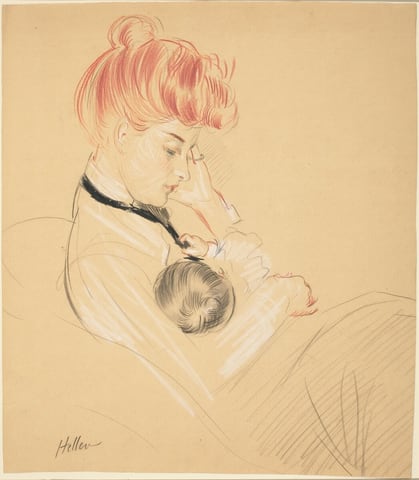
  4. Madame Helleu Cradling Paulette in Her Arms, by Paul-César Helleu, 1904/1905
    Madame Helleu Cradling Paulette in Her ArmsPaul-César Helleu, 1904/1905Courtesy National Gallery of Art, Washington

Section 1, south wall
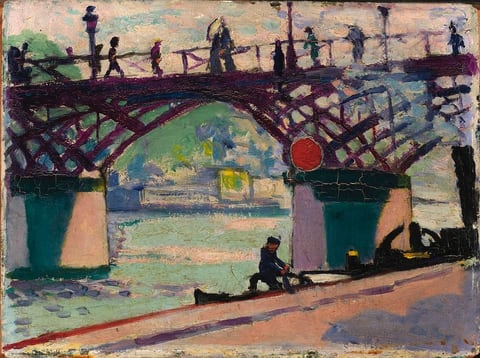
  1. Pont des Arts, by H. Lyman Saÿen, 1908-1911
    Pont des ArtsH. Lyman Saÿen, 1908-1911Courtesy of the Smithsonian American Art Museum
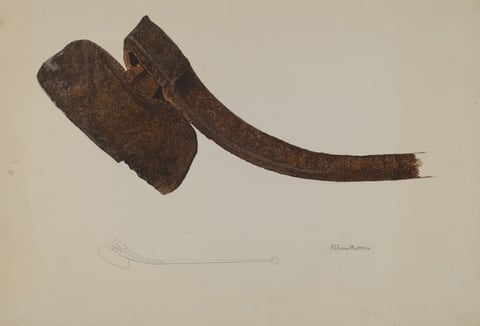
  2. The image shows a large, rusted ax with a curved brown handle placed diagonally across the canvas. The color palette consists of muted browns and beiges, highlighting the aged appearance of the ax. Beneath the ax, there is a faint outline sketch of a similar object, and the artist's signature is located to the right of the sketch. The ax is in the upper half of the image, while the sketch and signature are in the center-bottom section.
    Dumb IronAlfonso Moreno, c. 1938Courtesy National Gallery of Art, Washington
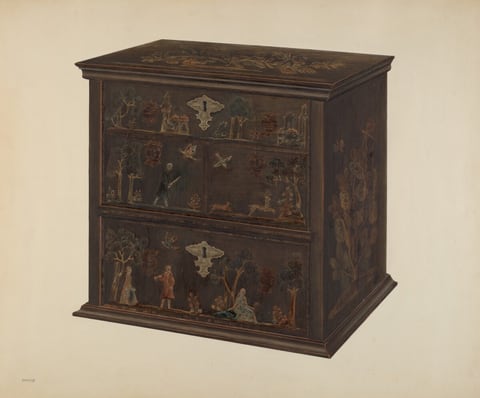
  3. This is a painting of a decorative wooden chest. The chest has intricate designs, such as painted figures, trees, and animals, creating a narrative scene on its front side, and floral motifs on its sides. The craftsmanship suggests it is an ornate object, potentially used for storage or as an ornamental piece. The painting focuses on the texture and details of the wood and decoration with precision, in a traditional arts and crafts or folk art style, emphasizing fine detail and storytelling through imagery on functional furniture.
    Jewel CabinetCharles Henning, c. 1939Courtesy National Gallery of Art, Washington
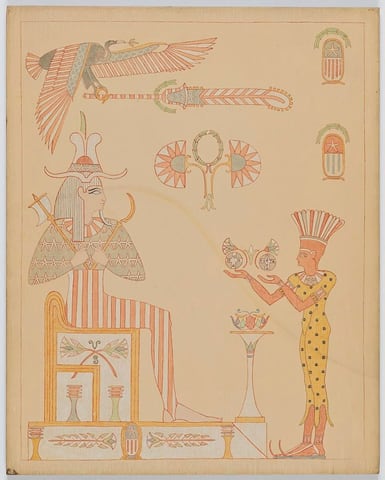
  4. THE TRIUMPH OF UNCLE SAM
    The Triumph of Uncle SamVictor Wilbour, 1917Courtesy of Cooper Hewitt, Smithsonian Design Museum

Section 2, south wall
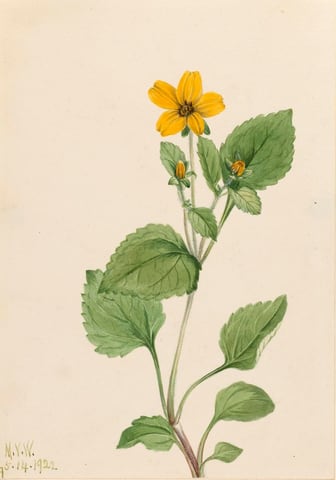
  1. Golden Star (Chrysogonum virginianum), by Mary Vaux Walcott, 1922
    Golden Star (Chrysogonum virginianum)Mary Vaux Walcott, 1922Courtesy of the Smithsonian American Art Museum
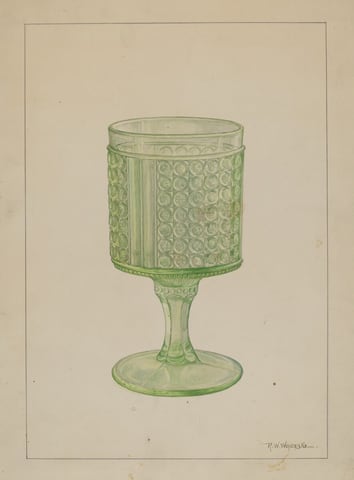
  2. The image shows a green glass goblet with a textured, bubble-like pattern on the cup and a smooth stem. The color palette consists of shades of green with varying tones, depending on the glass's thickness and pattern. The goblet is positioned centrally, seen straight-on with the cup's pattern visible across its surface. It rests on a flat surface, slightly above the center of the image.
    GobletRonau William Woiceske, 1935/1942Courtesy National Gallery of Art, Washington
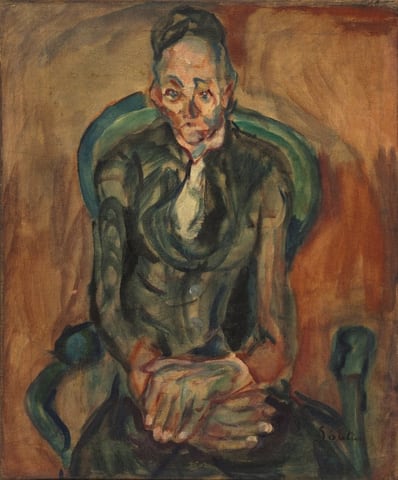
  3. Old Woman, by Chaïm Soutine, c. 1923–24
    Old WomanChaïm Soutine, c. 1923–24Courtesy of the Cleveland Museum of Art
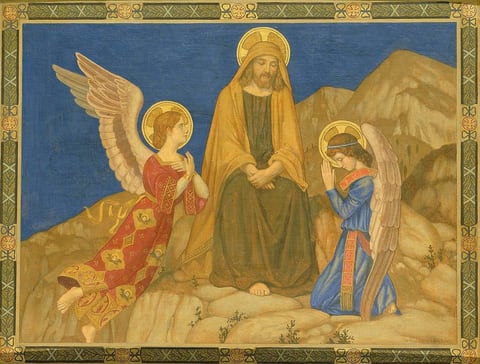
  4. In the Desert, by H. Siddons Mowbray, 1915-1925
    In the DesertH. Siddons Mowbray, 1915-1925Courtesy of the Smithsonian American Art Museum

Section 2, north wall
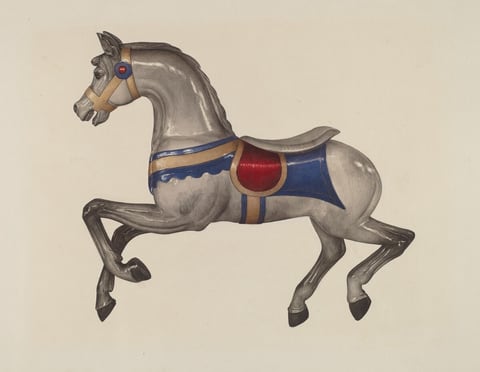
  1. This is a painting of a carousel horse. The image shows a gray carousel horse with glossy highlights and shading. The horse has a blue and red saddle with gold bands, and a blue harness with red accents. The horse is mid-gallop, with animated legs. The background is plain to focus on the horse's design. The style is detailed and realistic, reminiscent of carousel art from the late 19th to early 20th century.
    Carousel HorseDorothy Handy, c. 1939Courtesy National Gallery of Art, Washington
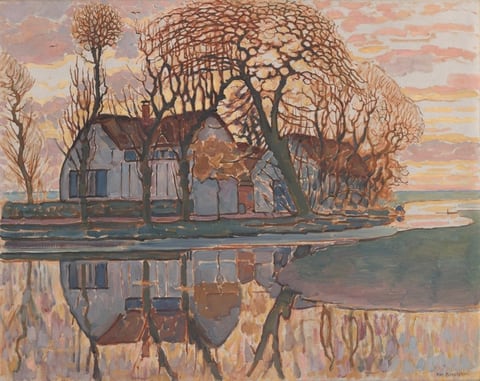
  2. A work made of oil on canvas.
    Farm near DuivendrechtPiet Mondrian, c. 1916Courtesy of the Art Institute of Chicago

Section 3, north wall
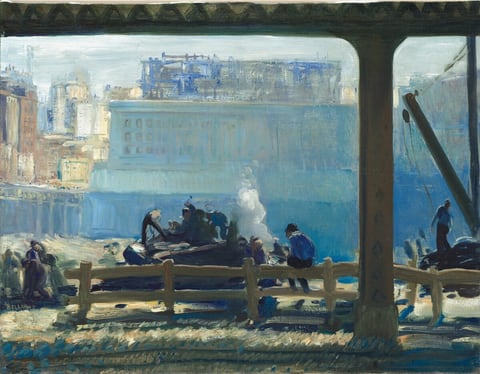
  1. From under an elevated train track, we look at a cluster of people hammering and working on the far side of a wooden fence, all against a silvery-blue building that fills most of the background in this horizontal painting. The scene is loosely painted mostly in tones of hazy and saturated blues, so many of the details are indistinct. About a quarter of the way in from the right edge of the composition, a thin iron column holds up the train platform. The column nearly spans the height of the painting, and the track it supports runs across the top edge of the canvas. At the foot of the column, along the bottom edge, are two parallel tracks embedded in an area otherwise painted with short, diagonal strokes in topaz blue, olive green, and straw yellow. Just beyond the tracks, the split-rail wooden fence runs across most of the painting, though there is an opening at the left edge of the canvas. A man sits with his back to us on the railing to our right of center. He wears a dark cap, a lapis-blue shirt, and navy-blue pants. Several men work on or near a mound-shaped form, perhaps a piece of machinery, just beyond the fence, near the center of the painting. One man holds a hammer high overhead while another reaches down or strikes the mound with his feet planted wide. More people work together to our left, and a man to our right stands near a crane. The people and these areas are painted with broad strokes and touches of cobalt blue, charcoal gray, khaki brown, and a few swipes of shell pink and bright white. A puff of white smoke billows up behind the central group, before the land drops precipitously away. The chasm is painted with shimmering tones of aquamarine and cerulean blue. A sky-blue, rectangular building perches at the far edge. A few windows are outlined in royal blue to our left but the rest of the building is loosely painted with long, vertical strokes so no architectural details can be made out. Behind this structure are more city buildings, suggested with strokes of muted rust red, parchment and bright white, and cobalt blue. The ice-blue sky fills the band between the top of the buildings and the train track running overhead. The artist signed his name near the lower left corner, “BELLOWS.”
    Blue MorningGeorge Bellows, 1909Courtesy National Gallery of Art, Washington
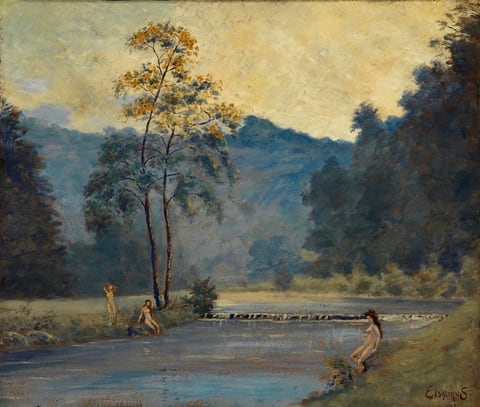
  2. Three Girls and River, by Louis M. Eilshemius, 1907
    Three Girls and RiverLouis M. Eilshemius, 1907Courtesy of the Smithsonian American Art Museum

Walk on

  • The 20th century, room 2
  • More by Louis M. Eilshemius 4 works
  • More American Gilded Age 67 works
Ochre Editions

The world's museums, on your wall. Every work here is a reproduction of a public-domain original, credited to the museum that holds it.

Shop

All artCollectionsLimited dropsPrints and framing

Help

Find an orderShippingReturnsVerify a certificate

About

About Ochre EditionsMuseum creditsFor agentsDevelopers

Legal

Terms of UseTerms of SaleLimited Editions and CertificatesPrivacy PolicyCookie PolicyAcceptable Use PolicyAgent & API TermsCopyright and DMCA PolicyPrinting Your Own PhotoVulnerability Disclosure PolicyAccessibility StatementOpen-Access Credits
© 2026 Ochre EditionsPrices in US dollars. Prints ship within the United States.