Skip to content
Ochre Editions
ArtArtistsCollectionsGalleriesDrops
SearchSign inCart (0)
The galleries · Time and place

The 20th century

Works made in the 20th century, anywhere in the world.

189 works · hang 6748 ·

Share Fork, in The 20th century

The rooms are imagined; every work on their walls is real.

Walk this roomRehang this room

Section 1, north wall

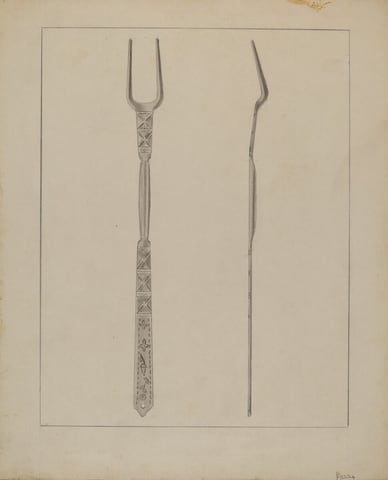
  1. This is a drawing of a tool with intricate patterns. The tool appears elongated with a pronged end, and features symmetrical geometric designs etched along the handle. The drawing also includes a side profile showing its slender form.
    ForkAnthony Zuccarello, c. 1936Courtesy National Gallery of Art, Washington
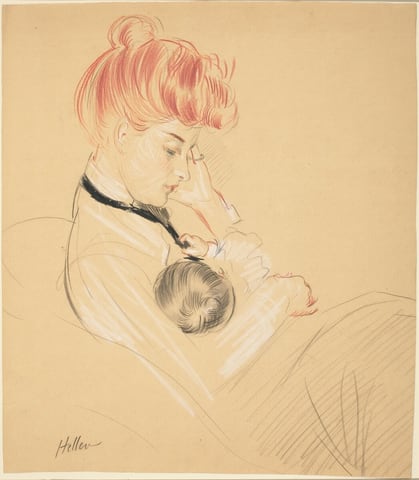
  2. Madame Helleu Cradling Paulette in Her Arms, by Paul-César Helleu, 1904/1905
    Madame Helleu Cradling Paulette in Her ArmsPaul-César Helleu, 1904/1905Courtesy National Gallery of Art, Washington
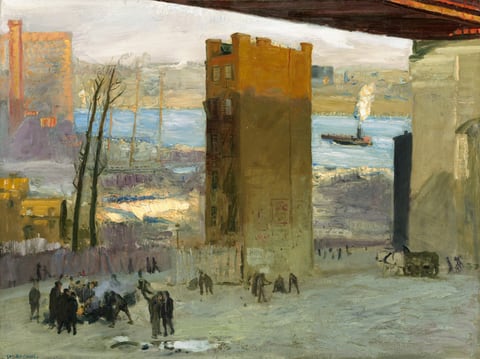
  3. A six-story, narrow building stands alone in an otherwise unoccupied lot under the deck of a high bridge, with a river and cityscape in the background in this horizontal painting. Dozens of people, small in scale, are each painted with a few swipes of black and some with peach-colored faces. They gather at the foot of the building and around a fire to our left, near the lower left corner of the composition. The fire is painted with a dash of orange, a few touches of canary yellow, and a smudge of gray smoke. Several more people stand and sit against the building, which has a streetlamp near its entrance. The back end of the building angles away from us to our right, so we see the narrow, front entrance side to our left. Each of the six floors of the building has two windows with fire escape ladders on the narrow side we can see. Some strokes in red and white on the lower levels of the long, flat side of the building suggest signs or posters. The top story glows a warm sienna brown in sunlight, while the rest of the building and the scene below are in shadow. More people walk along a grayish-violet fence that encloses the lot beyond the building. The ground is painted thickly with slate gray, pale, sage green, and one smear of white to suggest snow. To our right and a short distance from us, a white horse pulls a carriage near the foot of the bridge. The ivory-white, concrete piling rises up and off the right edge of the canvas and supports the deck of the bridge above. Only a sliver of the brick-red underside of the bridge is visible, skimming the top edge of the painting in the upper right corner. Two twiggy, barren trees grow up beyond the muted purple fence, and the landscape beyond is bright in the sunlight. A terracotta-orange building rises along the left edge of the painting, with the area between it and the lot under the bridge filled with thickly painted patches of butter yellow, amethyst purple, and sage green. Beyond that, an ice-blue river flows across the composition. The shore beyond is lined with patches of beige and tan paint that could be buildings. A black tugboat puffs bright white smoke in the river. The sky above is frosty white. The artist signed the work with dark blue in the lower left corner of the painting, “Geo Bellows.”
    The Lone TenementGeorge Bellows, 1909Courtesy National Gallery of Art, Washington
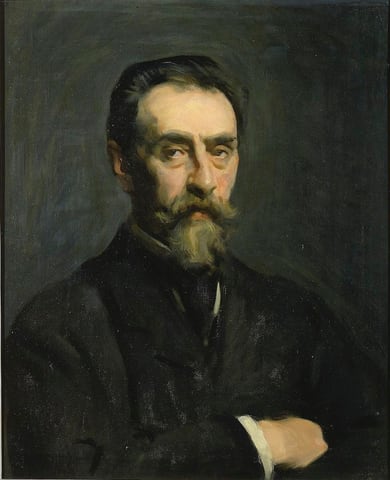
  4. Portrait of William E. Norton, by William Penhallow Henderson, 1901
    Portrait of William E. NortonWilliam Penhallow Henderson, 1901Courtesy of the Smithsonian American Art Museum

Section 1, south wall
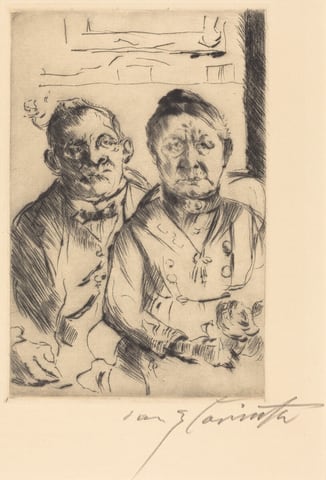
  1. The image depicts two individuals from the waist up. The person on the left has a round face and is slightly behind the person on the right who has a slightly elongated face. Both individuals appear to be seated and have short, neatly combed hair. They have neutral facial expressions and their features are indistinct. The person on the left wears a suit with a bow tie, while the person on the right is dressed in clothing with detailed patterns and holds a flower-like object in their left hand. The background shows simple line sketches that suggest an interior setting.
    Ostpreussisches Ehepaar (Couple from East Prussia)Lovis Corinth, 1916Courtesy National Gallery of Art, Washington
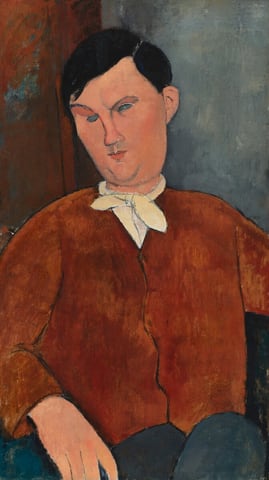
  2. Shown from the lap up, a person with peach-colored skin sits facing us as he looks down and to our left in this vertical, stylized, portrait painting. The person’s clothing and features are outlined with thin black lines, and areas are filled in with mottled, streaked color painted with visible strokes. The person has a round face with a double chin and a small red mouth. The eyes are painted as slate-blue slivers under thin brows, one of which is cocked. The man’s short black hair is parted to one side and combed across the top of his head. He wears a white cravat tied at his neck under a rust-red jacket or shirt. Two rounded, muted blue forms below suggest crossed knees. The man’s right elbow rests next to his body, and that hand is near his lap. The background is painted with pecan brown on the left third and gray-blue on the right two-thirds.
    Monsieur DeleuAmedeo Modigliani, 1916Courtesy National Gallery of Art, Washington
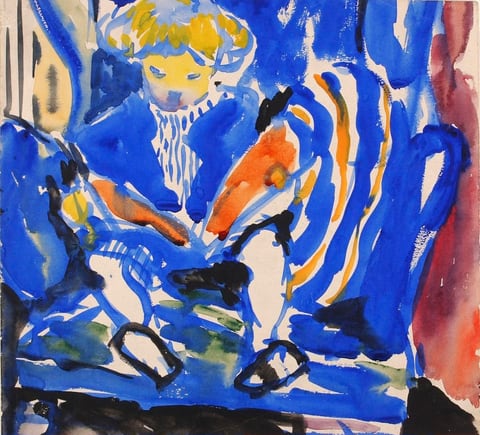
  3. Child Reading, by H. Lyman Saÿen, 1915-1918
    Child ReadingH. Lyman Saÿen, 1915-1918Courtesy of the Smithsonian American Art Museum
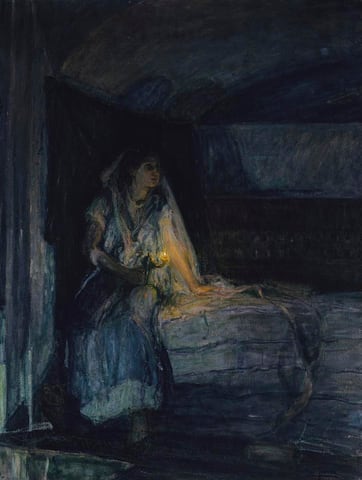
  4. Mary, by Henry Ossawa Tanner, ca. 1914
    MaryHenry Ossawa Tanner, ca. 1914Courtesy of the Smithsonian American Art Museum

Section 2, south wall
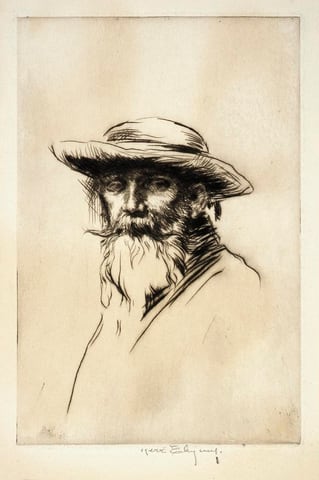
  1. Head of an Old Man, by Kerr Eby, ca. 1918
    Head of an Old ManKerr Eby, ca. 1918Courtesy of the Smithsonian American Art Museum
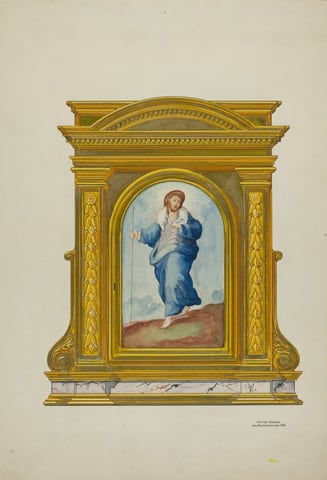
  2. The image shows a painted artwork within an ornate frame. The artwork features a figure standing with one hand raised. The figure has long hair and a beard, and wears flowing blue and white garments. The background shows an earthy surface and a sky. The frame is gold and elaborately designed. The scene is set against a blank, light-colored background.
    Original Tabernacle, for Communion VesselsDayton Brown, 1936Courtesy National Gallery of Art, Washington
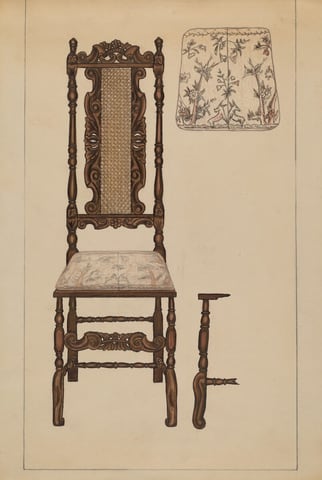
  3. This is a drawing of a wooden chair with detailed upholstery. The chair has an ornate, high backrest with elaborate scrollwork and a woven central panel. The seat is cushioned and covered with a floral patterned fabric. There is also a separate drawing of the fabric pattern used on the seat and a sketch of one of the chair's legs to show the craftsmanship and decorative elements.
    Side ChairUnrecorded American maker, 1935/1942Courtesy National Gallery of Art, Washington
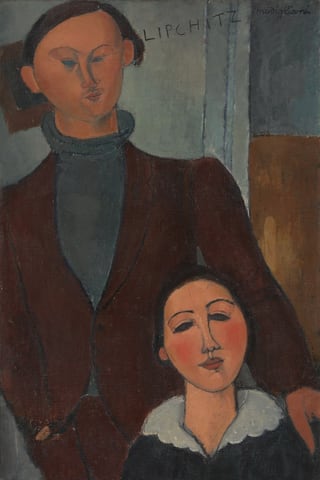
  4. Large painting, standing man blue turtleneck, sitting woman with white collar.
    Jacques and Berthe LipchitzAmedeo Modigliani, 1916Courtesy of the Art Institute of Chicago

Section 2, north wall
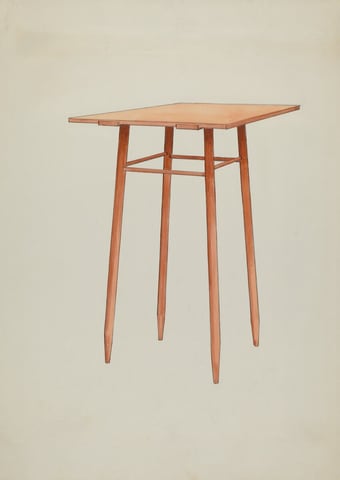
  1. The image shows a tall, narrow wooden table with a square top and four long, slender legs. The color palette is warm with shades of light brown and reddish-brown on the table. Positioned centrally, the table stands against a plain, light-colored background.
    Shaker StandRay Holden, c. 1936Courtesy National Gallery of Art, Washington
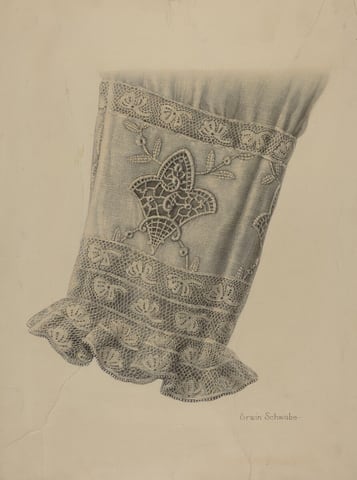
  2. The image shows a lace-trimmed sleeve with a floral lace design in the center, primarily in shades of gray and off-white. The sleeve is positioned vertically in the center of the image, with the top slightly obscured by shadow and the ruffled lace edge at the bottom. The lace details are intricate and precise, enhancing the texture and complexity of the design.
    Cuff LaceErwin Schwabe, c. 1937Courtesy National Gallery of Art, Washington
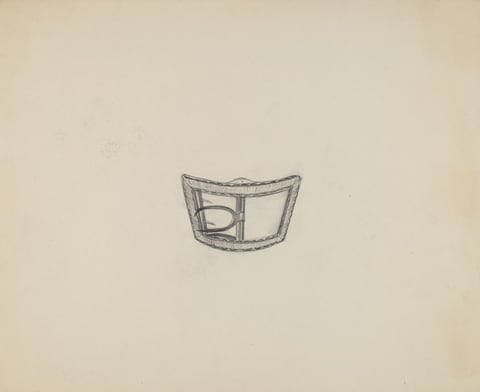
  3. The image displays a detailed pencil sketch of a curved architectural structure in the center of a light beige canvas. The sketch is in grayscale, with a simple color palette. The object occupies a small portion of the canvas, surrounded by negative space.
    Knee BuckleEdna Crenshaw Rex, c. 1937Courtesy National Gallery of Art, Washington
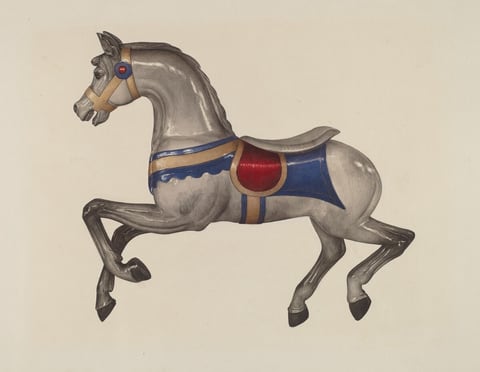
  4. This is a painting of a carousel horse. The image shows a gray carousel horse with glossy highlights and shading. The horse has a blue and red saddle with gold bands, and a blue harness with red accents. The horse is mid-gallop, with animated legs. The background is plain to focus on the horse's design. The style is detailed and realistic, reminiscent of carousel art from the late 19th to early 20th century.
    Carousel HorseDorothy Handy, c. 1939Courtesy National Gallery of Art, Washington

Walk on

  • The 20th century, room 2
  • Dorothy Handy's contemporaries 8 works
  • More American folk and design 90 works
Ochre Editions

The world's museums, on your wall. Every work here is a reproduction of a public-domain original, credited to the museum that holds it.

Shop

All artCollectionsLimited dropsPrints and framing

Help

Find an orderShippingReturnsVerify a certificate

About

About Ochre EditionsMuseum creditsFor agentsDevelopers

Legal

Terms of UseTerms of SaleLimited Editions and CertificatesPrivacy PolicyCookie PolicyAcceptable Use PolicyAgent & API TermsCopyright and DMCA PolicyPrinting Your Own PhotoVulnerability Disclosure PolicyAccessibility StatementOpen-Access Credits
© 2026 Ochre EditionsPrices in US dollars. Prints ship within the United States.