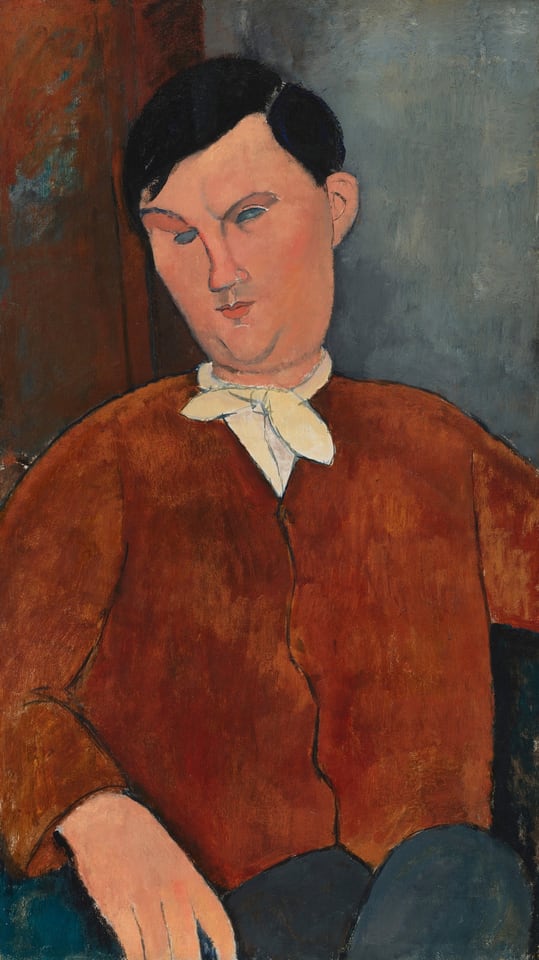
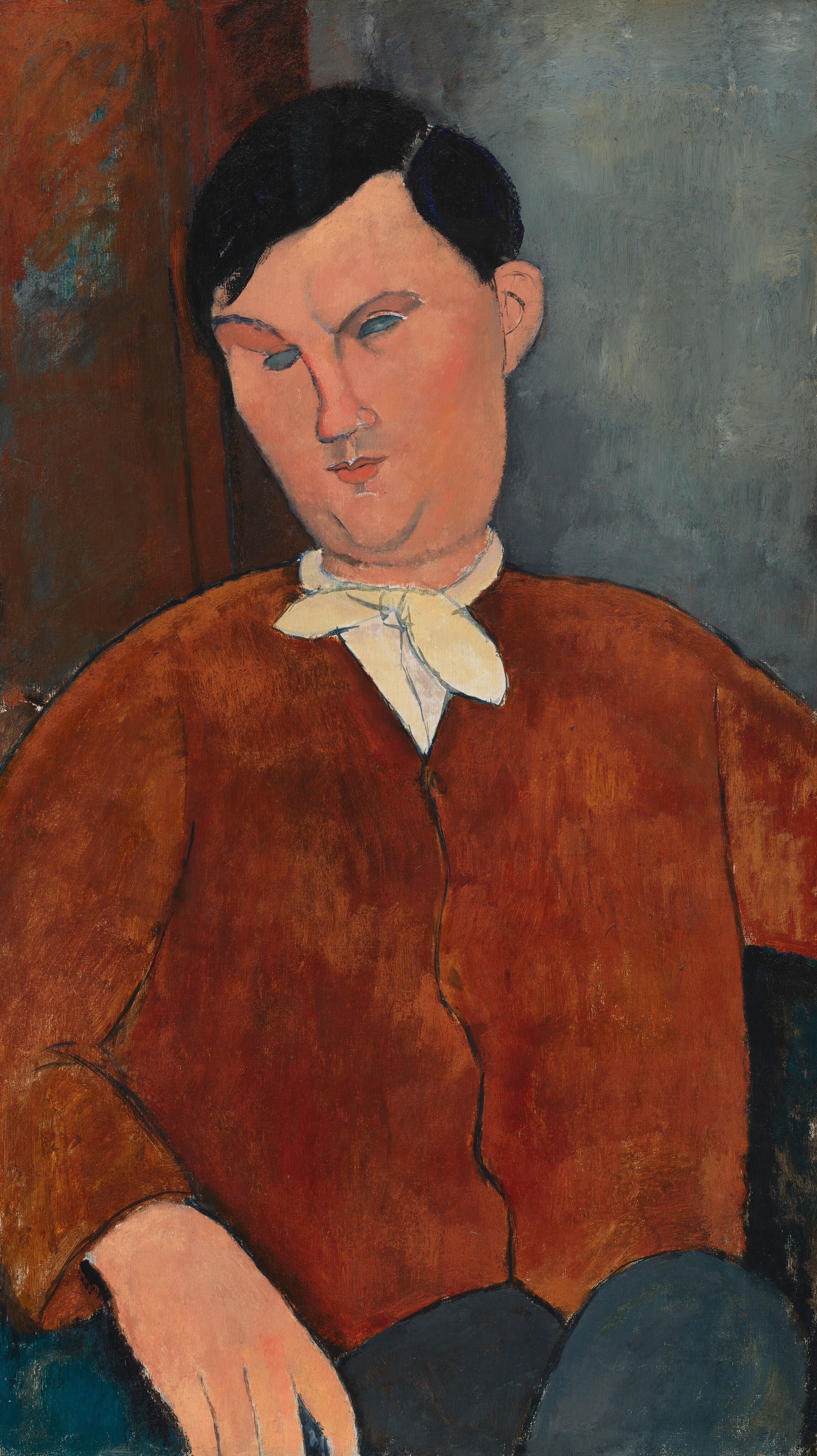
Monsieur Deleu1916
A round-faced man in a rust-red jacket and white cravat sits with his knees crossed, eyes lowered to slate-blue slivers beneath one cocked eyebrow. More about this work
About this work
A round-faced man in a rust-red jacket and white cravat sits with his knees crossed, eyes lowered to slate-blue slivers beneath one cocked eyebrow. Modigliani outlines the features with thin black lines and fills them with streaked, visible strokes of colour, setting the figure against a background split between pecan brown and grey-blue. The sitter is identified only as Monsieur Deleu. The portrait is typical of the many Modigliani painted of friends and acquaintances in wartime Paris, simplifying faces towards masks while letting a tilt of the head or a raised brow carry character.
Written by Ochre Editions.
What you’re looking at
Shown from the lap up, a person with peach-colored skin sits facing us as he looks down and to our left in this vertical, stylized, portrait painting. The person’s clothing and features are outlined with thin black lines, and areas are filled in with mottled, streaked color painted with visible strokes. The person has a round face with a double chin and a small red mouth. The eyes are painted as slate-blue slivers under thin brows, one of which is cocked. The man’s short black hair is parted to one side and combed across the top of his head. He wears a white cravat tied at his neck under a rust-red jacket or shirt. Two rounded, muted blue forms below suggest crossed knees. The man’s right elbow rests next to his body, and that hand is near his lap. The background is painted with pecan brown on the left third and gray-blue on the right two-thirds.
Description from the National Gallery of Art.
How it was made
- Oil paint
- Pigment ground in a drying oil, usually linseed. It dries slowly, so painters could blend on the canvas, build up thin translucent glazes, and rework a picture over weeks. Canvas replaced wooden panels in the 1500s because it is lighter and can be rolled.
Amedeo Modigliani
Italian, 1884–1920
Modigliani trained in Italy before moving to Paris in 1906, where he lived the precarious life of Montmartre and Montparnasse. Influenced by Cézanne, by African and ancient sculpture, and by his own work as a sculptor with Brâncuși’s encouragement, he developed a distinctive manner of elongated faces, almond eyes and long necks. His portraits of friends and fellow artists, among them Jacques and Berthe Lipchitz, and his reclining nudes date mainly from his last five years. He died of tuberculous meningitis at thirty-five.
Written by Ochre Editions.
Rights and the museum’s record
Public domain. The National Gallery of Art has dedicated this image to the public domain under CC0, so anyone may copy, adapt and use it, for any purpose, without asking. Our prints and files are reproductions made from the museum’s image; the museum doesn’t endorse them.
- Object number
- 1963.10.76
- Credit
- Courtesy National Gallery of Art, Washington
- Type
- Painting
- Licence
- CC0 1.0 Universal
- Museum record
- See it on the museum’s site
Report this work
More by Amedeo Modigliani
All their works
Close in colour