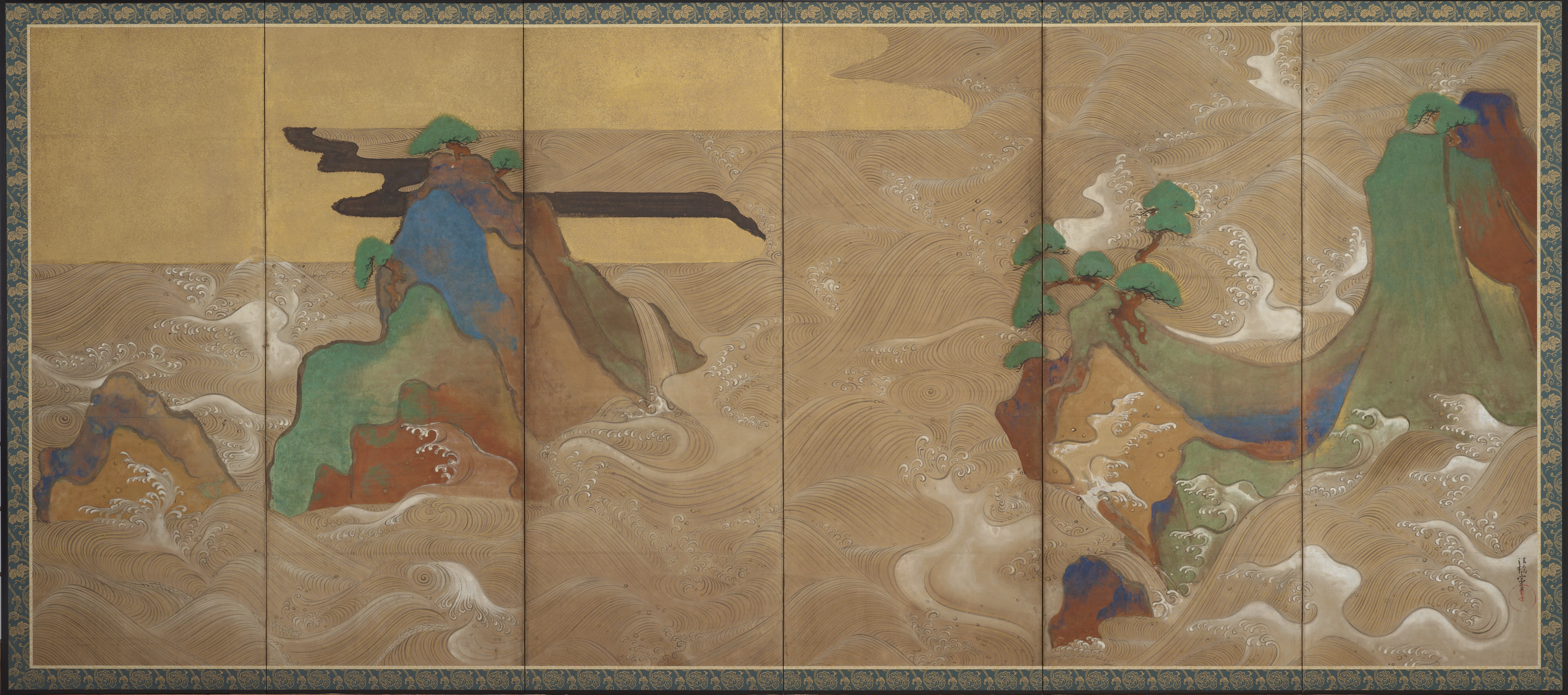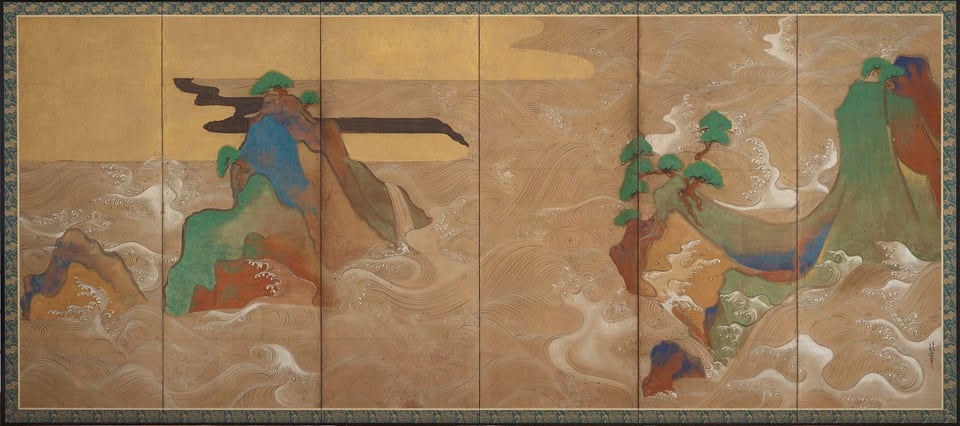
Waves at Matsushima 松島図屏風17th century
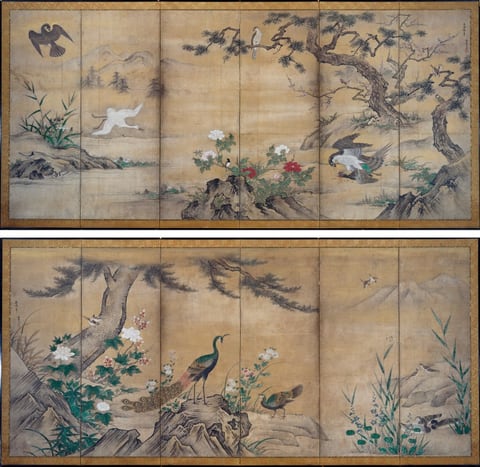
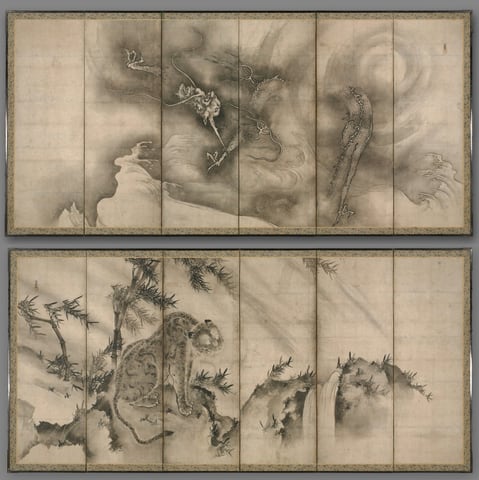
The brilliant paintings on this pair of folding screens are regarded as masterpieces among only six surviving sets of screens by Sotatsu, a talented and innovative artist who headed a painting workshop known as Tawaraya. More about this work
About this work
The brilliant paintings on this pair of folding screens are regarded as masterpieces among only six surviving sets of screens by Sotatsu, a talented and innovative artist who headed a painting workshop known as Tawaraya. As a townsman, Sotatsu produced paintings such as fans for popular consumption. By the late 1620s, however, Sotatsu was painting for the imperial court, and his works survive in the collections of the Kyoto imperial palace. For his artistic merit, he was granted the honorary Buddhist ecclesiastical title Hokkyo (Bridge of the Law), which is included in his signature on these screens.
Text from the National Museum of Asian Art.
How it was made
- Ink on paper
- Ink made from soot and animal glue, ground with water on an inkstone. A single brush can give a hair-fine line or a broad wash, and nothing can be corrected.
Rights and the museum’s record
Public domain. The National Museum of Asian Art has dedicated this image to the public domain under CC0, so anyone may copy, adapt and use it, for any purpose, without asking. Our prints and files are reproductions made from the museum’s image; the museum doesn’t endorse them.
- Object number
- F1906.231-232
- Credit
- Courtesy of the National Museum of Asian Art, Smithsonian Institution
- Type
- Painting
- Department
- National Museum of Asian Art
- Licence
- CC0 1.0 Universal
- Museum record
- See it on the museum’s site