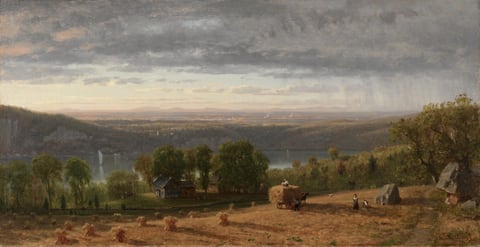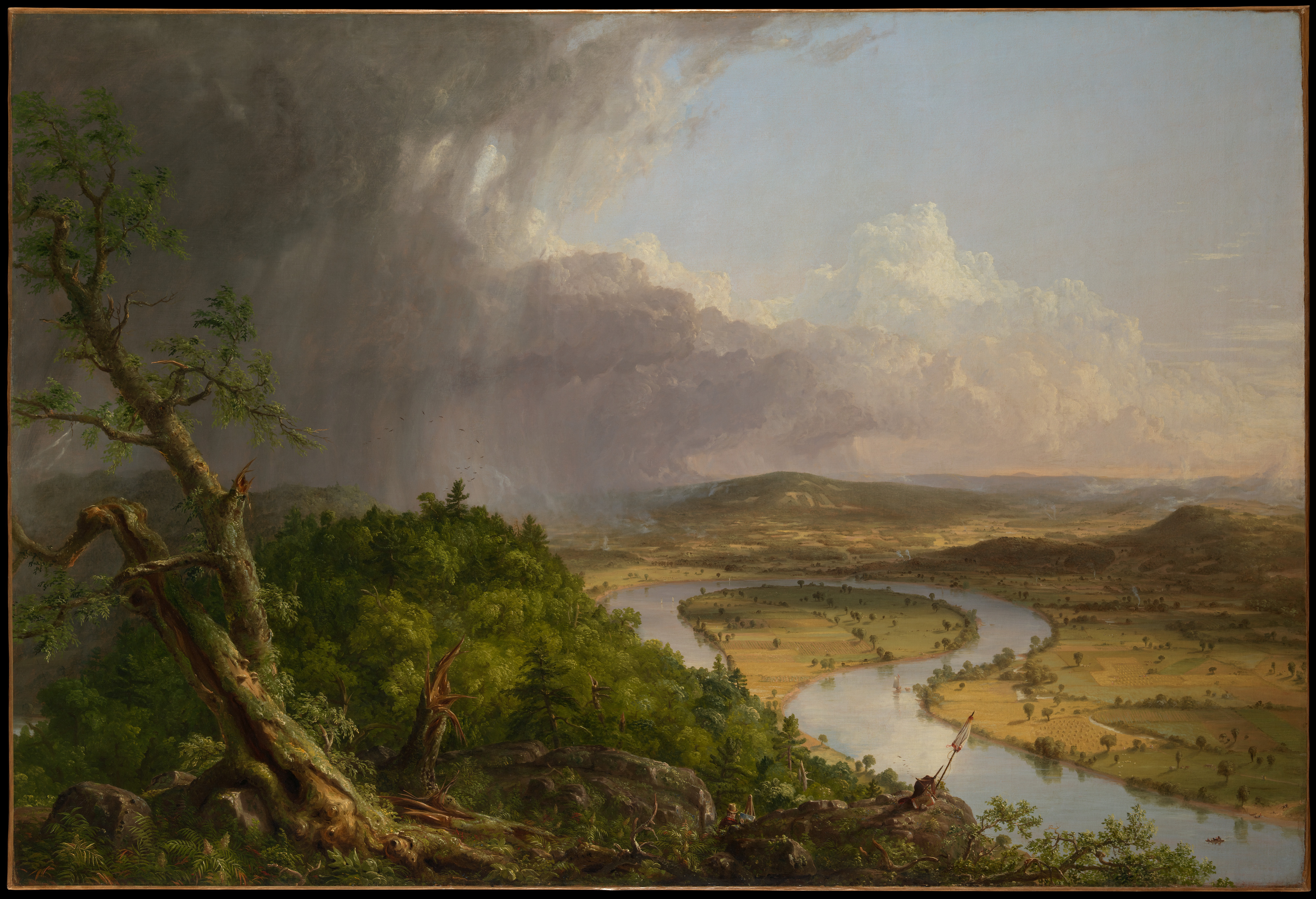
View from Mount Holyoke, Northampton, Massachusetts, after a Thunderstorm—The Oxbow1836
From the summit of Mount Holyoke, the Connecticut River loops in a great oxbow through cultivated fields, while at the left a storm passes over wild, shattered trees. More about this work
About this work
From the summit of Mount Holyoke, the Connecticut River loops in a great oxbow through cultivated fields, while at the left a storm passes over wild, shattered trees. Thomas Cole divides the canvas between wilderness and settlement, darkness and light, inviting reflection on what America was making of its landscape. He painted it for the National Academy of Design exhibition of 1836 and included a tiny self-portrait at his easel in the foreground, looking out at us. Look too at the distant hillside, where clearings in the forest have been read as Hebrew letters spelling ‘Noah’ or, upside down, ‘the Almighty’.
Written by Ochre Editions.
How it was made
- Oil paint
- Pigment ground in a drying oil, usually linseed. It dries slowly, so painters could blend on the canvas, build up thin translucent glazes, and rework a picture over weeks. Canvas replaced wooden panels in the 1500s because it is lighter and can be rolled.
Thomas Cole
American, born England,1801–1848 · Born in Lancashire; died in Catskill, New York.
Cole emigrated from Lancashire to the United States as a teenager and, largely self-taught, made his name in 1825 with views of the Catskill Mountains that launched what became known as the Hudson River School. Years in England and Italy deepened his ambitions, and he joined landscape to moral allegory in series such as The Course of Empire and The Voyage of Life. The Oxbow sets wild forest against cultivated valley. He lived at Catskill, New York, until his early death.
Written by Ochre Editions.
Hudson River School
American landscape painters of the mid-1800s who made wilderness their grand subject.
Rights and the museum’s record
Public domain. The Met has dedicated this image to the public domain under CC0, so anyone may copy, adapt and use it, for any purpose, without asking. Our prints and files are reproductions made from the museum’s image; the museum doesn’t endorse them.
- Object number
- 08.228
- Credit
- Courtesy of The Metropolitan Museum of Art
- Type
- Painting
- Department
- The American Wing
- Licence
- CC0 1.0 Universal
- Museum record
- See it on the museum’s site