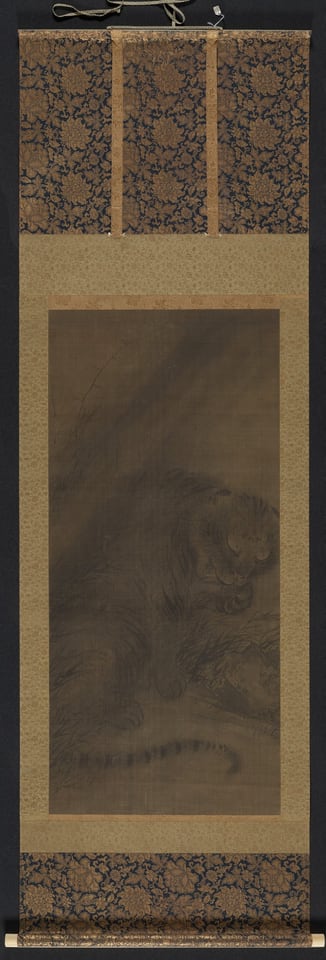
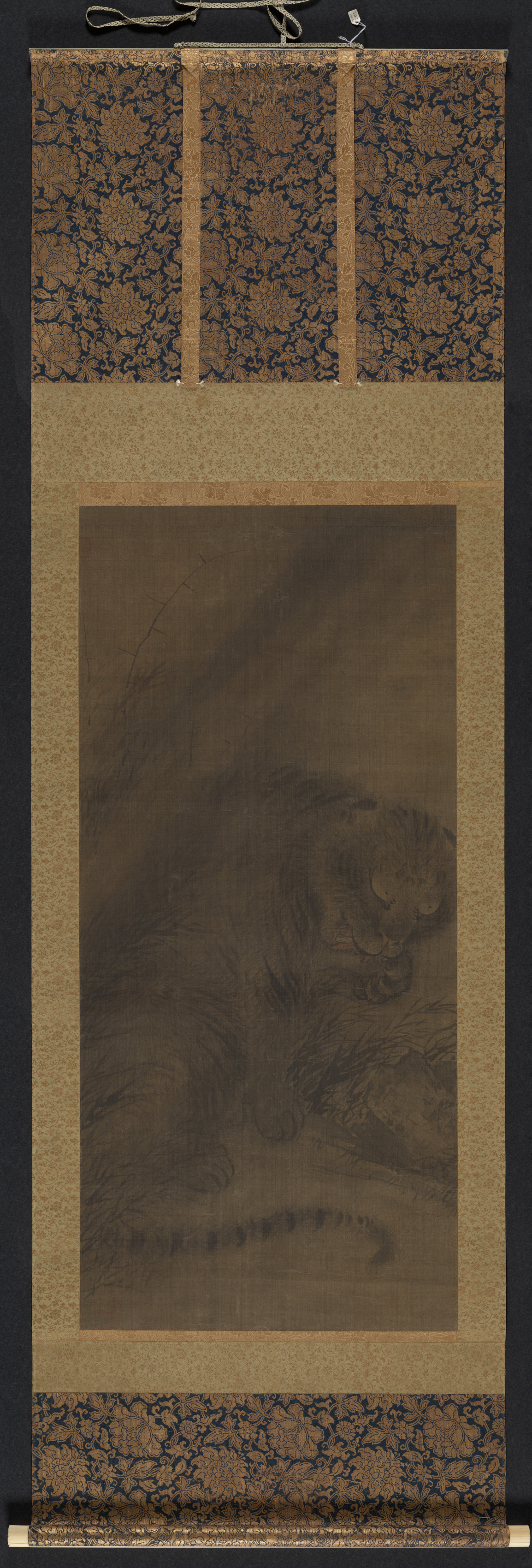
Tigerc. 1250–79
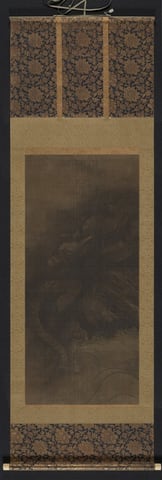
The dragon and tiger are tied to the philosophical concept of yin and yang, which describes opposite but complementary forces. The dragon occupies a tiered background of waves and mist. More about this work
About this work
The dragon and tiger are tied to the philosophical concept of yin and yang, which describes opposite but complementary forces. The dragon occupies a tiered background of waves and mist. Its luminous head emerges from the darker passages, and its narrow twisting body is serpent-like. By contrast, the close-up view of the tiger emphasizes its bulk. The tiger bends its head to lick its paw while its tail curls in the foreground. In their original Chan Buddhist context, this pair of scrolls likely flanked a central image, like the Bodhisattva Guanyin. The silk has darkened over the centuries, and the slight reddish shading in the tiger’s tongue and nose has faded.
Text from the Cleveland Museum of Art.
How it was made
- Hanging scroll
- A painting mounted on silk with a wooden roller at the foot. It was rolled up for storage and brought out to hang for a season, a guest or an occasion.
- Ink and colour on silk
- Silk was sized with glue and alum so it would hold a crisp brushline, and mineral colours were built up in thin layers. The sheen of the weave still shows through.
Fachang Muqi
Chinese, 1220–1280
Muqi, whose religious name was Fachang, was a Chan Buddhist monk who painted in and around Hangzhou during the Southern Song dynasty. Working in ink with great freedom, he painted birds, animals, fruit, landscapes and Buddhist figures. Little valued by Chinese critics, his work was treasured in Japan, where paintings such as the Six Persimmons, now at Daitoku-ji in Kyoto, shaped the taste of Zen temples and tea masters.
Written by Ochre Editions.
Chinese painting
Ink and colour on silk and paper, from imperial courts to scholars' retreats.
Rights and the museum’s record
Public domain. The Cleveland Museum of Art has dedicated this image to the public domain under CC0, so anyone may copy, adapt and use it, for any purpose, without asking. Our prints and files are reproductions made from the museum’s image; the museum doesn’t endorse them.
- Object number
- 1958.427.2
- Credit
- Courtesy of the Cleveland Museum of Art
- Type
- Painting
- Department
- Chinese Art
- Licence
- CC0 1.0 Universal
- Museum record
- See it on the museum’s site
Report this work
More by Fachang Muqi
All their works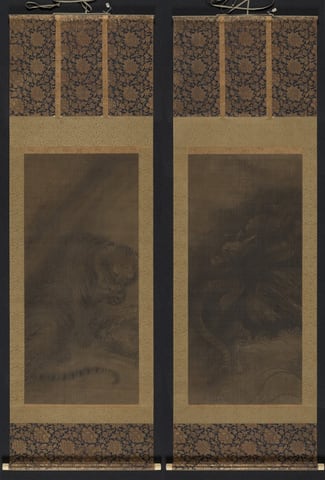
Close in colour