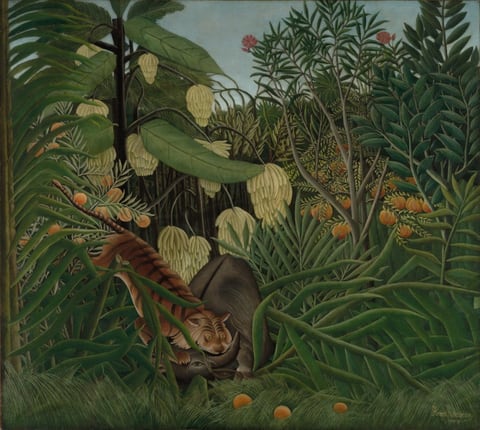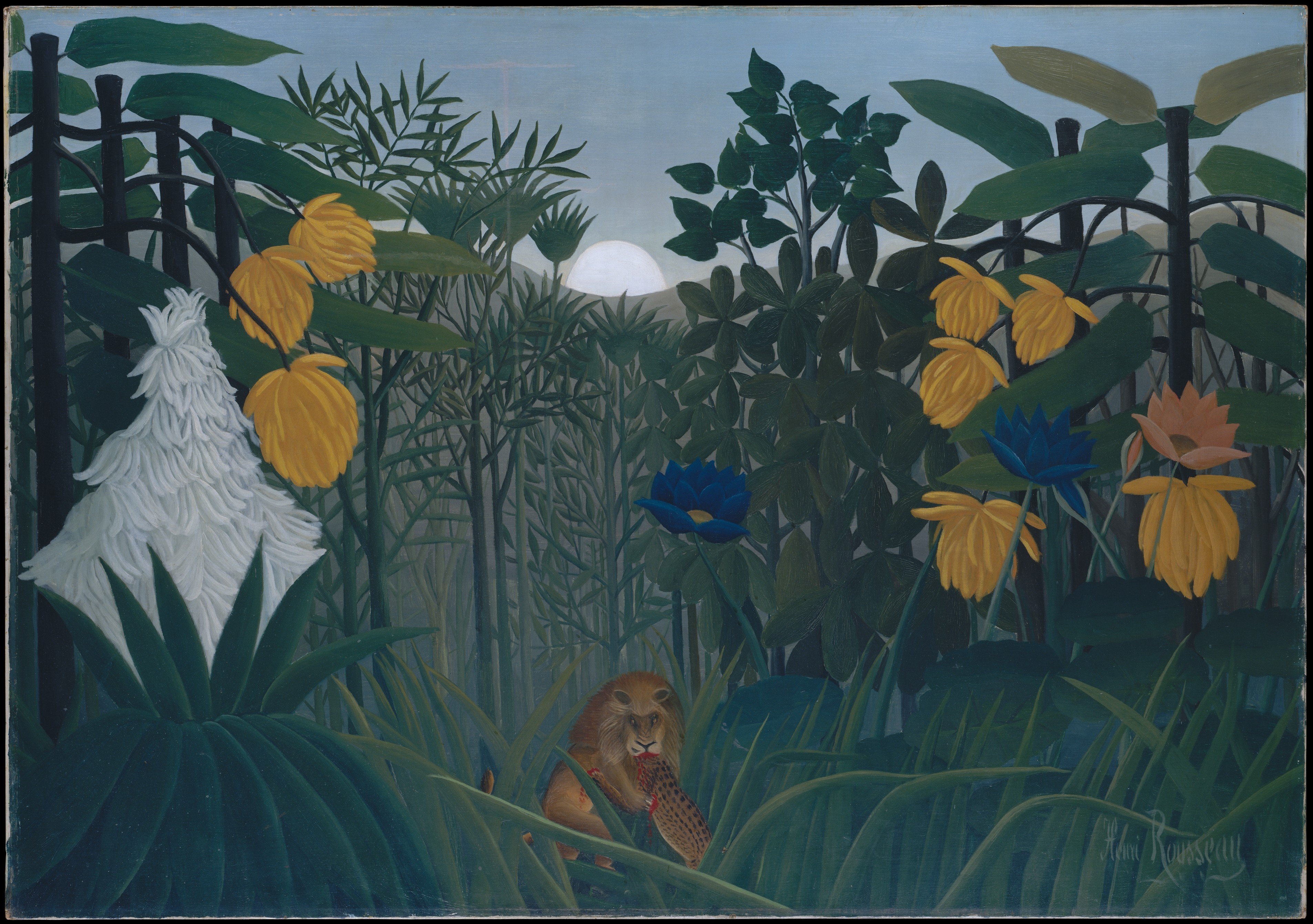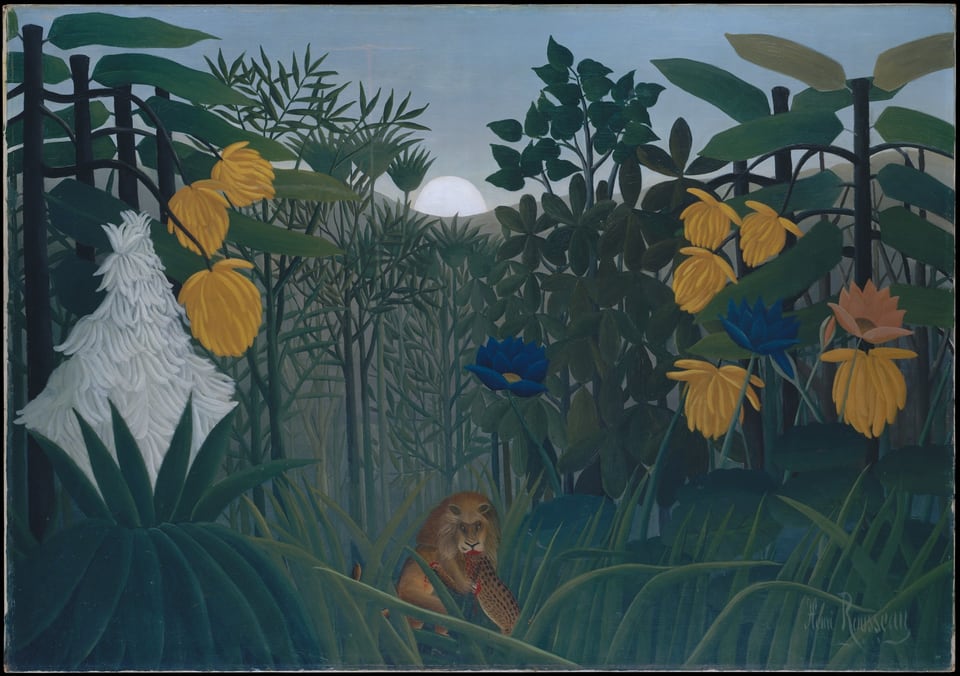
The Repast of the Lionca. 1907
A lion sinks its teeth into its prey amid towering, stylised jungle foliage, enormous leaves and flowers rendered in many carefully distinguished greens. More about this work
About this work
A lion sinks its teeth into its prey amid towering, stylised jungle foliage, enormous leaves and flowers rendered in many carefully distinguished greens. Henri Rousseau, a self-taught painter who worked for years in the Paris toll service, never travelled outside France; he based his jungles on visits to the city’s botanical garden and zoo and on illustrations in books and magazines. The calm, decorative precision of the plants contrasts strangely with the violence at the centre, giving the scene the logic of a dream.
Written by Ochre Editions.
How it was made
- Oil paint
- Pigment ground in a drying oil, usually linseed. It dries slowly, so painters could blend on the canvas, build up thin translucent glazes, and rework a picture over weeks. Canvas replaced wooden panels in the 1500s because it is lighter and can be rolled.
Henri Rousseau
French, 1844–1910 · Born in Laval; died in Paris.
Rousseau worked for years as a clerk in the Paris toll service, which earned him the nickname “le Douanier”, and taught himself to paint, exhibiting from 1886 at the jury-free Salon des Indépendants. Critics mocked his flat, meticulous style, but younger artists, Picasso among them, came to admire it. He is best known for his dense jungle scenes with wild animals, composed from visits to the Paris botanical garden and zoo and from illustrated books, without his ever leaving France.
Written by Ochre Editions.
Rights and the museum’s record
Public domain. The Met has dedicated this image to the public domain under CC0, so anyone may copy, adapt and use it, for any purpose, without asking. Our prints and files are reproductions made from the museum’s image; the museum doesn’t endorse them.
- Object number
- 51.112.5
- Credit
- Courtesy of The Metropolitan Museum of Art
- Type
- Paintings
- Department
- European Paintings
- Licence
- CC0 1.0 Universal
- Museum record
- See it on the museum’s site