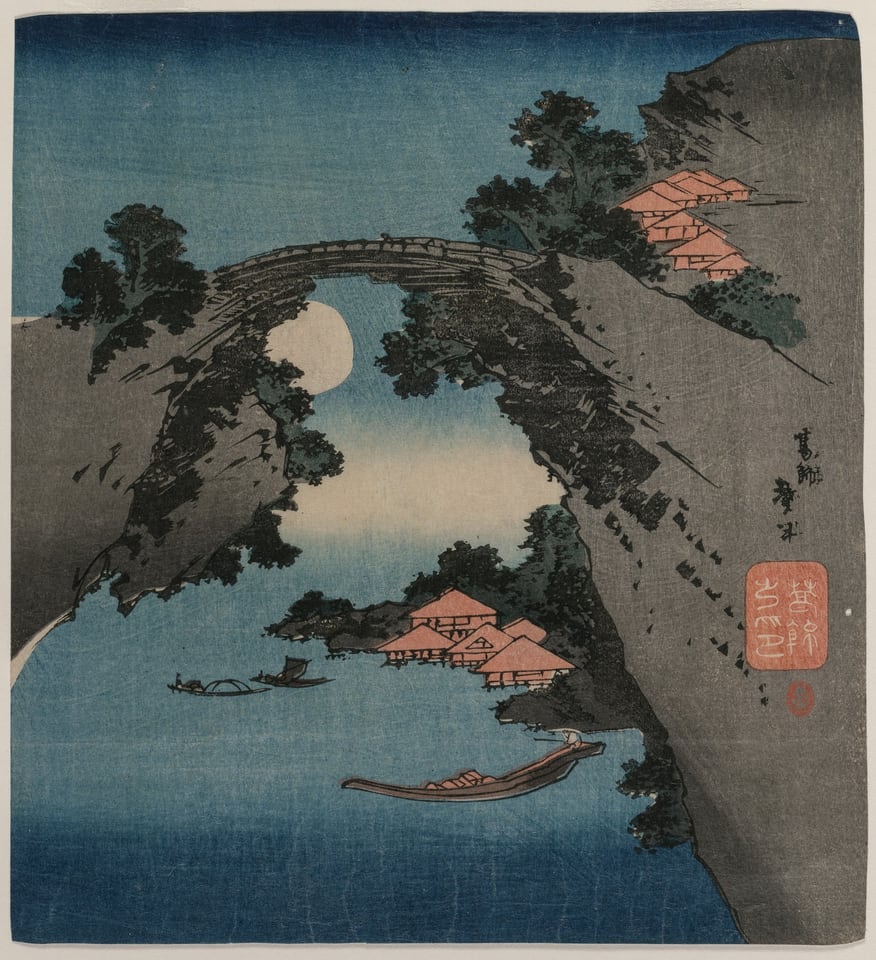
The Monkey Bridgeearly 1830s
Taito II, who studied with Hokusai, created this image of the Monkey Bridge in Kai Province, west of Tokyo. By depicting the moon beneath the narrow bridge, he emphasized the height of the gorge. More about this work
About this work
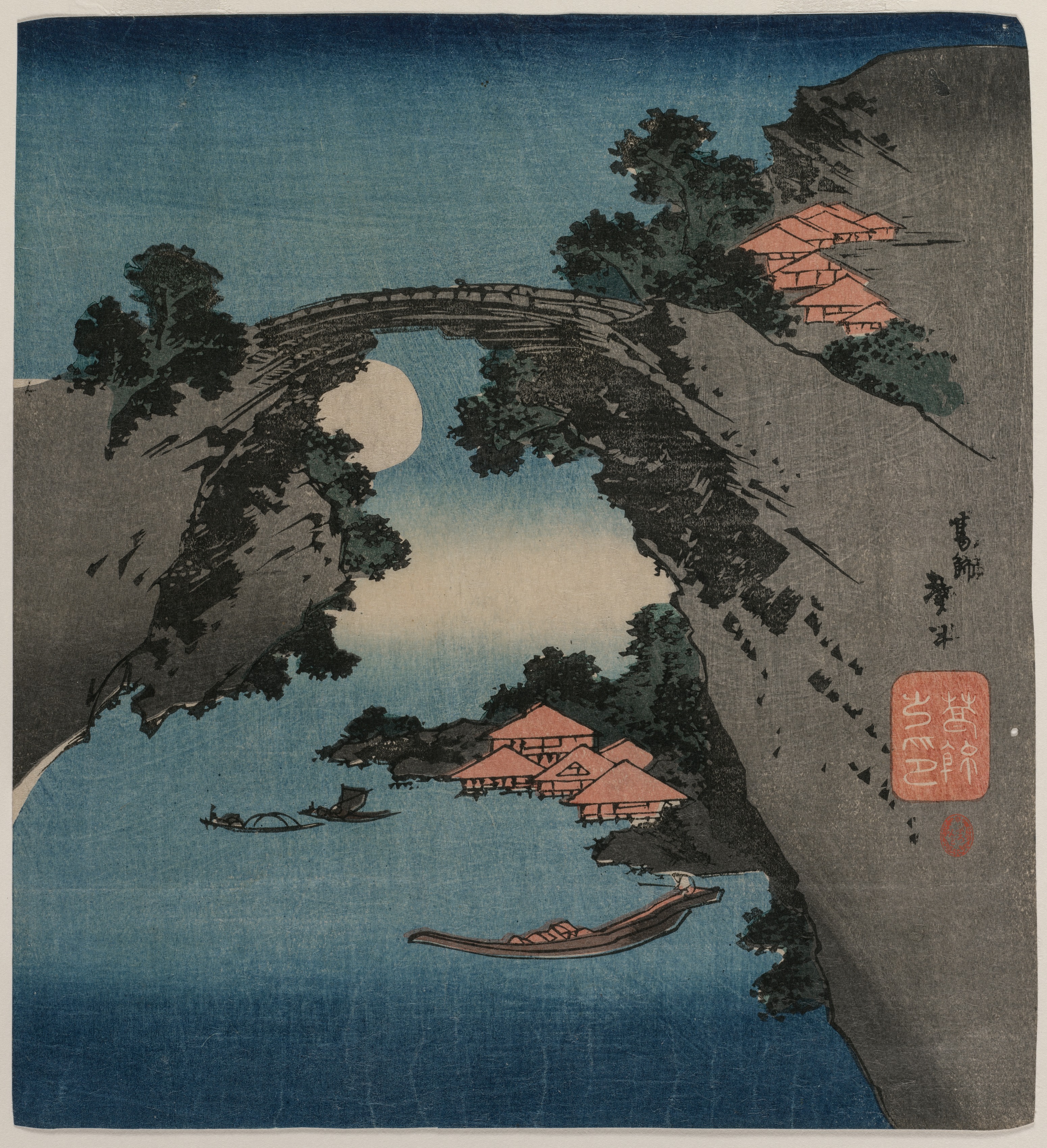
Taito II, who studied with Hokusai, created this image of the Monkey Bridge in Kai Province, west of Tokyo. By depicting the moon beneath the narrow bridge, he emphasized the height of the gorge. Before it was given to the museum by one of its founders, Jeptha H. Wade, this print was trimmed. Uncut versions of the same scene include a section with a poetic inscription designed to look like a rubbing from a stone stele, or commemorative marker, often erected in scenic locations. Ink was also applied differently to produce varying effects in other impressions.
Text from the Cleveland Museum of Art.
How it was made
- Colour woodblock print
- In Japan these were a team effort. The artist drew the design, a carver cut it into cherry-wood blocks, one block for each colour, and a printer brushed on the pigment and rubbed each sheet by hand. Full-colour prints of this kind were called nishiki-e, “brocade pictures”, from the 1760s on.
Katsushika Taito II
Japanese, active c. 1810–50s
Ukiyo-e
Japanese woodblock prints of the floating world: actors, courtesans, landscapes and the sea.
Rights and the museum’s record
Public domain. The Cleveland Museum of Art has dedicated this image to the public domain under CC0, so anyone may copy, adapt and use it, for any purpose, without asking. Our prints and files are reproductions made from the museum’s image; the museum doesn’t endorse them.
- Object number
- 1921.413
- Credit
- Courtesy of the Cleveland Museum of Art
- Type
- Department
- Japanese Art
- Licence
- CC0 1.0 Universal
- Museum record
- See it on the museum’s site
Report this work
Close in colour