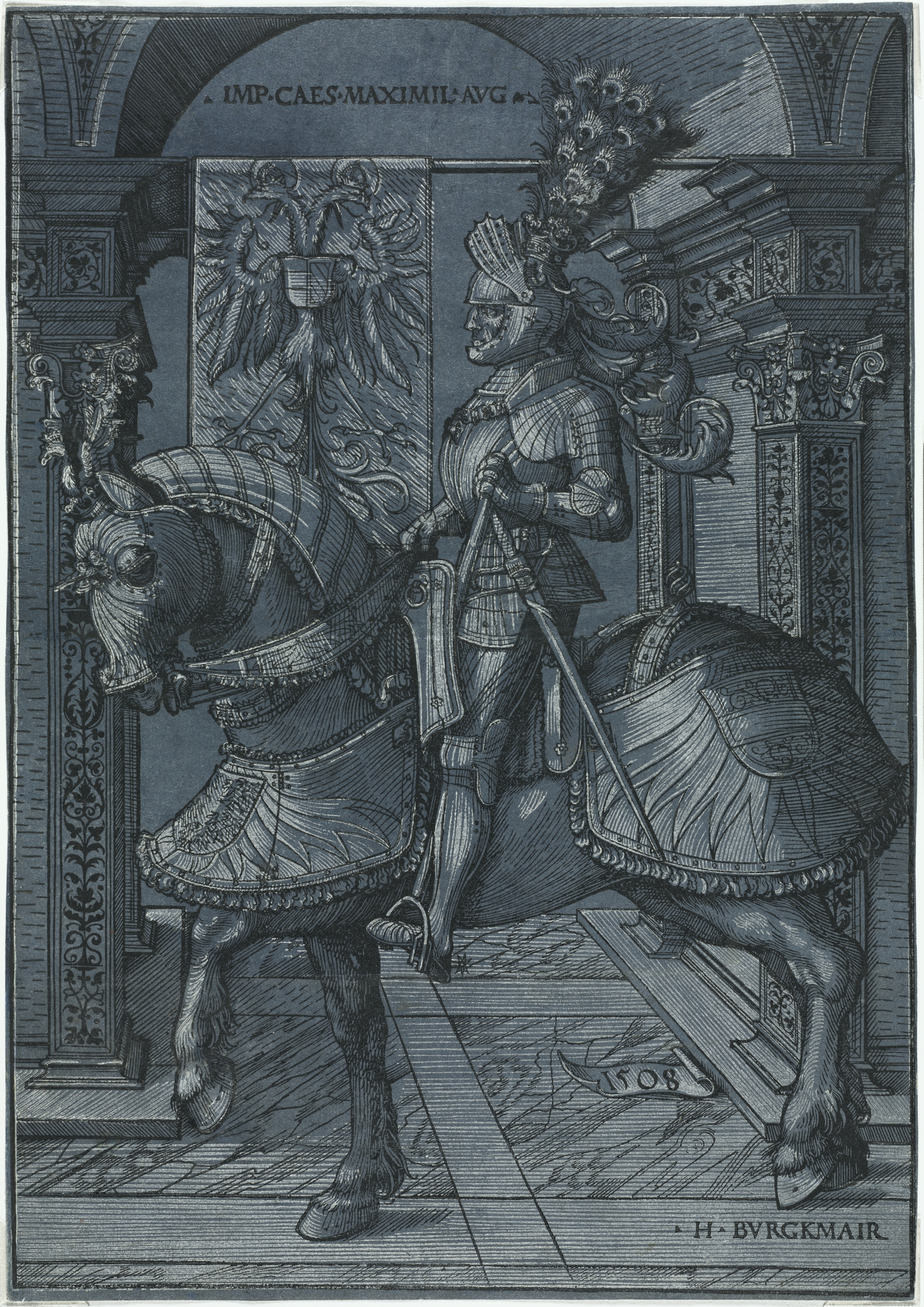
Equestrian Portrait of the Emperor Maximilian1508
Presented in full profile, the Holy Roman Emperor Maximilian I (reigned 1486–1519) and his mount emulate a classical equestrian portrait statue. More about this work
About this work
Presented in full profile, the Holy Roman Emperor Maximilian I (reigned 1486–1519) and his mount emulate a classical equestrian portrait statue. The Latin abbreviations inscribed at the top of the page describe him as “August Emperor Caesar Maximilian,” a title conceptually equating him with the leaders of the ancient Roman Empire. The two-headed eagle on the banner is the emblem of his dynastic family, the Hapsburgs. This exceptionally rare chiaroscuro woodcut— printed with black and white inks on paper prepared with tinted wash—represents one of the earliest experiments with this technique. Of the two surviving impressions printed on hand-colored paper, this is the only one that is blue.
Text from the Cleveland Museum of Art.
How it was made
- Woodcut
- A relief print. The block is cut away around the lines, so the lines stand up to take the ink, and the sheet is pressed onto them.
Hans Burgkmair
German, 1473–1531
Renaissance
European art from about 1400 to 1600, when painters rediscovered perspective and the classical past.
Rights and the museum’s record
Public domain. The Cleveland Museum of Art has dedicated this image to the public domain under CC0, so anyone may copy, adapt and use it, for any purpose, without asking. Our prints and files are reproductions made from the museum’s image; the museum doesn’t endorse them.
- Object number
- 1950.72
- Credit
- Courtesy of the Cleveland Museum of Art
- Type
- Department
- Prints
- Licence
- CC0 1.0 Universal
- Museum record
- See it on the museum’s site
Report this work
Close in colour