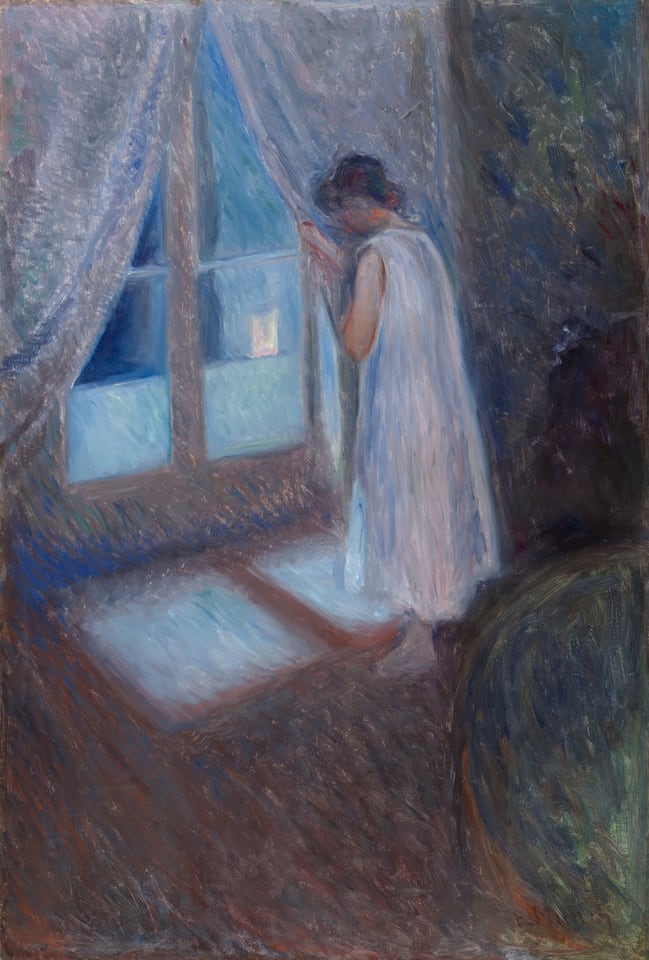
The Girl by the Window1893
Edvard Munch’s life and art have come to epitomize modern notions of anxiety. More about this work
About this work
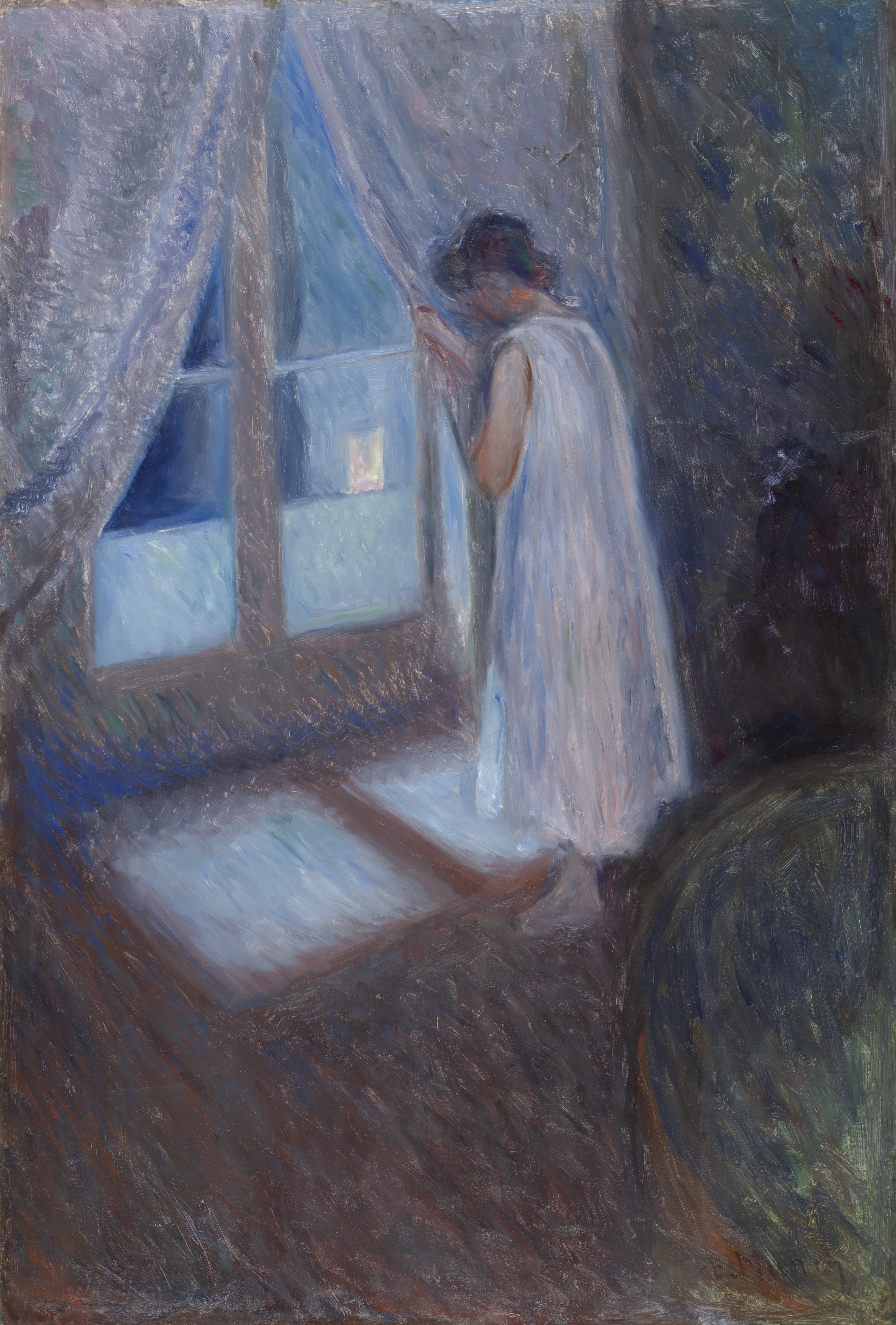
Edvard Munch’s life and art have come to epitomize modern notions of anxiety. Created the same year as his renowned The Scream , this painting depicts a young girl in her nightgown gazing out at the city from her darkened room. The steep angle of the floor and the deep shadows that obliterate almost everything in the room create an unsettling and enigmatic scene.
Text from the Art Institute of Chicago.
What you’re looking at
Loosely painted scene of a brown-haired girl in her nightgown standing in a dark room, gazing out a window into a brighter night, her face unseen and her hand drawing back the pale curtain. Light blues and pink whites dominate the girl and the window, while deep browns, blues, and greens color the darkened portions of her room.
Description from the Art Institute of Chicago.
How it was made
- Oil paint
- Pigment ground in a drying oil, usually linseed. It dries slowly, so painters could blend on the canvas, build up thin translucent glazes, and rework a picture over weeks. Canvas replaced wooden panels in the 1500s because it is lighter and can be rolled.
Edvard Munch
Norwegian, 1863–1944
Munch trained in Kristiania, now Oslo, and spent long periods in Paris and Berlin in the 1890s, where he developed The Frieze of Life, a cycle on love, anxiety and death that includes The Scream. His painting drew on personal loss, including the early deaths of his mother and sister. He also made woodcuts and lithographs of great originality, sawing his blocks into pieces to ink them separately. After a breakdown in 1908 he returned to Norway, where he lived and worked until his death.
Written by Ochre Editions.
Rights and the museum’s record
Public domain. The Art Institute of Chicago has dedicated this image to the public domain under CC0, so anyone may copy, adapt and use it, for any purpose, without asking. Our prints and files are reproductions made from the museum’s image; the museum doesn’t endorse them.
- Object number
- 2000.50
- Credit
- Courtesy of the Art Institute of Chicago
- Type
- Painting
- Department
- Painting and Sculpture of Europe
- Licence
- CC0 1.0 Universal
- Museum record
- See it on the museum’s site