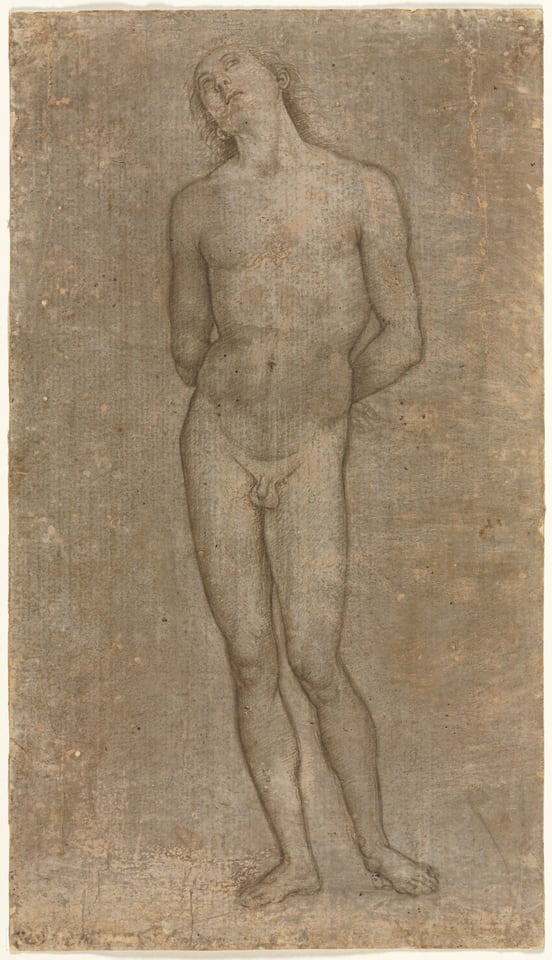
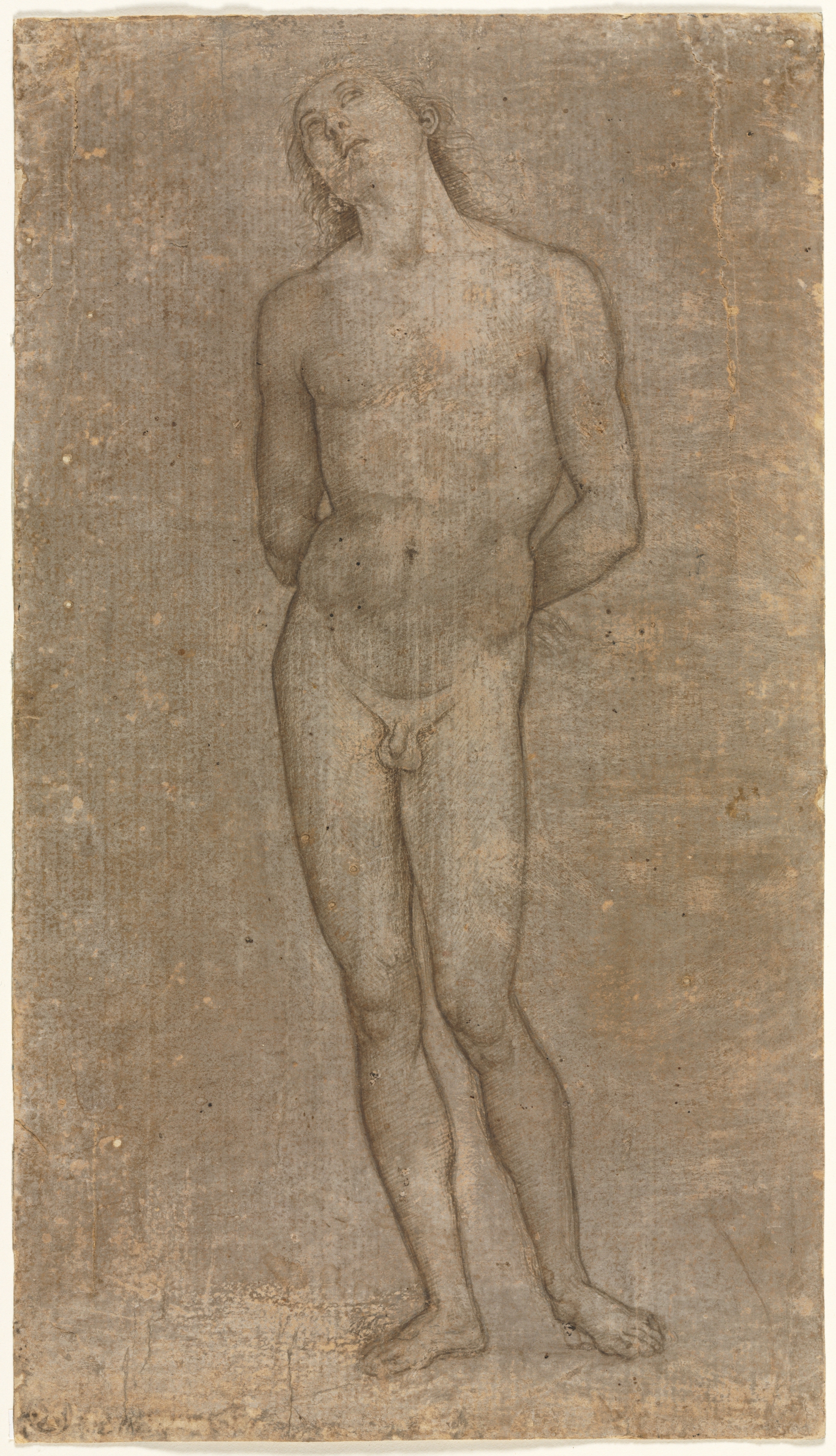
Saint Sebastianc. 1493
The Florentine painter Perugino made drawings to record figural types and poses that could be repeated throughout his finished paintings. More about this work
About this work
The Florentine painter Perugino made drawings to record figural types and poses that could be repeated throughout his finished paintings. He used the elegant, graceful figure seen here, with its soft athletic body and upwardly turned gaze, in at least two paintings of the 3rd-century martyr Saint Sebastian (the related paintings are now in the collection of the Galleria degli Uffizi, and the Louvre). Sebastian was shot with arrows after being exposed as a Christian convert; he was particularly revered during the Renaissance as a protector against illness such as the plague. Portrayal of the saint required Perugino to express his knowledge of human anatomy, while evoking the gentle s-curve associated with classical sculpture. Drawn with metalpoint, a typical drawing medium in the 1400s, the reinforced lines along the contour of the figure indicate that it was probably used by the artist or by one of his many studio assistants to transfer the design to another sheet.
Text from the Cleveland Museum of Art.
Perugino
Italian, c. 1450/55–1523
Pietro Vannucci took the name Perugino from Perugia, the chief city of his native Umbria, and trained in Florence, probably alongside Leonardo in Verrocchio’s studio. In the early 1480s he was among the painters of the Sistine Chapel walls, where his Delivery of the Keys sets calm figures before a vast, ordered piazza. His serene, symmetrical style and soft landscapes made him one of the most sought-after painters in Italy, and the young Raphael learned much from him.
Written by Ochre Editions.
Renaissance
European art from about 1400 to 1600, when painters rediscovered perspective and the classical past.
Rights and the museum’s record
Public domain. The Cleveland Museum of Art has dedicated this image to the public domain under CC0, so anyone may copy, adapt and use it, for any purpose, without asking. Our prints and files are reproductions made from the museum’s image; the museum doesn’t endorse them.
- Object number
- 1958.411
- Credit
- Courtesy of the Cleveland Museum of Art
- Type
- Drawing
- Department
- Drawings
- Licence
- CC0 1.0 Universal
- Museum record
- See it on the museum’s site
Report this work
More by Perugino
All their works
Close in colour