The Nativity1500–05
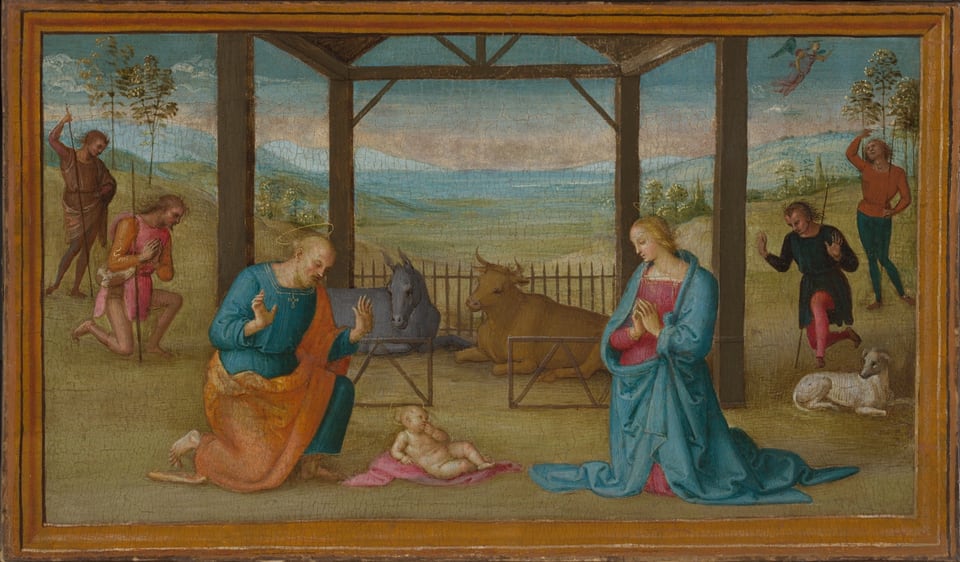
Mary and Joseph adore the newborn Christ Child in a simple shelter, with the ox nearby and a quiet landscape beyond. More about this work
About this work
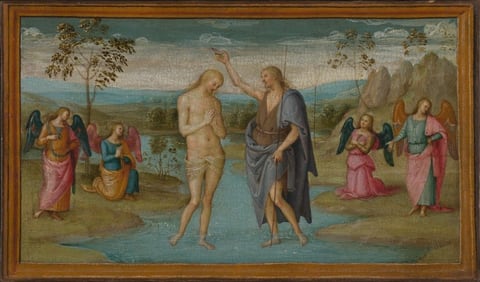
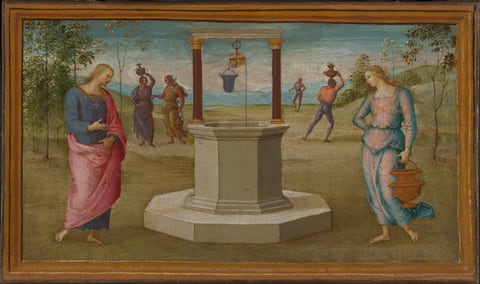
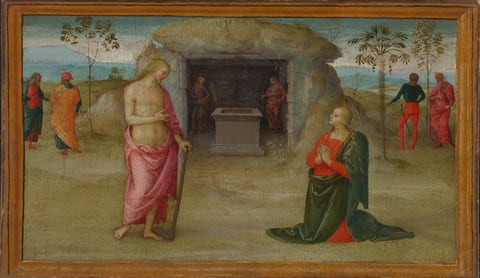
Mary and Joseph adore the newborn Christ Child in a simple shelter, with the ox nearby and a quiet landscape beyond. Perugino’s balanced compositions, gentle figures and soft, even light made him one of the most sought-after painters in Italy around 1500, and his young pupil Raphael absorbed his manner before developing his own. The panel belongs with the Art Institute’s other scenes from the life of Christ by Perugino, all painted in the early 1500s and later transferred from wood to canvas.
Written by Ochre Editions.
What you’re looking at
A work made of tempera on panel, transferred to canvas.
Description from the Art Institute of Chicago.
How it was made
- Tempera
- Pigment bound with egg yolk. It dries in minutes and can’t be blended wet, so painters built up form with fine, hatched strokes. It was Europe’s main panel technique before oil.
Perugino
Italian, c. 1450/55–1523
Pietro Vannucci took the name Perugino from Perugia, the chief city of his native Umbria, and trained in Florence, probably alongside Leonardo in Verrocchio’s studio. In the early 1480s he was among the painters of the Sistine Chapel walls, where his Delivery of the Keys sets calm figures before a vast, ordered piazza. His serene, symmetrical style and soft landscapes made him one of the most sought-after painters in Italy, and the young Raphael learned much from him.
Written by Ochre Editions.
Renaissance
European art from about 1400 to 1600, when painters rediscovered perspective and the classical past.
Rights and the museum’s record
Public domain. The Art Institute of Chicago has dedicated this image to the public domain under CC0, so anyone may copy, adapt and use it, for any purpose, without asking. Our prints and files are reproductions made from the museum’s image; the museum doesn’t endorse them.
- Object number
- 1933.1025
- Credit
- Courtesy of the Art Institute of Chicago
- Type
- Painting
- Department
- Painting and Sculpture of Europe
- Licence
- CC0 1.0 Universal
- Museum record
- See it on the museum’s site