Battle of the Nudes1470s–80s
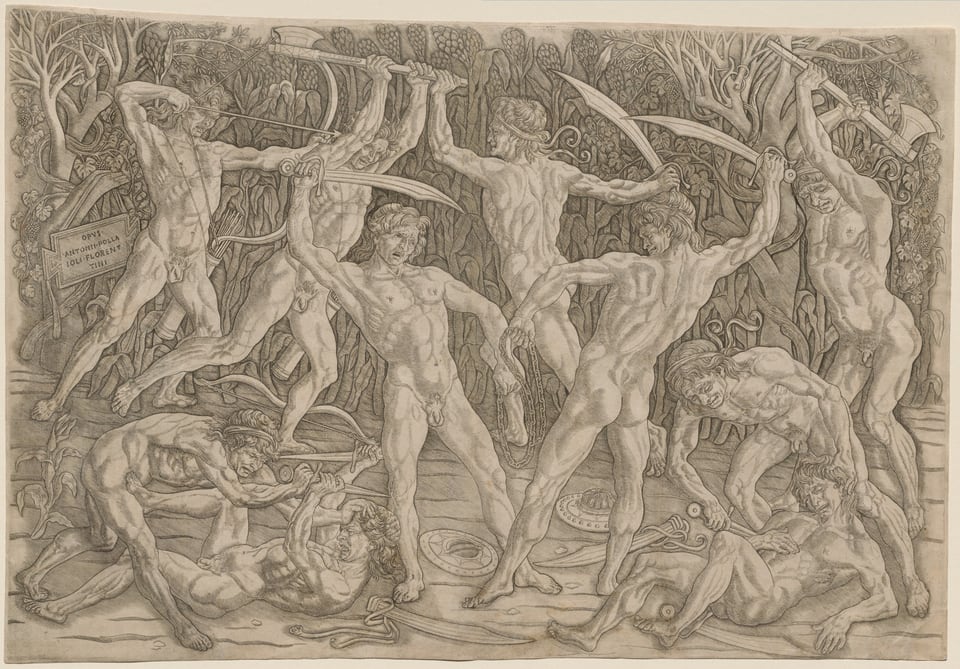
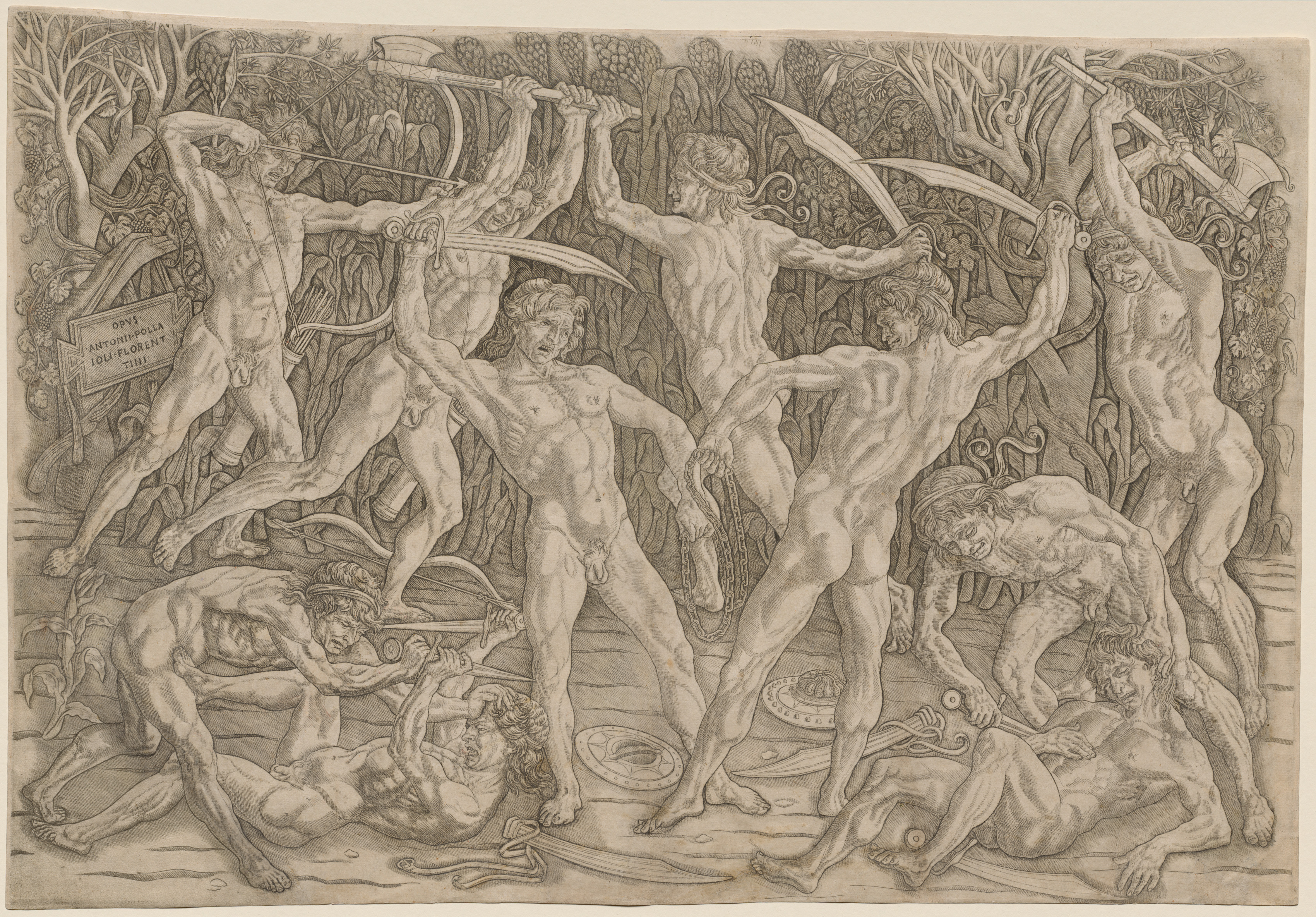
This engraving is one of the earliest Renaissance prints to portray the nude male body in action. Antonio del Pollaiuolo’s grimacing warriors appear like clones in different poses. More about this work
About this work
This engraving is one of the earliest Renaissance prints to portray the nude male body in action. Antonio del Pollaiuolo’s grimacing warriors appear like clones in different poses. The print may have functioned as a model for workshop apprentices studying human anatomy while learning to draw; however, the artist’s Latin signature suggests it also had an audience educated in literature. Art historians remain uncertain whether Pollaiuolo intended to depict a particular story or historical event. It is possible he created a deliberately ambiguous allegory that would appeal to patrons interested in interpreting symbols. For example, the continuous chain shared by the two central men could refer to an ancient idea that the body is the chain of the soul, only to be released in death.
Text from the Cleveland Museum of Art.
How it was made
- Engraving
- Lines cut directly into a metal plate with a steel burin, which makes them swell and taper. It took years to master, and for centuries it was how paintings travelled as pictures.
Antonio Pollaiuolo
Italian, 1431/32–1498 · Born in Florence; died in Rome.
Renaissance
European art from about 1400 to 1600, when painters rediscovered perspective and the classical past.
Rights and the museum’s record
Public domain. The Cleveland Museum of Art has dedicated this image to the public domain under CC0, so anyone may copy, adapt and use it, for any purpose, without asking. Our prints and files are reproductions made from the museum’s image; the museum doesn’t endorse them.
- Object number
- 1967.127
- Credit
- Courtesy of the Cleveland Museum of Art
- Type
- Department
- Prints
- Licence
- CC0 1.0 Universal
- Museum record
- See it on the museum’s site
Report this work
More by Antonio Pollaiuolo
All their works
Close in colour