Minerva Terrace, Yellowstone1872
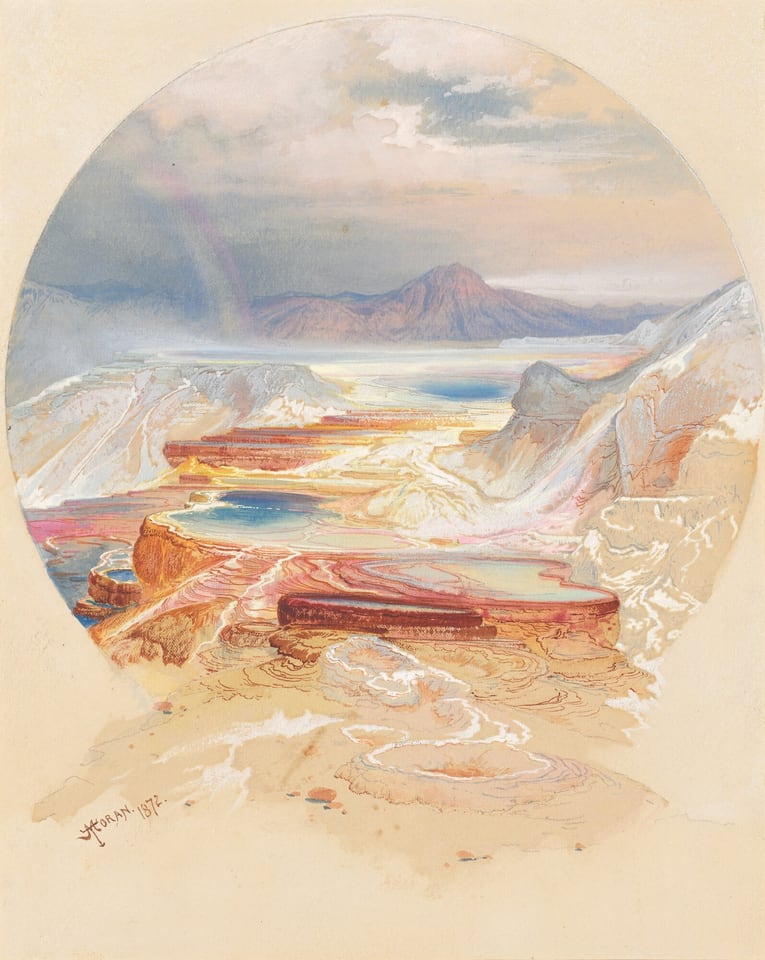
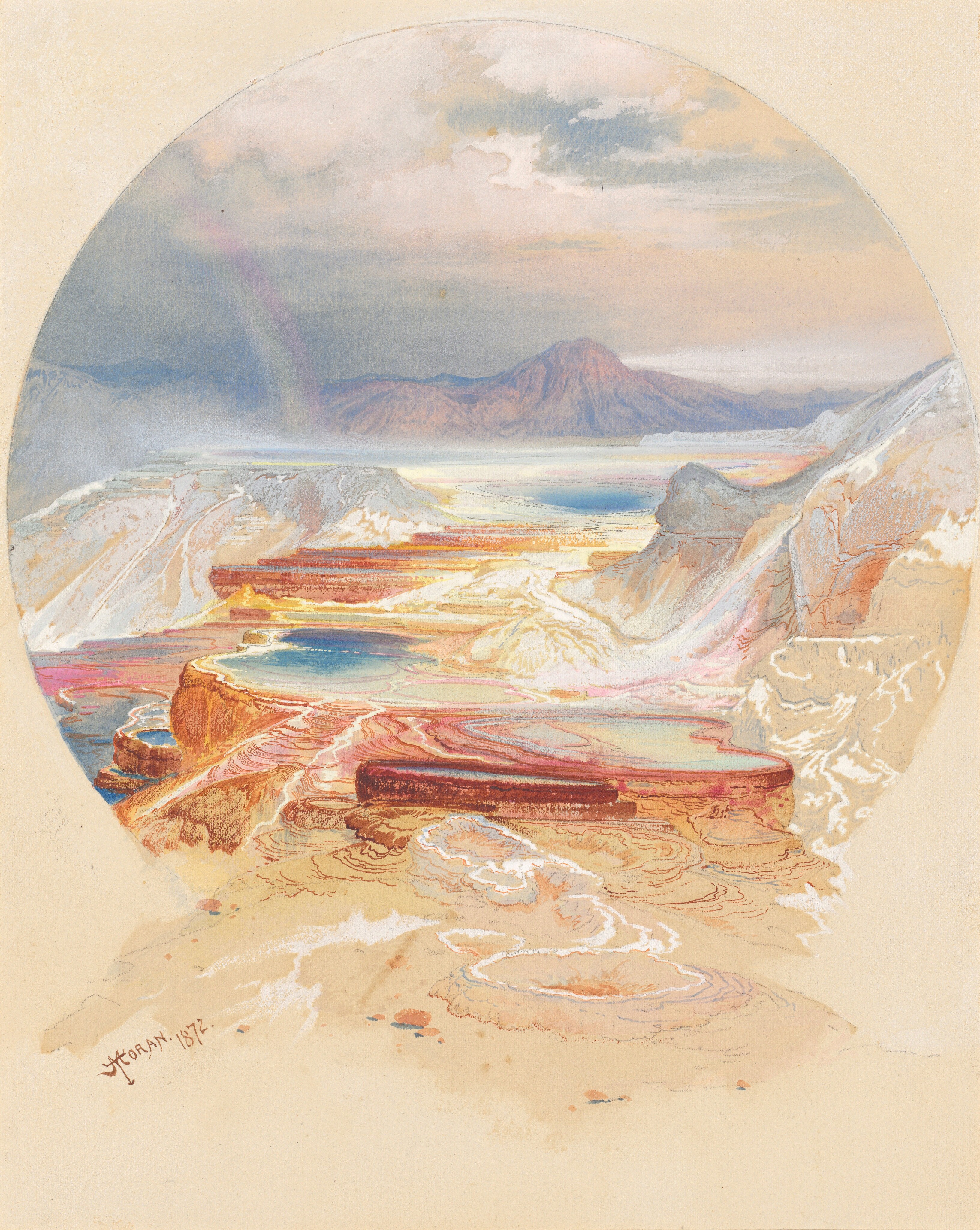
The colourful terraced pools of Mammoth Hot Springs, stained yellow, orange, red and blue by minerals, step down towards us beneath a distant purple peak and a faint rainbow. More about this work
About this work
The colourful terraced pools of Mammoth Hot Springs, stained yellow, orange, red and blue by minerals, step down towards us beneath a distant purple peak and a faint rainbow. Thomas Moran joined the 1871 government expedition led by Ferdinand Hayden to explore the Yellowstone region, and his watercolours, together with William Henry Jackson’s photographs, helped persuade Congress to establish Yellowstone as the first national park in 1872. Here he sets the view within a circle, as if seen through a lens.
Written by Ochre Editions.
What you’re looking at
This painting shows a view looking out over a vast landscape. Most of the painting is circular, with a small part of the bottom bleeding out of the circle towards us. The top third of the circle shows a mountain range with a large purple peak in the distance. In front of the mountain is a faint rainbow. A body of water flows from in front of the mountain to the bottom of the painting, weaving in between shorter white peaks. Towards the bottom, the water appears to flow into small, layered pools of various bright colors including yellow, orange, red, pink, blue, and teal. The sky is a light blue-gray color. The background of the painting outside of the circle is plain paper.
Description from the National Gallery of Art.
How it was made
- Opaque watercolour
- Watercolour made opaque with white or chalk and laid in flat, even layers. Persian and Indian painters ground their colours from minerals, applied them with the finest brushes and burnished the finished page.
- Watercolour
- Pigment in gum arabic, thinned with water and laid in transparent washes. Nothing white is painted: the light is the paper showing through.
- Graphite
- Pencil. Graphite has been used for drawing since the 1500s; in 1795 Nicolas-Jacques Conté mixed it with clay, so its hardness could be graded.
Thomas Moran
American, born England, 1837–1926
Moran came to Philadelphia from England as a child, trained as a wood engraver and largely taught himself to paint, deeply influenced by Turner’s work, which he studied in London. In 1871 he joined Ferdinand Hayden’s survey of Yellowstone, and his sketches and paintings from it helped persuade Congress to create the first national park in 1872. He returned to the American West many times, painting the Grand Canyon, the Tetons and Yosemite on a grand scale.
Written by Ochre Editions.
Hudson River School
American landscape painters of the mid-1800s who made wilderness their grand subject.
Rights and the museum’s record
Public domain. The National Gallery of Art has dedicated this image to the public domain under CC0, so anyone may copy, adapt and use it, for any purpose, without asking. Our prints and files are reproductions made from the museum’s image; the museum doesn’t endorse them.
- Object number
- 2012.93.2
- Credit
- Courtesy National Gallery of Art, Washington
- Type
- Drawing
- Licence
- CC0 1.0 Universal
- Museum record
- See it on the museum’s site
Report this work
More by Thomas Moran
All their works
Close in colour