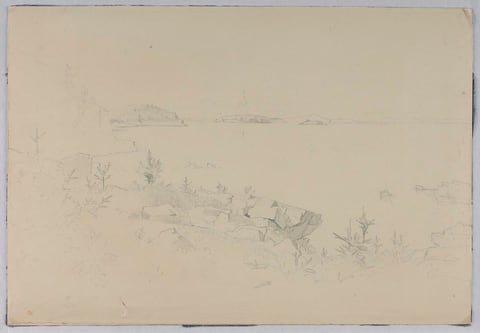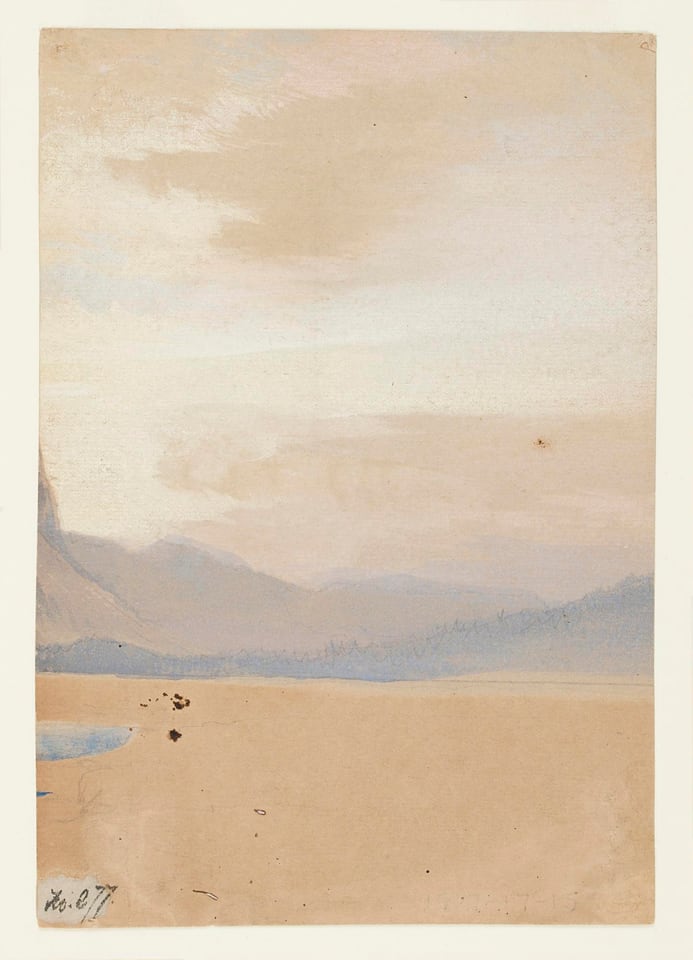
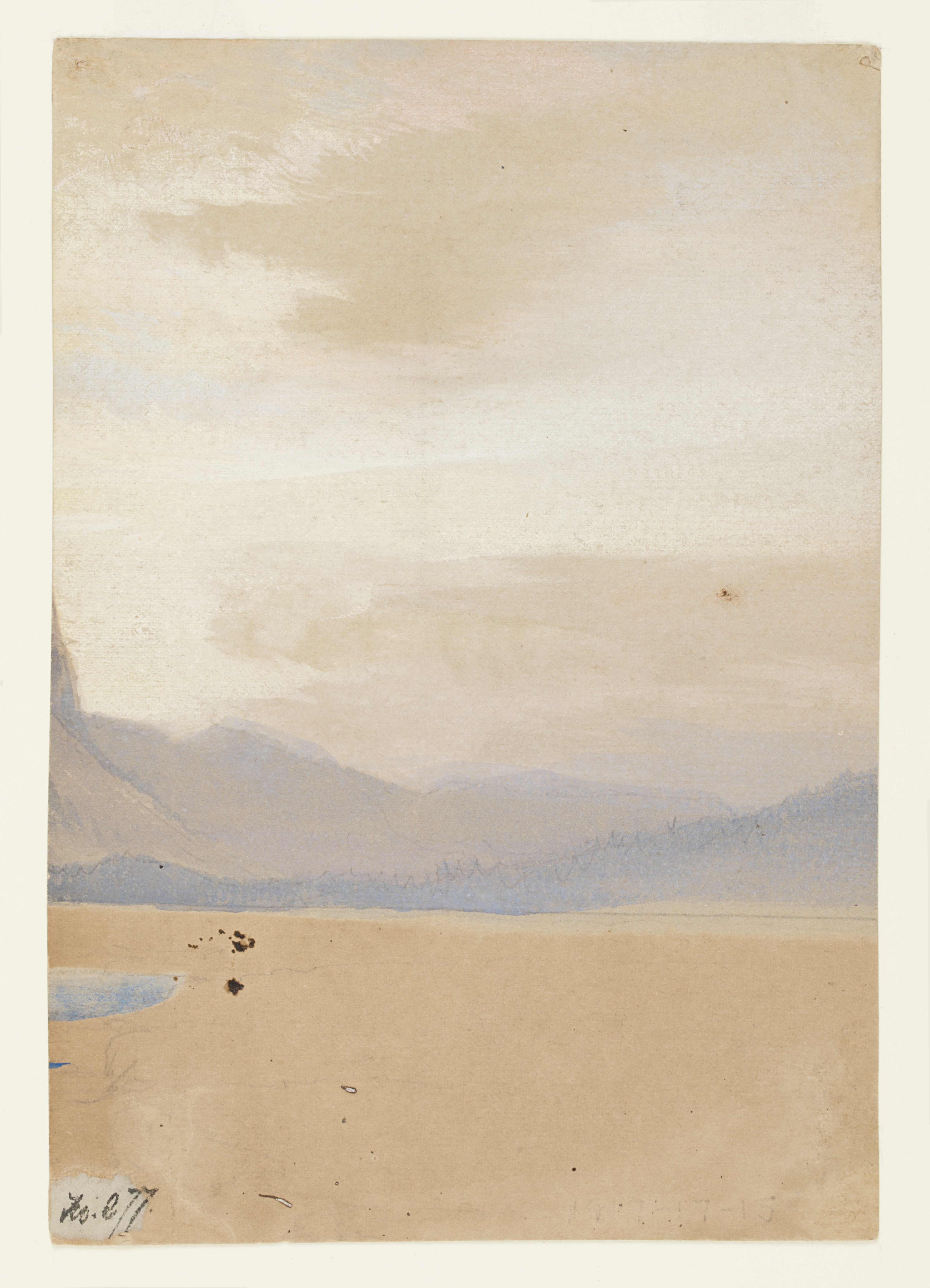
American Plains with Mountain Range in the Distancebefore 1872
Plains with mountain range in the distance. More about this work
About this work
Plains with mountain range in the distance.
Text from Cooper Hewitt, Smithsonian Design Museum.
What you’re looking at
AMERICAN PLAINS WITH MOUNTAIN RANGE IN THE DISTANCE
Description from Cooper Hewitt, Smithsonian Design Museum.
How it was made
- Watercolour
- Pigment in gum arabic, thinned with water and laid in transparent washes. Nothing white is painted: the light is the paper showing through.
- Graphite
- Pencil. Graphite has been used for drawing since the 1500s; in 1795 Nicolas-Jacques Conté mixed it with clay, so its hardness could be graded.
Thomas Moran
American, born England, 1837–1926
Moran came to Philadelphia from England as a child, trained as a wood engraver and largely taught himself to paint, deeply influenced by Turner’s work, which he studied in London. In 1871 he joined Ferdinand Hayden’s survey of Yellowstone, and his sketches and paintings from it helped persuade Congress to create the first national park in 1872. He returned to the American West many times, painting the Grand Canyon, the Tetons and Yosemite on a grand scale.
Written by Ochre Editions.
Hudson River School
American landscape painters of the mid-1800s who made wilderness their grand subject.
Rights and the museum’s record
Public domain. Cooper Hewitt, Smithsonian Design Museum has dedicated this image to the public domain under CC0, so anyone may copy, adapt and use it, for any purpose, without asking. Our prints and files are reproductions made from the museum’s image; the museum doesn’t endorse them.
- Object number
- 1917-17-15-a
- Credit
- Courtesy of Cooper Hewitt, Smithsonian Design Museum
- Type
- Drawing
- Department
- Cooper Hewitt, Smithsonian Design Museum
- Licence
- CC0 1.0 Universal
- Museum record
- See it on the museum’s site
Report this work
More by Thomas Moran
All their works
Close in colour