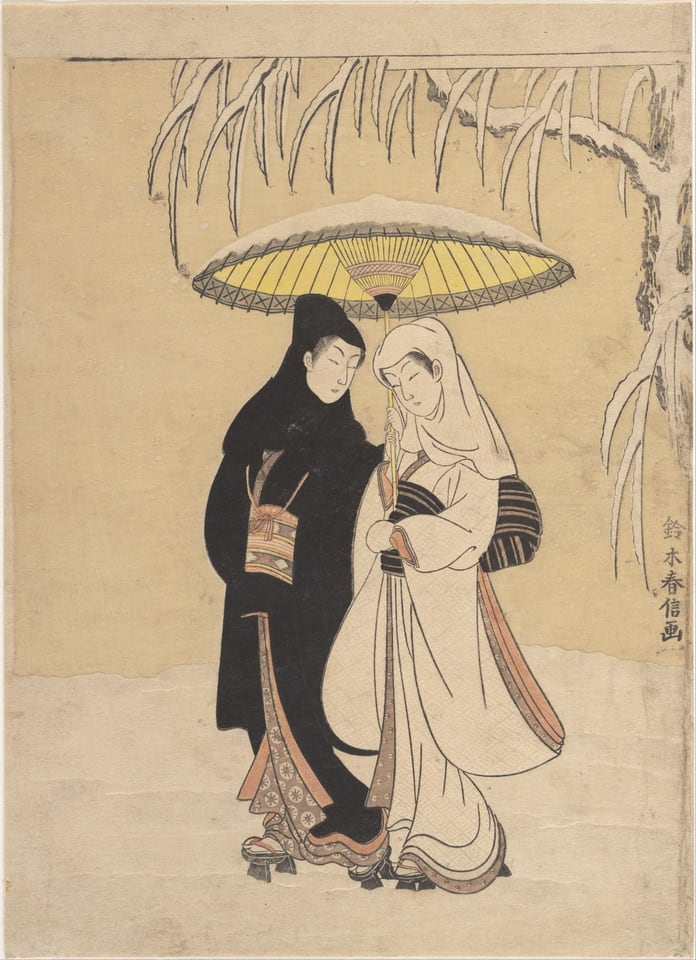
Lovers Walking in the Snow (Crow and Heron)1764–72
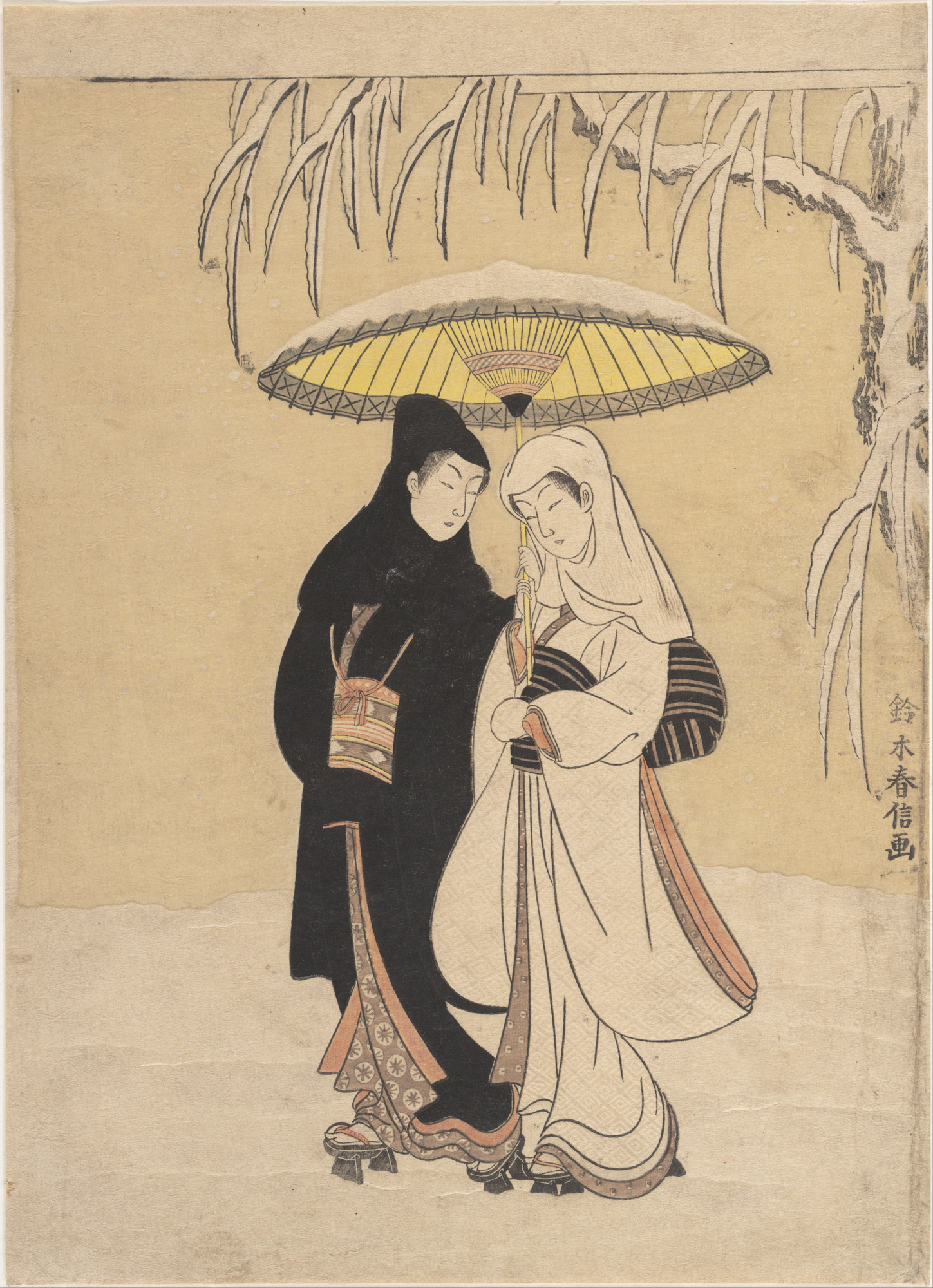
A young man and woman share a single umbrella as they walk through falling snow, one dressed in black and the other in white, which gives the print its nickname, Crow and Heron. More about this work
About this work
A young man and woman share a single umbrella as they walk through falling snow, one dressed in black and the other in white, which gives the print its nickname, Crow and Heron. Suzuki Harunobu led the first designers of full-colour woodblock prints, known as brocade pictures, from about 1765, and he favoured slender, delicate figures and poetic subjects. Here the white snow and garments are left as bare paper, enhanced by blind embossing that raises the texture of the paper itself.
Written by Ochre Editions.
How it was made
- Colour woodblock print
- In Japan these were a team effort. The artist drew the design, a carver cut it into cherry-wood blocks, one block for each colour, and a printer brushed on the pigment and rubbed each sheet by hand. Full-colour prints of this kind were called nishiki-e, “brocade pictures”, from the 1760s on.
Suzuki Harunobu
Japanese, 1725–1770
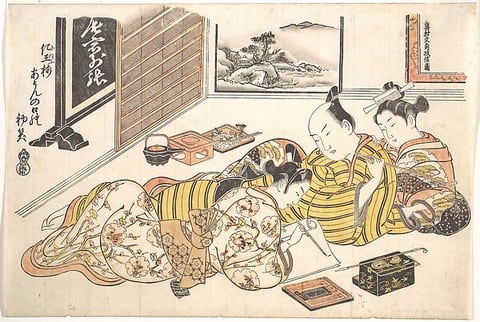
Harunobu was the first great master of the full-colour woodblock picture, or nishiki-e, which developed in Edo around 1765 out of privately commissioned calendar designs. Working mostly in the small chūban format, he favoured slender, youthful figures in intimate scenes, often with subtle allusions to classical poetry. In the few years before his death he produced hundreds of designs, and his delicate style shaped the work of a generation.
Written by Ochre Editions.
Ukiyo-e
Japanese woodblock prints of the floating world: actors, courtesans, landscapes and the sea.
Rights and the museum’s record
Public domain. The Met has dedicated this image to the public domain under CC0, so anyone may copy, adapt and use it, for any purpose, without asking. Our prints and files are reproductions made from the museum’s image; the museum doesn’t endorse them.
- Object number
- JP2453
- Credit
- Courtesy of The Metropolitan Museum of Art
- Type
- Prints
- Department
- Asian Art
- Licence
- CC0 1.0 Universal
- Museum record
- See it on the museum’s site
Report this work
More by Suzuki Harunobu
All their works
Close in colour