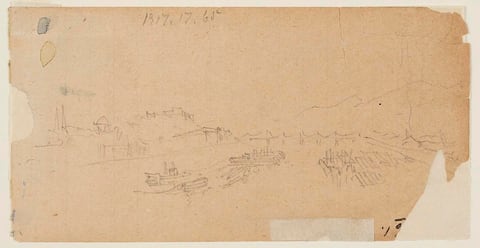
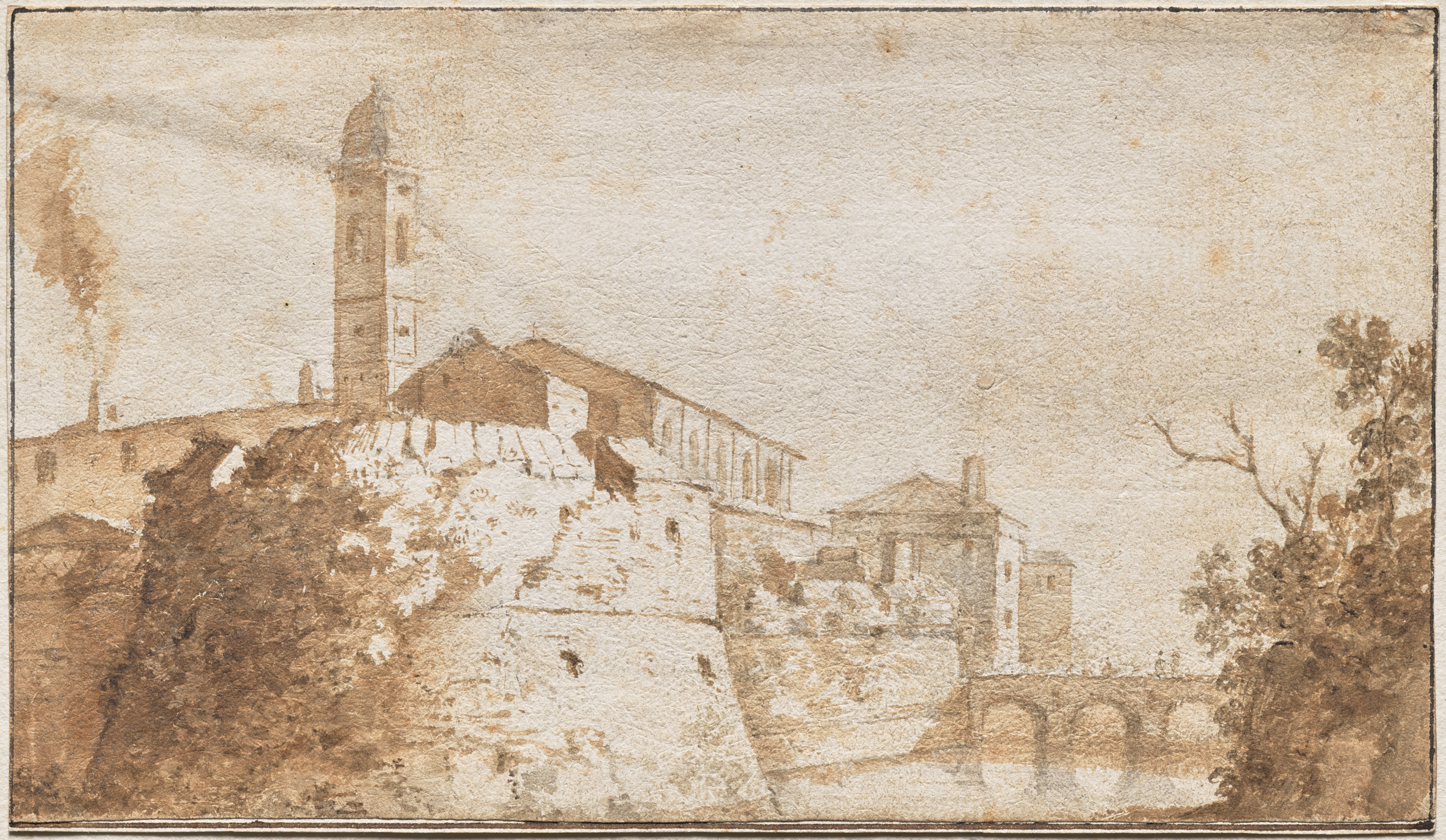
A View of Bracciano with the Church of S. Maria Assuntac. 1619–33
In the early 1600s, artists from Northern Europe began to take long trips to Italy as part of their artistic training. More about this work
About this work
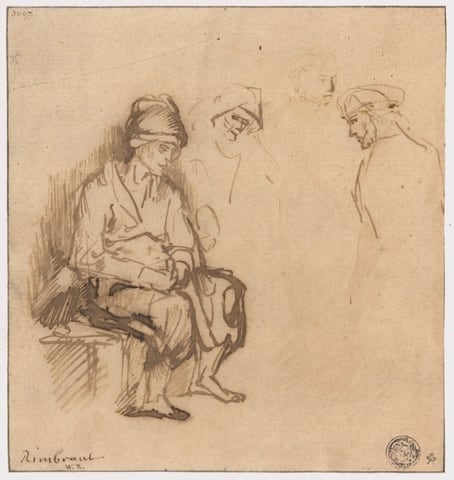
In the early 1600s, artists from Northern Europe began to take long trips to Italy as part of their artistic training. Bartholomeus Breenberg traveled to Italy around 1620 and probably stayed for at least 12 years. While there, he sketched ancient ruins and the countryside, features he would use in his paintings when he returned to Amsterdam in the 1630s. The area around the Lago di Bracciano, a volcanic lake northwest of Rome, was home to several medieval villages that provided charming vistas for artists. In his view, Breenberg emphasized the crumbling turret of a medieval castle in Bracciano in front of the ordered, linear outline of the Church of Santa Maria Assunta beyond. Combining gray and brown ink washes to plot gradations in tone, he created vivid contrasts of light and shade, capturing the effects of the bright Italian sunshine.
Text from the Cleveland Museum of Art.
How it was made
- Graphite
- Pencil. Graphite has been used for drawing since the 1500s; in 1795 Nicolas-Jacques Conté mixed it with clay, so its hardness could be graded.
- Laid paper
- Handmade on a mould of close-set wires, which leave fine parallel lines you can see when the sheet is held to the light.
Bartholomeus Breenberg
Dutch, 1599–1657
Dutch Golden Age
Seventeenth-century painting from the Dutch Republic: still lifes, interiors, portraits and flat, wide skies.
Rights and the museum’s record
Public domain. The Cleveland Museum of Art has dedicated this image to the public domain under CC0, so anyone may copy, adapt and use it, for any purpose, without asking. Our prints and files are reproductions made from the museum’s image; the museum doesn’t endorse them.
- Object number
- 2020.127
- Credit
- Courtesy of the Cleveland Museum of Art
- Type
- Drawing
- Department
- Drawings
- Licence
- CC0 1.0 Universal
- Museum record
- See it on the museum’s site
Report this work
Close in colour