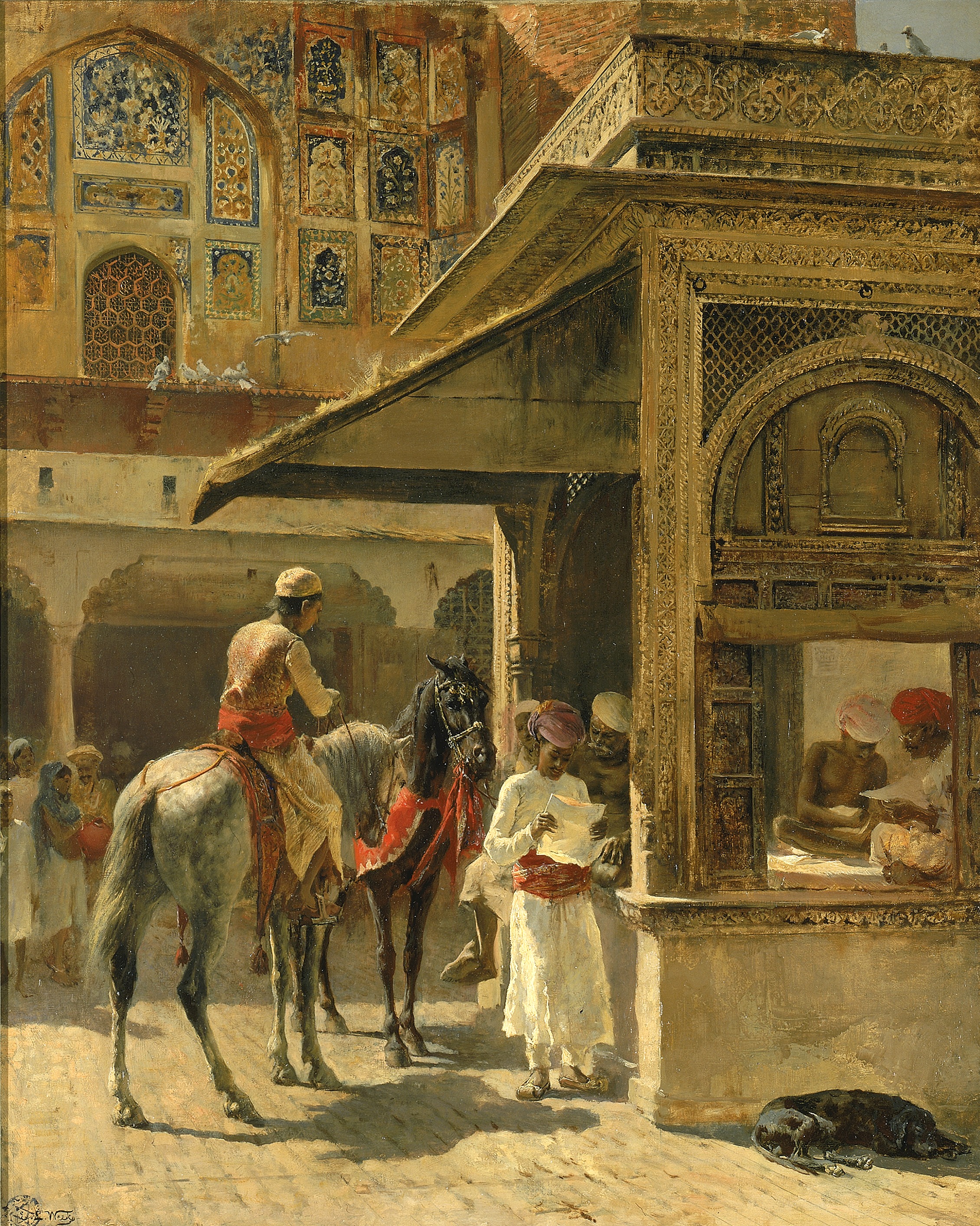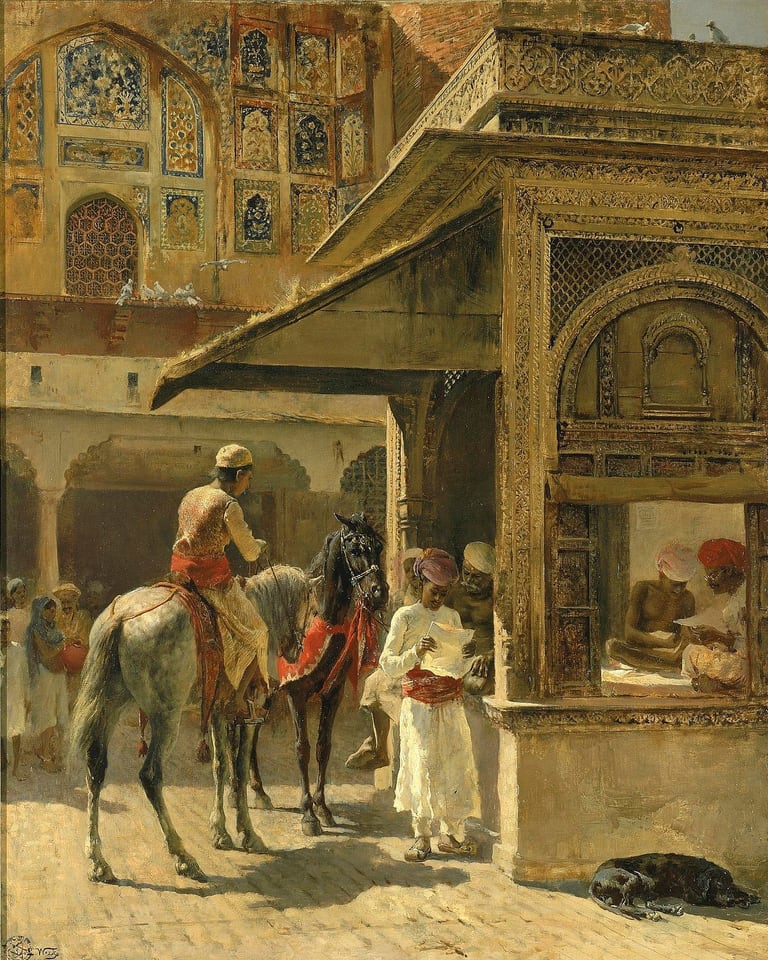
Hindu Merchantsca. 1885
Edwin Lord Weeks traveled to India in 1883, following many years of travel throughout North Africa. More about this work
About this work
Edwin Lord Weeks traveled to India in 1883, following many years of travel throughout North Africa. A photographer as well as a painter, he wrote in his letters that he wandered the streets by day and developed his photographs at night. He reveled in the local culture, paying particular attention to the details of dress and customs. He was less interested in royalty than in the everyday lives of people he encountered in the streets. Weeks relied on his photographs to supply the rich details of Indian architecture: elaborately carved cornices and arches filled with polychromed geometric and floral designs speak to the visual sophistication of Indian civilization. The lasting impact of his paintings was to bring alive a culture with which most of his American patrons were unfamiliar.
Text from the Smithsonian American Art Museum.
How it was made
- Oil paint
- Pigment ground in a drying oil, usually linseed. It dries slowly, so painters could blend on the canvas, build up thin translucent glazes, and rework a picture over weeks. Canvas replaced wooden panels in the 1500s because it is lighter and can be rolled.
Edwin Lord Weeks
born Boston, MA 1849-died Paris, France 1903
Rights and the museum’s record
Public domain. The Smithsonian American Art Museum has dedicated this image to the public domain under CC0, so anyone may copy, adapt and use it, for any purpose, without asking. Our prints and files are reproductions made from the museum’s image; the museum doesn’t endorse them.
- Object number
- 1924.7.1
- Credit
- Courtesy of the Smithsonian American Art Museum
- Type
- Painting
- Department
- Painting and Sculpture
- Licence
- CC0 1.0 Universal
- Museum record
- See it on the museum’s site