Jan van der Straet, called Stradanus
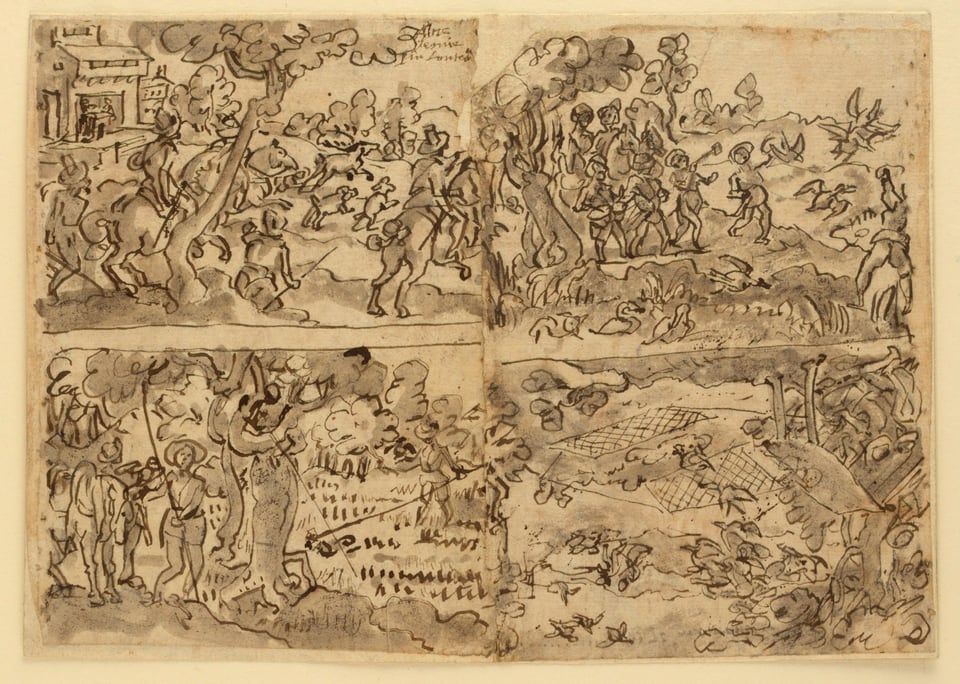
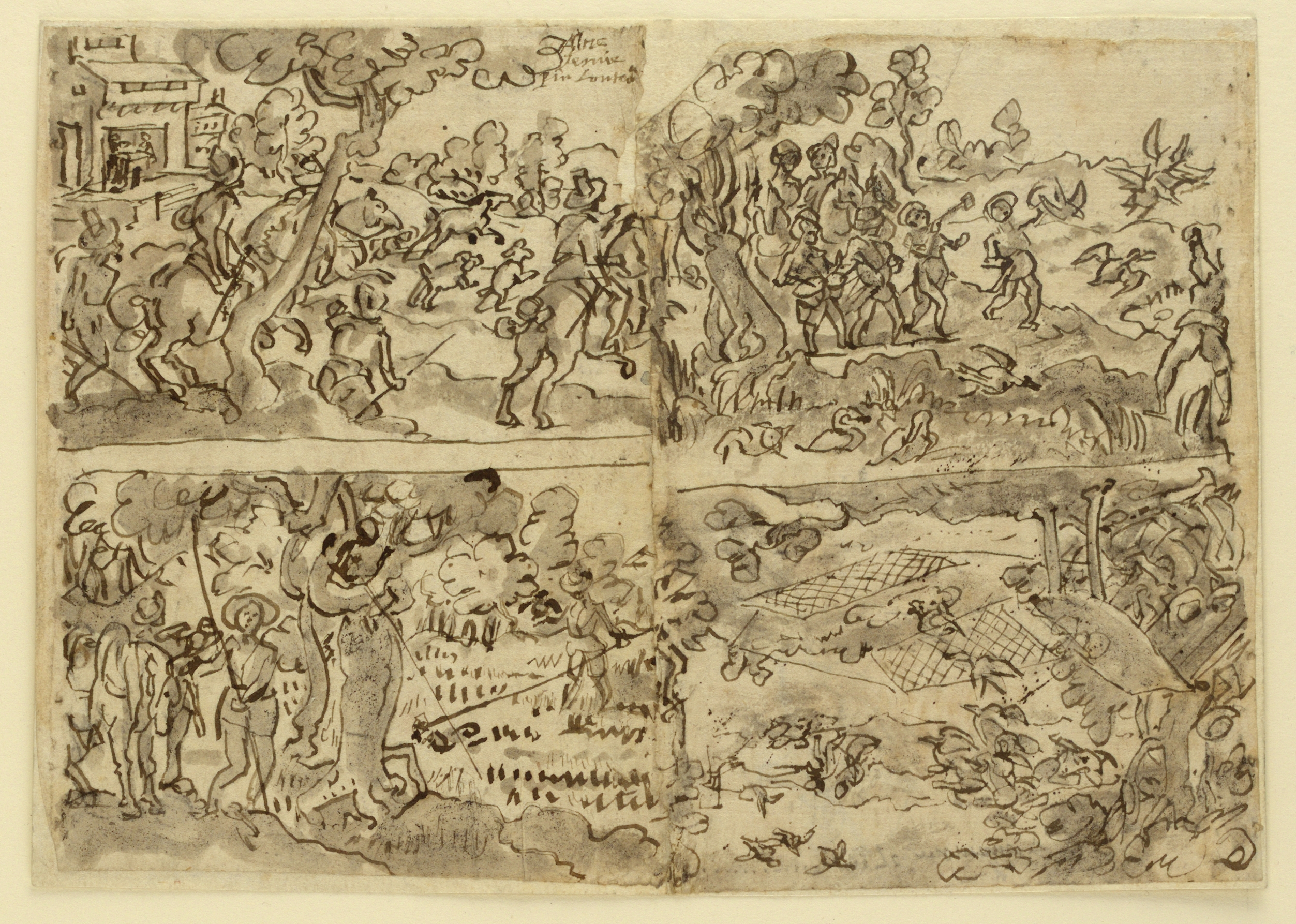
Goose and Duck Hunt with Falcons [above right]; Goose Hunt [below right]ca. 1596-99
Recto, above: View of a landscape with a duckpond in the foreground. In the background, hunters use falcons to catch ducks and geese. More about this work
About this work
Recto, above: View of a landscape with a duckpond in the foreground. In the background, hunters use falcons to catch ducks and geese.
Text from Cooper Hewitt, Smithsonian Design Museum.
What you’re looking at
1901-39-151-a: DEER HUNT WITH HOUNDS [ABOVE]; SKYLARK HUNT WITH FALCONS [BELOW]; 1901-39-151-b: GOOSE AND DUCK HUNT WITH FALCONS [ABOVE RIGHT]; GOOSE HUNT [BELOW RIGHT]
Description from Cooper Hewitt, Smithsonian Design Museum.
How it was made
- Chalk
- Natural black, red and white chalks. Used together on toned paper they could give the warmth of flesh with very little effort, and they were favourites for studies from life.
- Pen and ink
- Drawn with a quill or reed pen, often with wash added by brush to model light and shadow.
- Laid paper
- Handmade on a mould of close-set wires, which leave fine parallel lines you can see when the sheet is held to the light.
Jan van der Straet, called Stradanus
Flemish, 1523–1605
Jan van der Straet, known as Stradanus, trained in Antwerp before settling in Florence around 1550, where he worked for the Medici under Giorgio Vasari on the decoration of the Palazzo Vecchio. He designed tapestries for the Medici factory and many drawings for engravers in Antwerp, including the Nova Reperta, celebrating modern inventions, and the Venationes, a large series of hunting scenes. He spent the rest of his life in Florence.
Written by Ochre Editions.
Rights and the museum’s record
Public domain. Cooper Hewitt, Smithsonian Design Museum has dedicated this image to the public domain under CC0, so anyone may copy, adapt and use it, for any purpose, without asking. Our prints and files are reproductions made from the museum’s image; the museum doesn’t endorse them.
- Object number
- 1901-39-151-b
- Credit
- Courtesy of Cooper Hewitt, Smithsonian Design Museum
- Type
- Drawing
- Department
- Cooper Hewitt, Smithsonian Design Museum
- Licence
- CC0 1.0 Universal
- Museum record
- See it on the museum’s site
Report this work
More by Jan van der Straet, called Stradanus
All their works
Close in colour