Skip to content
Ochre Editions
ArtArtistsCollectionsGalleriesDrops
SearchSign inCart (0)
The galleries · Style galleries

The Northern Renaissance

Dürer's prints, Holbein's portraits and the art of northern Europe in the 1500s.

62 works · hang 5145 ·

Share The Northern Renaissance, in the galleries

The rooms are imagined; every work on their walls is real.

Walk this roomRehang this room

First room, north wall

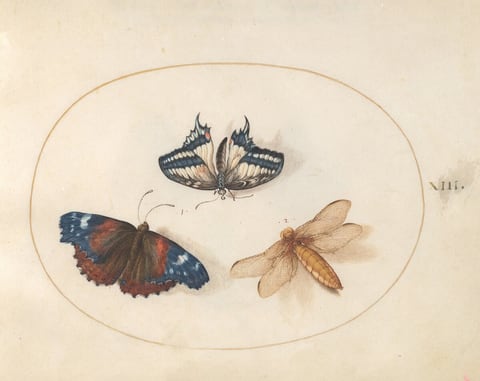
  1. Three insects are depicted in the image: a butterfly with dark blue and red wings on the bottom left, a larger butterfly with white, black, and blue patterns at the top center, and a dragonfly with brown and gold tones on the bottom right. The color palette includes rich blues, reds, browns, and golds against a neutral background. The central butterfly is positioned higher than the other two insects, with the left butterfly and right dragonfly symmetrically arranged below.
    Plate 13: Yellow Swallowtail and Red Admiral Butterflies with a Dragonfly (Broad-Bodied Chaser?)Joris Hoefnagel, c.1575/1590sCourtesy National Gallery of Art, Washington
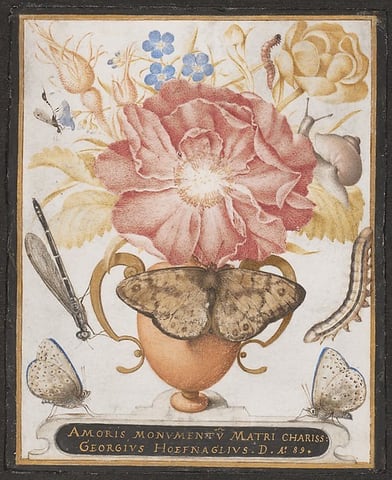
  2. Still Life with Flowers, a Snail and Insects, by Joris Hoefnagel, 1589
    Still Life with Flowers, a Snail and InsectsJoris Hoefnagel, 1589Courtesy of The Metropolitan Museum of Art
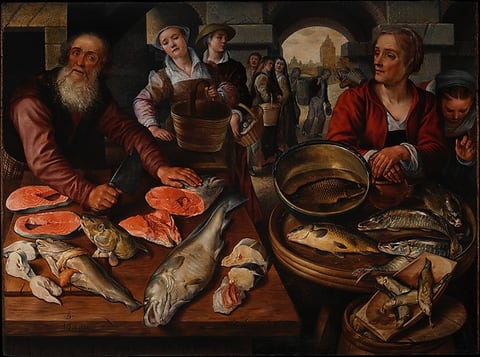
  3. Fish Market, by Joachim Beuckelaer, 1568
    Fish MarketJoachim Beuckelaer, 1568Courtesy of The Metropolitan Museum of Art

First room, south wall
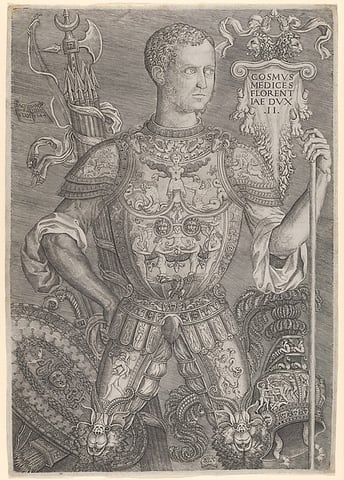
  1. Portrait of Cosimo de' Medici in full armor, his left hand resting on a staff, by Niccolò della Casa, 1544
    Portrait of Cosimo de' Medici in full armor, his left hand resting on a staffNiccolò della Casa, 1544Courtesy of The Metropolitan Museum of Art
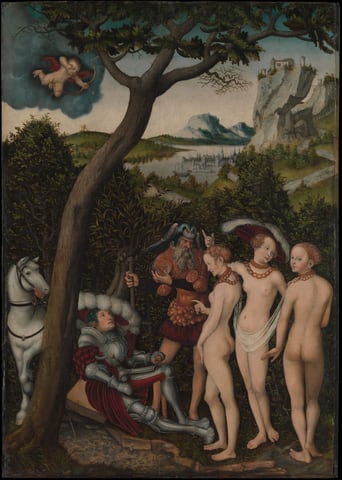
  2. The Judgment of Paris, by Lucas Cranach the Elder, ca. 1528
    The Judgment of ParisLucas Cranach the Elder, ca. 1528Courtesy of The Metropolitan Museum of Art
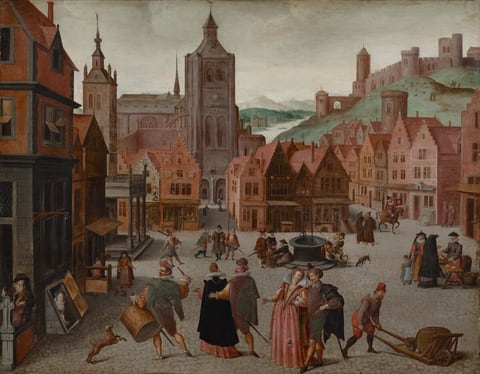
  3. We look slightly down onto a scene with people gathering in small groups in a cobblestone town square lined with rows of brick, wood, and stone buildings, many with stepped rooflines, in this horizontal painting. Singly or in pairs or trios, men, women, and children walk across the square, move goods around, or talk to merchants. All the people have light skin. Many of the men have mustaches and wear hats, and some carry swords. In tones of black, olive green, brick red, and plum purple, they wear hip-length cloaks over jackets, with white collars or ruffs and brass buttons, and knee-length breeches over yellow or black stockings. The women all wear long dresses in salmon pink, coral red, or golden yellow, with white collars or ruffs, and many wear black, ankle-length cloaks, some with hoods. Closest to us, a sumptuously dressed man and woman walk toward us while another similarly elegant couple walks away. Also facing away from us, to our left, a man wearing a large drum strapped around his waist raises one drumstick as he looks over his left shoulder. Nearby, a woman peers up out of a cellar door that opens on an angle to the street. More couples gather around a well across the square, and two women and a child talk to a third woman selling wares at a wooden table to our right. A pair of hooded priests or monks walk near a man blowing on a trumpet on horseback. The buildings are mostly shades of brick red and brown, and most have three or four stories with steeply pitched roofs. More people walk along side streets leading off the main square. One gap in the buildings across from us leads to a nickel-gray stone church with a pointed spire and square tower. A grassy, green hill rises steeply beyond the buildings to our right, leading down to a waterway that extends up and away into the distance. A few boats float in the water, which reflects the leaden-gray sky. Beyond the town square, a brown stone structure like a fortress with turret towers and crenellated walls looms along the ridge of the hill to our right. Tiny in scale, people on horseback and tending sheep dot the hillside below. The date “1590” is painted on the front of one of the buildings across from us while another date, “1597,” is painted on the end of a short wall near the lower left corner.
    The Marketplace in Bergen op ZoomAbel Grimmer, probably 1590 and 1597Courtesy National Gallery of Art, Washington
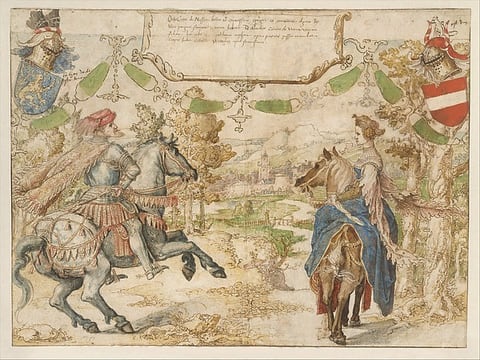
  4. Otto, Count of Nassau and his Wife Adelheid van Vianen, by Bernard van Orley, 1530–35
    Otto, Count of Nassau and his Wife Adelheid van VianenBernard van Orley, 1530–35Courtesy of The Metropolitan Museum of Art

Second room, south wall
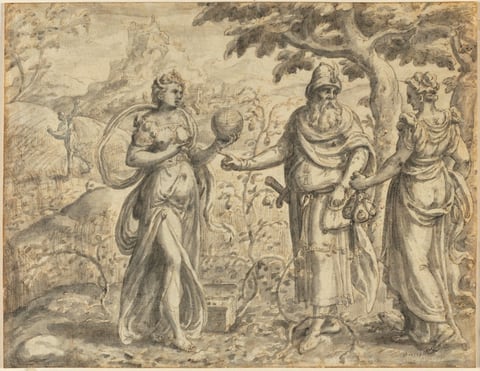
  1. The Seed Received among the Thorns, from the Parable of the Sower, by Gerard P. van Groningen, c. 1573
    The Seed Received among the Thorns, from the Parable of the SowerGerard P. van Groningen, c. 1573Courtesy of the Cleveland Museum of Art
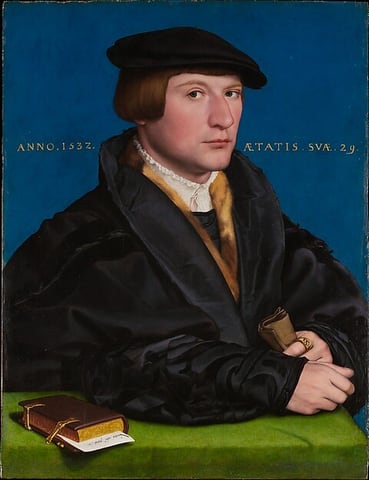
  2. Hermann von Wedigh III (died 1560), by Hans Holbein the Younger, 1532
    Hermann von Wedigh III (died 1560)Hans Holbein the Younger, 1532Courtesy of The Metropolitan Museum of Art
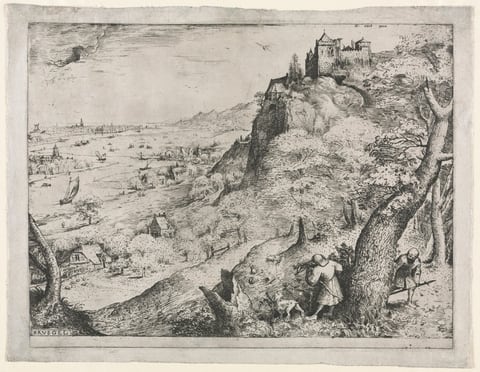
  3. The Rabbit Hunt, by Pieter Bruegel, 1560
    The Rabbit HuntPieter Bruegel, 1560Courtesy of the Cleveland Museum of Art

Second room, north wall
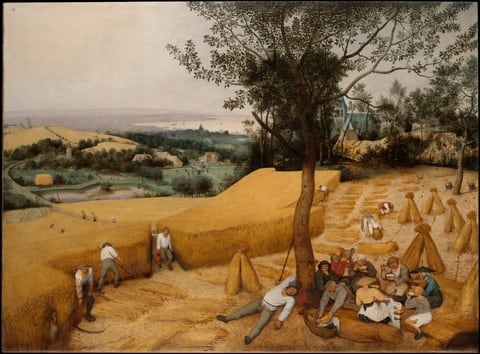
  1. The Harvesters, by Pieter Bruegel, 1565
    The HarvestersPieter Bruegel, 1565Courtesy of The Metropolitan Museum of Art
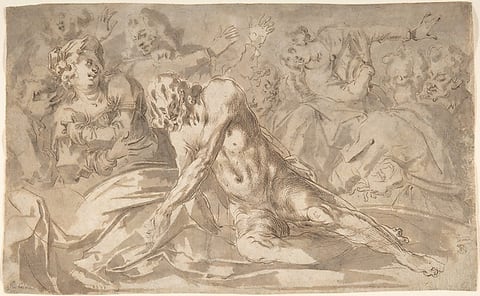
  2. The Raising of Lazarus, by Jacques Bellange, ca. 1606–8
    The Raising of LazarusJacques Bellange, ca. 1606–8Courtesy of The Metropolitan Museum of Art
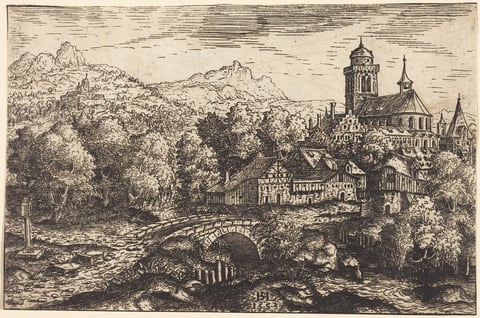
  3. The image features a landscape view of a medieval village scene. It includes a stone bridge over a river, buildings, a church with a tower, trees, hills, mountains, and cloudy sky. The image is depicted in intricate detail using a monochromatic palette, focusing on contrasts of light and shadow.
    Mountainous Landscape with a VillageHanns Lautensack, 1553Courtesy National Gallery of Art, Washington

Third room, north wall
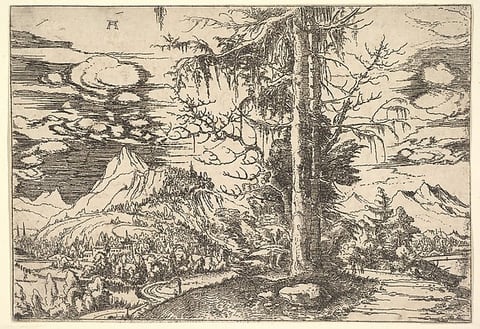
  1. Landscape with a Double Spruce, by Albrecht Altdorfer, ca. 1521–22
    Landscape with a Double SpruceAlbrecht Altdorfer, ca. 1521–22Courtesy of The Metropolitan Museum of Art
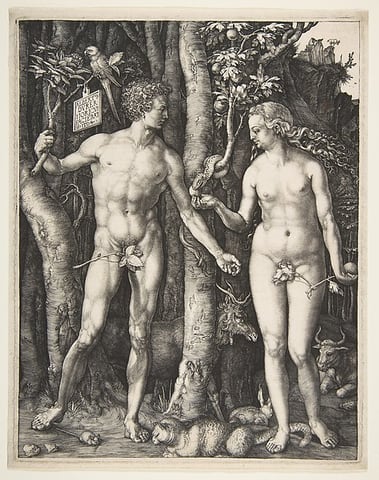
  2. Adam and Eve, by Albrecht Dürer, 1504
    Adam and EveAlbrecht Dürer, 1504Courtesy of The Metropolitan Museum of Art
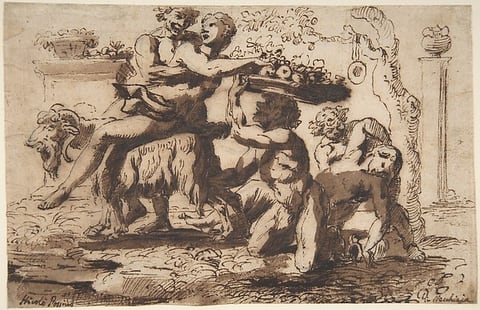
  3. Bacchanal, by Nicolas Poussin, ca. 1635–36
    BacchanalNicolas Poussin, ca. 1635–36Courtesy of The Metropolitan Museum of Art

Walk on

  • The Northern Renaissance, room 2
  • More by Nicolas Poussin 6 works
  • 16th-century France 8 works
Ochre Editions

The world's museums, on your wall. Every work here is a reproduction of a public-domain original, credited to the museum that holds it.

Shop

All artCollectionsLimited dropsPrints and framing

Help

Find an orderShippingReturnsVerify a certificate

About

About Ochre EditionsMuseum creditsFor agentsDevelopers

Legal

Terms of UseTerms of SaleLimited Editions and CertificatesPrivacy PolicyCookie PolicyAcceptable Use PolicyAgent & API TermsCopyright and DMCA PolicyPrinting Your Own PhotoVulnerability Disclosure PolicyAccessibility StatementOpen-Access Credits
© 2026 Ochre EditionsPrices in US dollars. Prints ship within the United States.