Skip to content
Ochre Editions
ArtArtistsCollectionsGalleriesDrops
SearchSign inCart (0)
The galleries · Style galleries

The Italian Renaissance

Florence, Venice and Rome from 1400 to 1600: perspective, anatomy and the classical past.

61 works · hang 9523 ·

Share The Italian Renaissance, in the galleries

The rooms are imagined; every work on their walls is real.

Walk this roomRehang this room

First room, north wall

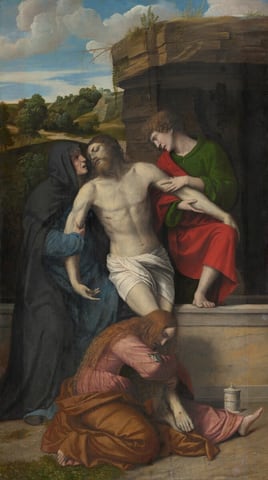
  1. Two women and a man support the gray, lifeless body of a nearly nude man along a stone ledge in this vertical painting. The people have pale skin, except for the dead man at the center, Jesus, who has ash-white skin with dark shadows around his closed eyes. He has a long straight nose, and his lips are slightly parted. He has a brown beard, and his long, wavy hair falls away from his face. A white cloth wraps across his hips, and blood trickles from a gash over his right ribs and holes in his feet. A woman and man prop him up on either side, each holding Jesus by a limp arm, and each has a faint, gold halo encircling their heads. To our left, the woman holds her face close to his, her brows deeply furrowed and her mouth wide open, teeth showing. Her forehead, chin, and neck are covered by a white veil, worn under navy-blue cloak that covers her head and body. The cloak falls open over one arm and a bent knee to reveal her long-sleeved, lighter blue dress. On Jesus’s other side, a cleanshaven man with curly brown hair holds Jesus’s arm with both hands. The man’s eyes squint with tears as he tips his head toward Jesus. His pink lips are parted, and the corner of the mouth we can see is pulled down. He wears an emerald-green, long-sleeved tunic under a vivid red cloth that wraps around his right arm, waist, and left leg. The fourth and final person is a woman sitting on the ground, her arms wrapped tightly around Jesus’s crossed ankles. She sits with one foot tucked under her body and the other leg out straight. Waist-length, wavy, auburn-brown hair falls freely over her shoulders and across her face, but we can see her downturned, open mouth and nearly closed eyes. She wears a rose-pink dress, cinched at the waist. A brown cloth wraps around her waist and right leg. A cylindrical, lidded, white jar sits on the dirt ground nearby. The group is arranged in front a thigh-high stone ledge, except for the man in green and red, who steps into what is presumably the coffin. A rocky outcropping to our right has a cave-like opening with grasses and growth along the top. The landscape beyond has a dirt path winding between pine-green hills dotted with trees. Two slate-blue buildings perch atop one hill. White clouds float across the blue sky above.
    PietàMoretto da Brescia, 1520sCourtesy National Gallery of Art, Washington
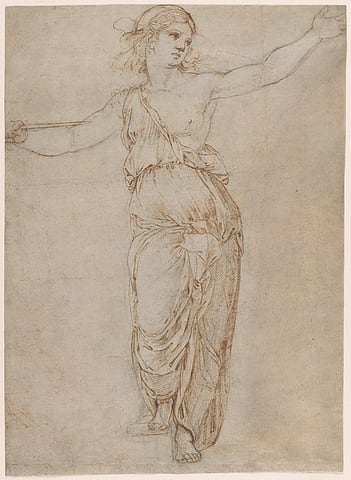
  2. Lucretia, by Raphael, 1508–10
    LucretiaRaphael, 1508–10Courtesy of The Metropolitan Museum of Art
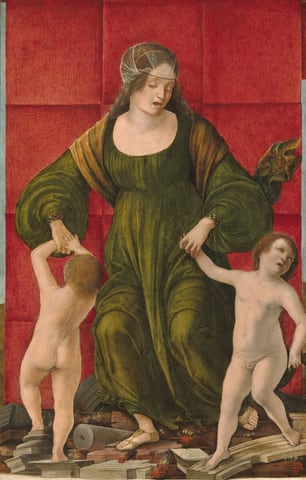
  3. A woman holds the hands of two nude children in front of a crimson-red cloth in this vertical painting. All three have pale skin and brown hair. The woman wears a forest-green dress with voluminous sleeves and a gauzy white headdress that wraps around her hair and is fastened with a band across her forehead. She stands crouching with one foot extended slightly forward in a sandal, surrounded by broken chunks of masonry and bits of burning logs. Her body faces us but she turns her head to the right. Her mouth is wide open, and her eyes cut back to our left. The woman clutches the children’s hands in both of her own. The child to our left turns away from us and reaches one hand up to touch the back of the woman’s hand. The child on the right twists away from the woman, eyes squinted up and to the right and mouth open. Behind them, fold lines create a grid across the red cloth. Slivers of grass and blue sky line each side of the composition.
    The Wife of Hasdrubal and Her ChildrenErcole de' Roberti, c. 1490/1493Courtesy National Gallery of Art, Washington

First room, south wall
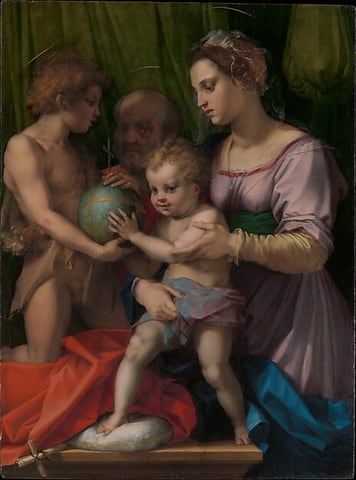
  1. The Holy Family with the Young Saint John the Baptist, by Andrea del Sarto, ca. 1528
    The Holy Family with the Young Saint John the BaptistAndrea del Sarto, ca. 1528Courtesy of The Metropolitan Museum of Art
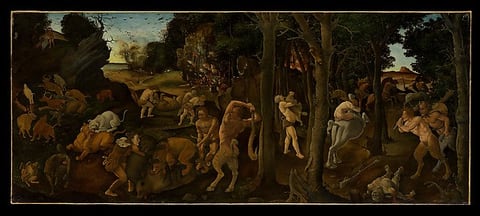
  2. A Hunting Scene, by Piero di Cosimo (Piero di Lorenzo di Piero d'Antonio), ca. 1494–1500
    A Hunting ScenePiero di Cosimo (Piero di Lorenzo di Piero d'Antonio), ca. 1494–1500Courtesy of The Metropolitan Museum of Art

Second room, south wall
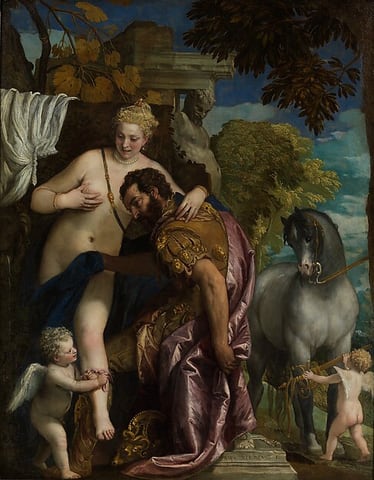
  1. Mars and Venus United by Love, by Paolo Veronese (Paolo Caliari), 1570s
    Mars and Venus United by LovePaolo Veronese (Paolo Caliari), 1570sCourtesy of The Metropolitan Museum of Art
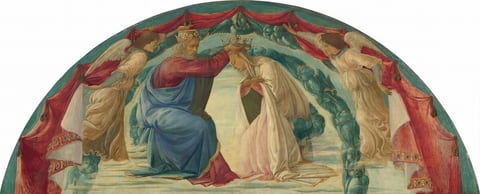
  2. In a wide, arched panel, a bearded man wearing a crown places another crown on the head of a woman. To our right, the woman bows her head with her eyes nearly closed and crosses her wrists over her chest. A white cloak covers her head, drapes over her shoulders, and pools in deep folds around her feet. The cloak is lined with pine green, and she wears a shell-pink dress. To our left, the man has shoulder-length, curly gray hair and a beard. His robe is dark rose pink, and the cloak is azure blue lined with pine green. Two winged angels have brown hair, short, white wings, and wear voluminous white robes. They stand to either side of the man and woman and hold up a swag of raspberry-red cloth hung with gold tassels. All the people have pale, peachy skin. Winged baby heads encircled with gold rays create an arch behind the man and woman, who sit on clouds. The background is pale blue sky.
    The Coronation of the VirginFilippino Lippi, c. 1475Courtesy National Gallery of Art, Washington

Second room, north wall
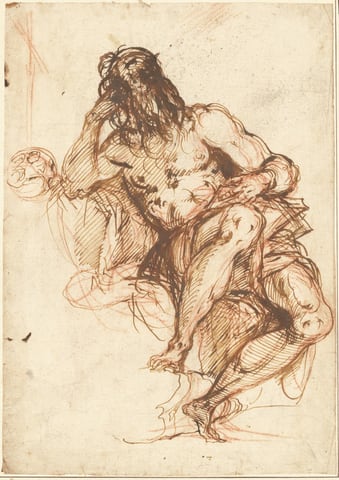
  1. The image shows a sketch of a seated bearded figure holding an orb. The figure appears muscular, with a beard merging into long hair. The face is not detailed, and draped fabric covers part of the body. There is no jewelry, and the background is plain.
    Saint JeromeAlessandro Vittoria, 1565/1570Courtesy National Gallery of Art, Washington
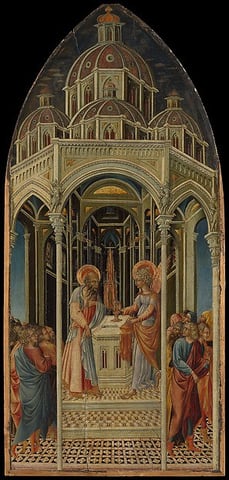
  2. The Annunciation to Zacharias; (verso) The Angel of the Annunciation, by Giovanni di Paolo, ca. 1455–60
    The Annunciation to Zacharias; (verso) The Angel of the AnnunciationGiovanni di Paolo, ca. 1455–60Courtesy of The Metropolitan Museum of Art
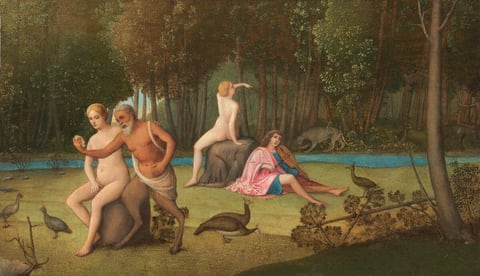
  3. Two women, a man, and a satyr, a man with goat’s legs, are in two pairs in a forested landscape in this horizontal painting. The pale-skinned women are nude, and their blond hair is tied up and back. One woman sits on a brown boulder to the left of center. One hand covers her groin, and the other hand rests on the satyr’s shoulder. The satyr has deeply tanned skin, short white hair, and a long white beard. A white cloth wraps over one shoulder and across his hips. He holds up an object, perhaps a shell, with one hand. That arm crosses over the woman’s breasts. His other hand is by his lower belly, and he looks at the shell. A bit farther back and to our right, a second nude woman also sits on a boulder. She faces away from us and holds up a long stick with her left arm, which arcs over her body. A clean-shaven, pale-skinned man sits with his back against the boulder. He has long brown hair and looks off to the distance to our right. He wears a carnation-pink robe over a sapphire-blue tunic. His legs splay in front of him, his feet bare, as he holds a bow to a violin-like instrument tucked under his chin. The two pairs sit in a grassy glade occupied also by five pheasant- or peacock-like birds. A thin river running behind the glade is lined with spindly trees that together make an impenetrable bronze-brown and laurel-green canopy. The second woman’s stick points or is directed to a gray, mountain lion-like cat on the far bank. Closer inspection reveals deer and another person, who points, tucked among the trunks. A glimpse of blue sky is visible through a break in the tree trunks.
    OrpheusUnrecorded Italian maker, c. 1515Courtesy National Gallery of Art, Washington
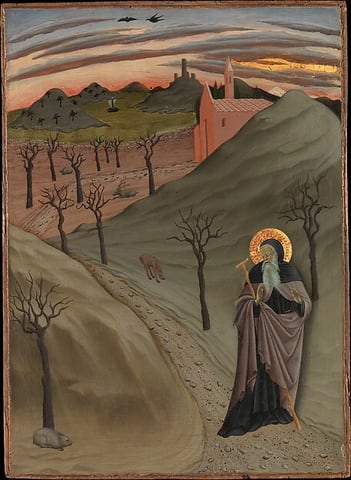
  4. Saint Anthony the Abbot in the Wilderness, by Sano di Pietro (Ansano di Pietro di Mencio), ca. 1440
    Saint Anthony the Abbot in the WildernessSano di Pietro (Ansano di Pietro di Mencio), ca. 1440Courtesy of The Metropolitan Museum of Art

Third room, north wall
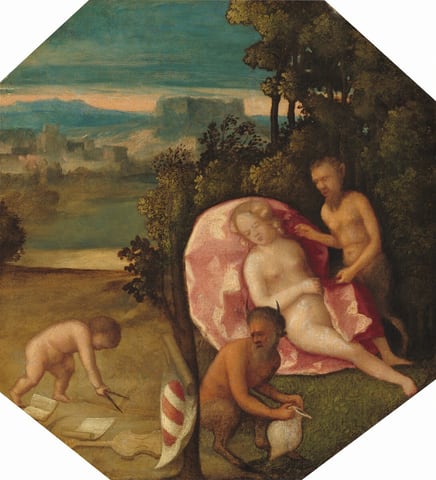
  1. A nude woman, pudgy child, and two satyrs, which have men’s heads and torsos with goat’s legs and horns, are in a landscape in this octagonal painting. The scene is divided in half by a tree stump which only reaches to the center of the composition. To the left of the stump, the pale-skinned, nude child stands and hunches over to draw on the ground with a V-shaped compass. Two pieces of paper and a violin lie nearby. The landscape behind him has a body of water leading back to a town with buildings streaked with peach, perhaps flames. A band of peach sky separates the blue silhouettes of mountains lining the horizon from the vivid blue sky above. At the bottom center of the painting, a shield with an oval horizontally striped with red and white leans on the boy’s side of the tree, which has one leafy branch growing on the left side. One satyr holds a jug and kneels close to the tree with his back to it as he looks back over one shoulder. He and the other satyr both have dark, peach-toned skin and full beards. The second satyr hovers to the right of the nude, sleeping woman, both hands reaching for her or the rose-pink cloth surrounding her. The woman has blond curls, a round face, and she sleeps with one hand resting across her belly and her head tipped to our left. The trio are on a grassy area enclosed by dense, dark-green bushes and trees.
    AllegoryPietro degli Ingannati, c. 1515-1525Courtesy National Gallery of Art, Washington
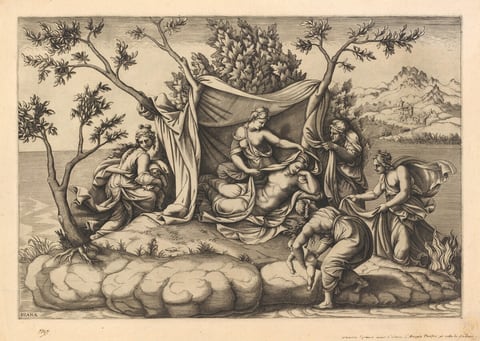
  2. Latona Giving Birth to Apollo and Diana on the Island of Delos, by Diana Scultori, 1561-1565
    Latona Giving Birth to Apollo and Diana on the Island of DelosDiana Scultori, 1561-1565Courtesy National Gallery of Art, Washington
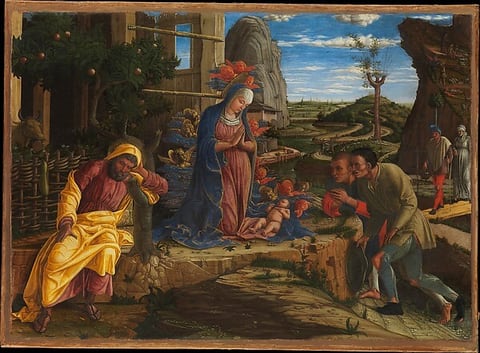
  3. The Adoration of the Shepherds, by Andrea Mantegna, shortly after 1450
    The Adoration of the ShepherdsAndrea Mantegna, shortly after 1450Courtesy of The Metropolitan Museum of Art

Third room, south wall
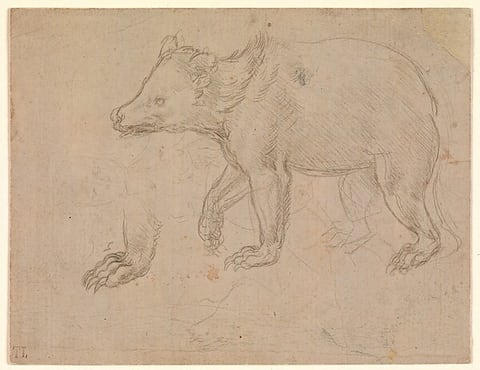
  1. A Bear Walking, by Leonardo da Vinci, ca. 1482–85
    A Bear WalkingLeonardo da Vinci, ca. 1482–85Courtesy of The Metropolitan Museum of Art
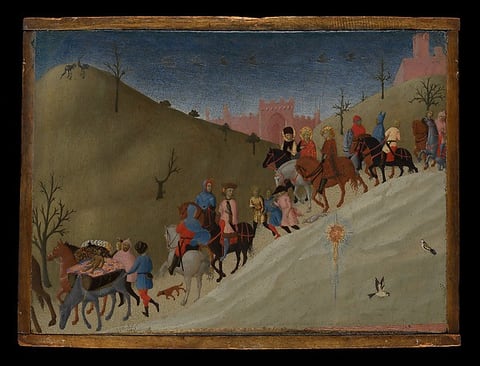
  2. The Journey of the Magi, by Sassetta, ca. 1433–35
    The Journey of the MagiSassetta, ca. 1433–35Courtesy of The Metropolitan Museum of Art

Walk on

  • The Italian Renaissance, room 2
  • More by Sassetta 3 works
  • 15th-century Italy 57 works
Ochre Editions

The world's museums, on your wall. Every work here is a reproduction of a public-domain original, credited to the museum that holds it.

Shop

All artCollectionsLimited dropsPrints and framing

Help

Find an orderShippingReturnsVerify a certificate

About

About Ochre EditionsMuseum creditsFor agentsDevelopers

Legal

Terms of UseTerms of SaleLimited Editions and CertificatesPrivacy PolicyCookie PolicyAcceptable Use PolicyAgent & API TermsCopyright and DMCA PolicyPrinting Your Own PhotoVulnerability Disclosure PolicyAccessibility StatementOpen-Access Credits
© 2026 Ochre EditionsPrices in US dollars. Prints ship within the United States.