Skip to content
Ochre Editions
ArtArtistsCollectionsGalleriesDrops
SearchSign inCart (0)
The galleries · Time and place

The 18th century

Works made in the 18th century, anywhere in the world.

347 works · hang 9870 ·

Share The 18th century, in the galleries

The rooms are imagined; every work on their walls is real.

Walk this roomRehang this room

First room, north wall

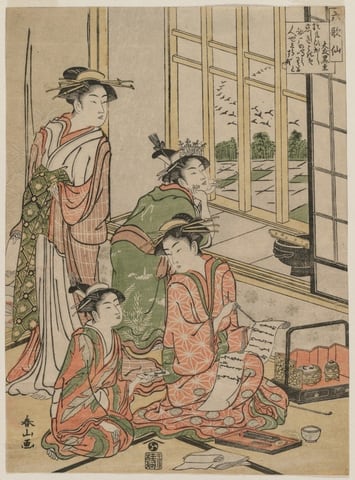
  1. Courtesans at Leisure from the series The Six Immortal Poets, by Katsukawa Shunzan, early 1780s
    Courtesans at Leisure from the series The Six Immortal PoetsKatsukawa Shunzan, early 1780sCourtesy of the Cleveland Museum of Art
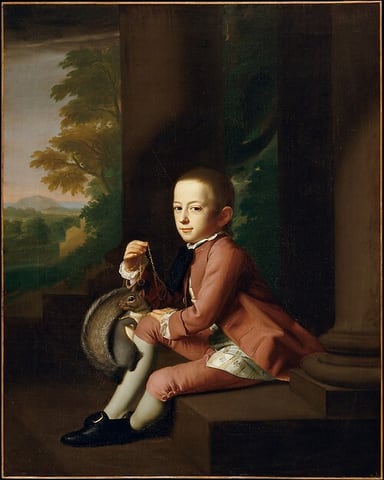
  2. Daniel Crommelin Verplanck, by John Singleton Copley, 1771
    Daniel Crommelin VerplanckJohn Singleton Copley, 1771Courtesy of The Metropolitan Museum of Art
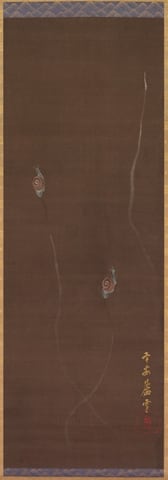
  3. Snails, by Nagasawa Rosetsu, c. 1788–89
    SnailsNagasawa Rosetsu, c. 1788–89Courtesy of the Cleveland Museum of Art

First room, south wall
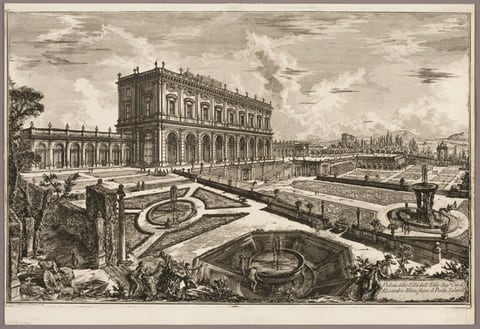
  1. A work made of etching on ivory laid paper.
    View of the Villa of His Eminence Cardinal Alessandro Albani, outside Porta Salaria, from Views of RomeGiovanni Battista Piranesi, 1769, published 1800–07Courtesy of the Art Institute of Chicago
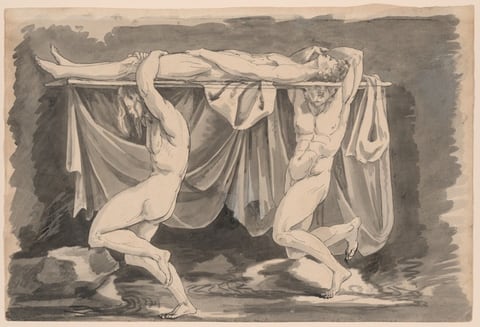
  2. A work made of brush and black ink wash, with pen and black ink and opaque white and gray watercolor, on cream laid paper.
    A Hero Born on a Bier, from The Master of Giants PortfolioPrince Hoare, 1779Courtesy of the Art Institute of Chicago
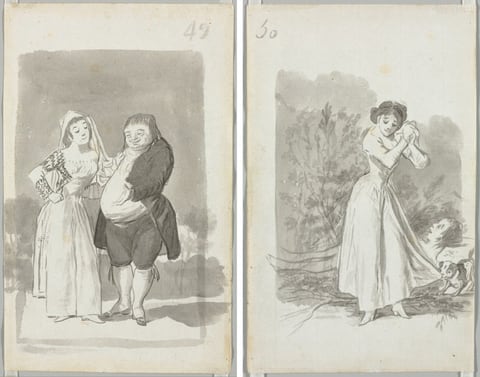
  3. Young Woman (possibly a Sex Worker) with a Man (recto); Young Woman Wringing Her Hands over a Man's Naked Body (verso), by Francisco Goya, 1796–97
    Young Woman (possibly a Sex Worker) with a Man (recto); Young Woman Wringing Her Hands over a Man's Naked Body (verso)Francisco Goya, 1796–97Courtesy of the Cleveland Museum of Art
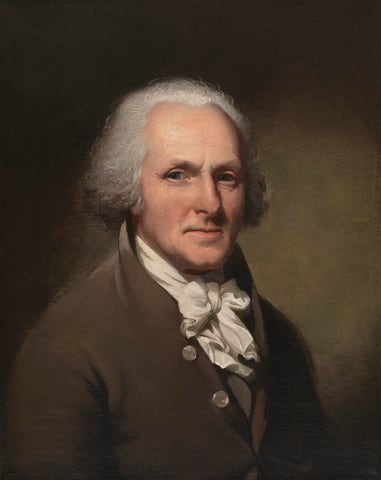
  4. Artist: Charles Willson Peale, Sitter: Charles Willson Peale, Current owner: National Portrait Gallery, Smithsonian Institution
    Charles Willson Peale Self-PortraitCharles Willson Peale, c. 1791Courtesy of the National Portrait Gallery, Smithsonian Institution

Second room, south wall
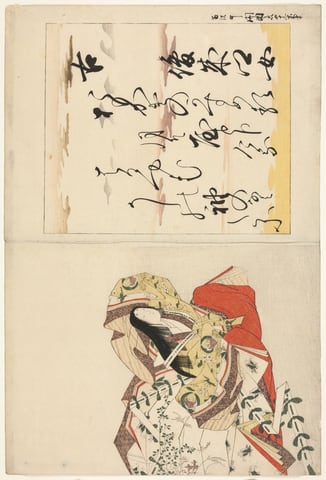
  1. A work made of page from a color woodblock-printed volume.
    The Poetess Shunzei no Musume, from the series The Thirty-six Immortal Women Poets (Nishikizuri onna sanjurokkasen)Chôbunsai Eishi, Edo period (1615–1868), 1801Courtesy of the Art Institute of Chicago
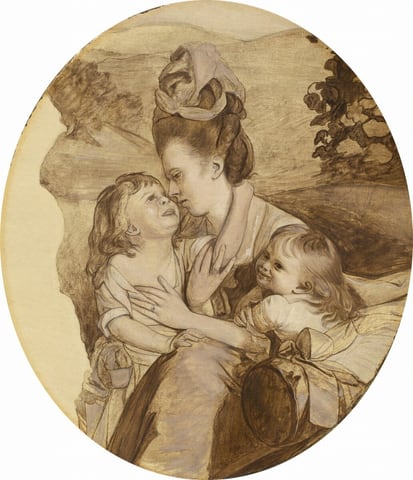
  2. Sketch for The Copley Family, by John Singleton Copley, 1776
    Sketch for The Copley FamilyJohn Singleton Copley, 1776Courtesy National Gallery of Art, Washington
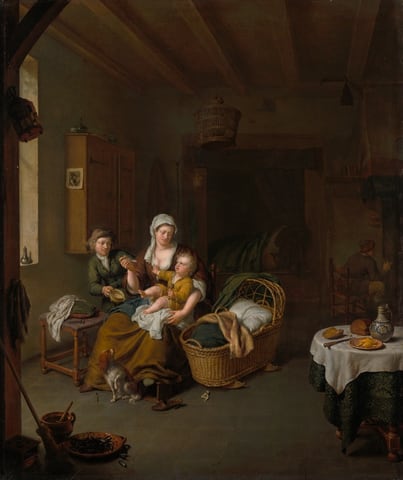
  3. Painting of a scene in a dimly-lit, cavernous room with a bassinet and small table. A shaft of light falls on four figures: a light-skinned woman in a white head covering, a baby on her lap, a male figure at her side, and a small dog at their feet. The couple feeds the fussing baby from a bowl, smiling.
    A Mother Feeding her Child (The Happy Mother)Willem van Mieris, 1707Courtesy of the Art Institute of Chicago
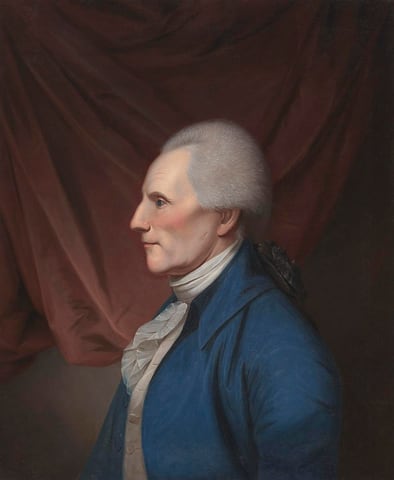
  4. Artist: Charles Willson Peale, Sitter: Richard Henry Lee, Current owner: National Portrait Gallery, Smithsonian Institution
    Richard Henry LeeCharles Willson Peale, c. 1795-1805Courtesy of the National Portrait Gallery, Smithsonian Institution

Second room, north wall
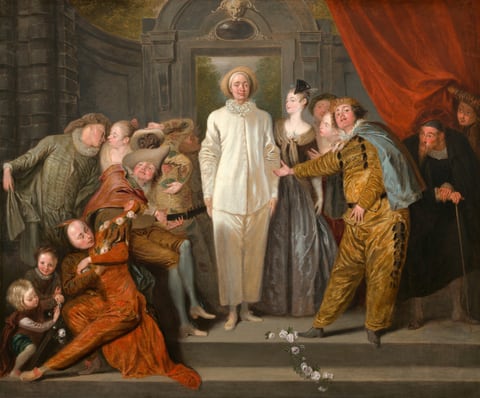
  1. A man wearing loose, ivory-white clothing stands flanked by two groups of people in this horizontal painting. All the people have pale or peachy skin except for one person, who may have a brown mask. The man in the center, representing the character Pierrot, stands facing us with his hands by his sides. He has slightly bulging eyes, a bulbous nose, ruddy cheeks, and his full pink lips slightly smile. He wears a straw hat pushed back on his high forehead and a narrow ruffled collar around his neck. His shirt has long, voluminous sleeves and a row of small white buttons down the front. The pants are baggy and end abruptly above his white-stockinged ankles over white slippers. The fabric seems to have a sheen. In the shallow space behind him, a stone wall curves toward us to either side of a doorway that leads to a park-like setting. A crimson-red curtain is pulled to our right. Pierrot stands on the top of two steps, and the people to either side are arranged along the stage or the step that runs close to the bottom edge of the canvas. A spray of white flowers drapes down the front of the steps to our right of center. The group to our left has eight men, women, and children. Closest to us and in the lower left corner, a young man wearing a tomato-red jester’s costume trimmed with bells sits on the steps as he twists and looks back at the scene behind him. He holds a scepter or puppet in the shape of a doll-like jester. Two children gather at his feet. One weaves stems of white flowers together, and the other looks at us, smiling. Just above them another cleanshaven young man sits holding a lute in his lap. He wears a brick-red coat, brown breeches, and slate-blue stockings over crossed legs. He leans back and looks up and to our left, his round cheeks flushed. At the back of this group, two people wear tan-colored costumes covered in muted green and pink diamond shapes, and one might wear a brown mask. That person’s pink lips, black mustache and eyebrows, and black dots for eyes appear painted onto a hard, molded surface. The group of six people to our right stand on the same level as Pierrot. At the front of that group, a heavyset young man wears a gold-colored costume trimmed with black and a waist-length, Wedgewood-blue cape. He faces us but looks to our right as he leans back with one arm extended toward Pierrot. Beyond him are two woman and another person shown only from the neck up. The woman closest to Pierrot wears a pewter-gray gown with a scooped neckline. To the right of the man in gold is an old man with a long beard, wearing a black skullcap and cloak. He leans on a short staff and turns his head to look at the group. The last person on the far right is shown from the neck up and stands before the red curtain hanging from the upper right.
    The Italian ComediansAntoine Watteau, probably 1720Courtesy National Gallery of Art, Washington
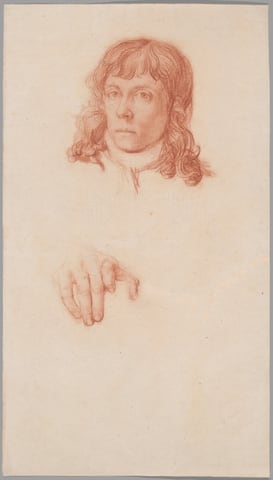
  2. A work made of red chalk on cream laid paper.
    Self-PortraitJohn Flaxman, c. 1779Courtesy of the Art Institute of Chicago
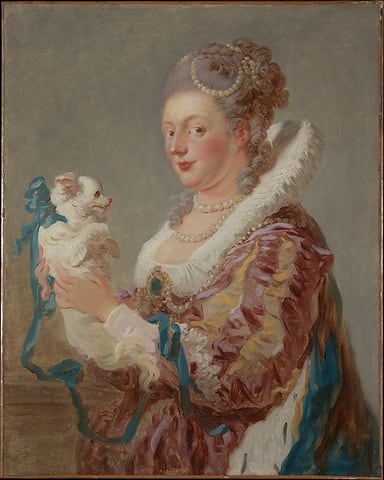
  3. Marie Emilie Coignet de Courson (1716–1806) with a Dog, by Jean Honoré Fragonard, ca. 1769
    Marie Emilie Coignet de Courson (1716–1806) with a DogJean Honoré Fragonard, ca. 1769Courtesy of The Metropolitan Museum of Art

Third room, north wall
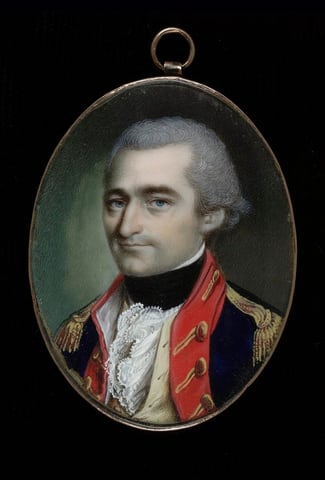
  1. Col. Josiah Parker, by John Ramage, ca. 1789
    Col. Josiah ParkerJohn Ramage, ca. 1789Courtesy of the Smithsonian American Art Museum
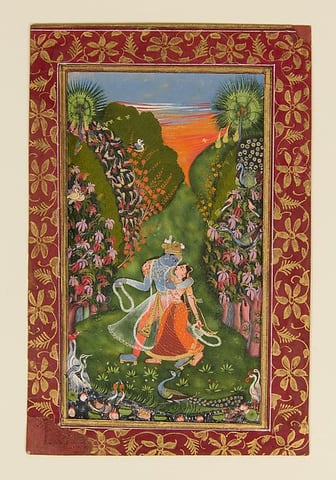
  2. Radha and Krishna Walk in a Flowering Grove (recto); Krishna Fluting (verso), by the Kota Master, ca. 1720 (recto); ca. 1750–75 (verso)
    Radha and Krishna Walk in a Flowering Grove (recto); Krishna Fluting (verso)the Kota Master, ca. 1720 (recto); ca. 1750–75 (verso)Courtesy of The Metropolitan Museum of Art

Walk on

  • The 18th century, room 2
  • the Kota Master's contemporaries 8 works
  • More Mughal and Rajput painting 40 works
Ochre Editions

The world's museums, on your wall. Every work here is a reproduction of a public-domain original, credited to the museum that holds it.

Shop

All artCollectionsLimited dropsPrints and framing

Help

Find an orderShippingReturnsVerify a certificate

About

About Ochre EditionsMuseum creditsFor agentsDevelopers

Legal

Terms of UseTerms of SaleLimited Editions and CertificatesPrivacy PolicyCookie PolicyAcceptable Use PolicyAgent & API TermsCopyright and DMCA PolicyPrinting Your Own PhotoVulnerability Disclosure PolicyAccessibility StatementOpen-Access Credits
© 2026 Ochre EditionsPrices in US dollars. Prints ship within the United States.