Snailsc. 1788–89
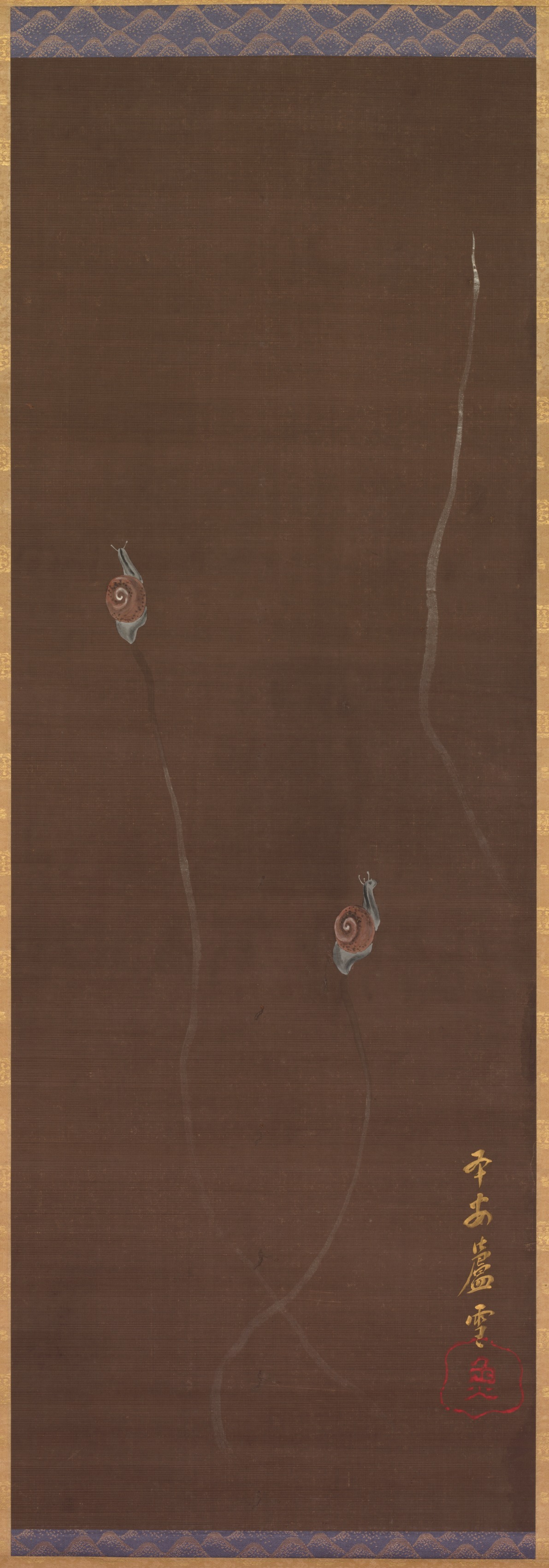
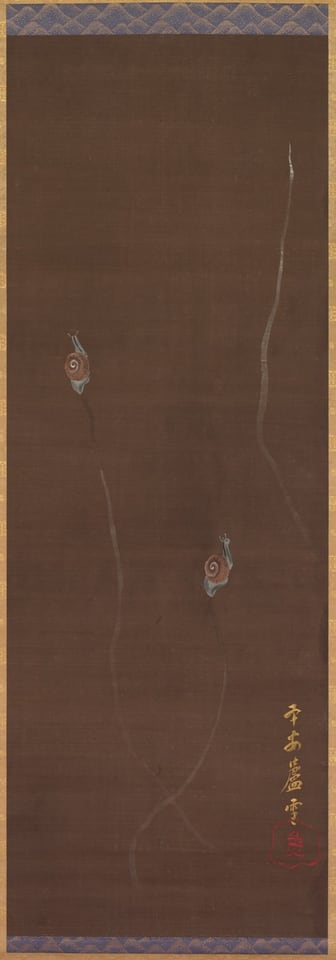
In this work, Nagasawa Rosetsu carefully described two snails in a manner known as “earth painting” ( doro-e ), building up colors mixed with crushed white shells in emulation of the thick brushstrokes of oil paint seen in European painting. More about this work
About this work
In this work, Nagasawa Rosetsu carefully described two snails in a manner known as “earth painting” ( doro-e ), building up colors mixed with crushed white shells in emulation of the thick brushstrokes of oil paint seen in European painting. A silvery metallic pigment indicates the snails’ trails, glistening along an earthen wall. Notably, one trail has no snail, leaving the viewer to guess why.
Text from the Cleveland Museum of Art.
How it was made
- Hanging scroll
- A painting mounted on silk with a wooden roller at the foot. It was rolled up for storage and brought out to hang for a season, a guest or an occasion.
- Ink on paper
- Ink made from soot and animal glue, ground with water on an inkstone. A single brush can give a hair-fine line or a broad wash, and nothing can be corrected.
Nagasawa Rosetsu
Japanese, 1754–1799
Rights and the museum’s record
Public domain. The Cleveland Museum of Art has dedicated this image to the public domain under CC0, so anyone may copy, adapt and use it, for any purpose, without asking. Our prints and files are reproductions made from the museum’s image; the museum doesn’t endorse them.
- Object number
- 1998.5
- Credit
- Courtesy of the Cleveland Museum of Art
- Type
- Painting
- Department
- Japanese Art
- Licence
- CC0 1.0 Universal
- Museum record
- See it on the museum’s site