Skip to content
Ochre Editions
ArtArtistsCollectionsGalleriesDrops
SearchSign inCart (0)
The galleries · Time and place

16th-century Netherlands

Works made in the Netherlands in the 16th century.

35 works · hang 589 ·

Share 16th-century Netherlands, in the galleries

The rooms are imagined; every work on their walls is real.

Walk this roomRehang this room

First room, north wall

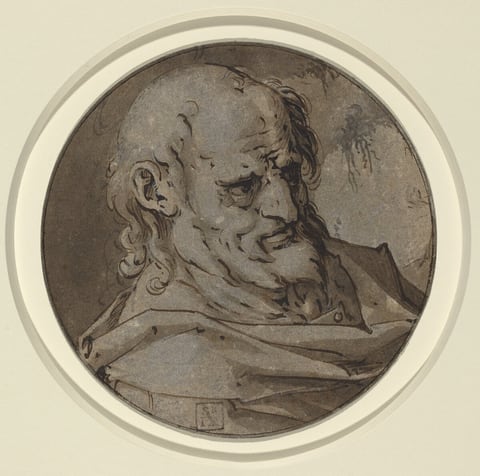
  1. The image features the upper body and head of a man in a circular frame. The man is facing slightly to the side and downward, with his body oriented to the left and his head turned towards the viewer. He has a prominent forehead, a defined nose, a furrowed brow, and a scrunched face. His hair is thinning on top, with longer strands curling around the back and sides of his head. The man has a beard with similar curled texture as his hair. He is wearing a garment that drapes over his shoulders, with visible folds and a texture that suggests a substantial fabric. No jewelry or objects are in his hands, as they are not visible in this image. The background is plain with a light, sketchy look, focusing attention on the man as the central figure in the circular composition.
    Head of an ApostleHendrick GoltziusCourtesy National Gallery of Art, Washington
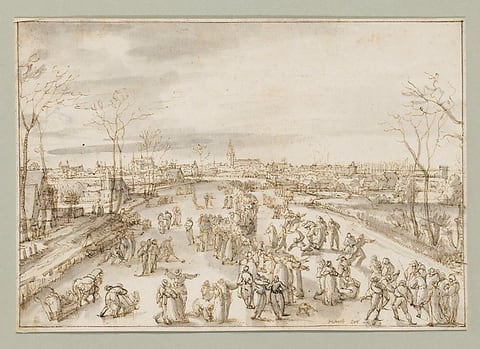
  2. Ice skaters on the Amstel in Amsterdam, by Hans Bol, 1589
    Ice skaters on the Amstel in AmsterdamHans Bol, 1589Courtesy of The Metropolitan Museum of Art
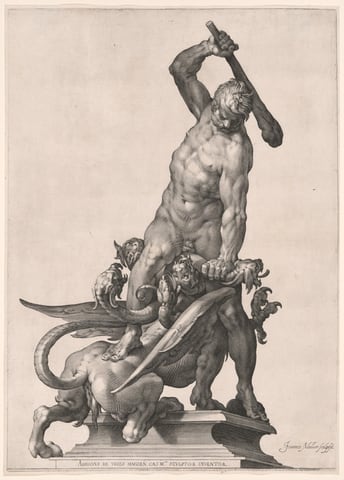
  3. A work made of engraving on ivory laid paper.
    Hercules Slaying the HydraJan Harmensz. Muller, c. 1602Courtesy of the Art Institute of Chicago
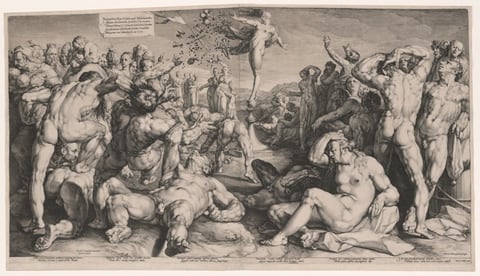
  4. A work made of engraving on two joined sheets of ivory laid paper.
    Fortune Distributing her GiftsJan Harmensz. Muller, 1590Courtesy of the Art Institute of Chicago

First room, south wall
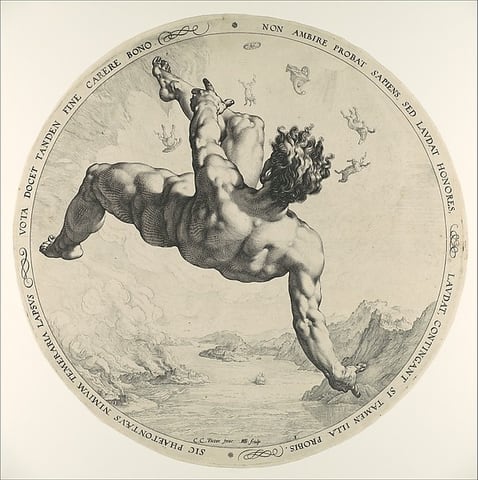
  1. Phaeton, from "The Four Disgracers", by Hendrick Goltzius, 1588
    Phaeton, from "The Four Disgracers"Hendrick Goltzius, 1588Courtesy of The Metropolitan Museum of Art
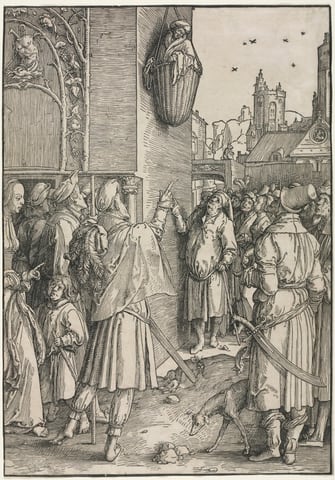
  2. The Power of Women: The Poet Virgil Suspended in a Basket, by Lucas van Leyden, c. 1512
    The Power of Women: The Poet Virgil Suspended in a BasketLucas van Leyden, c. 1512Courtesy of the Cleveland Museum of Art
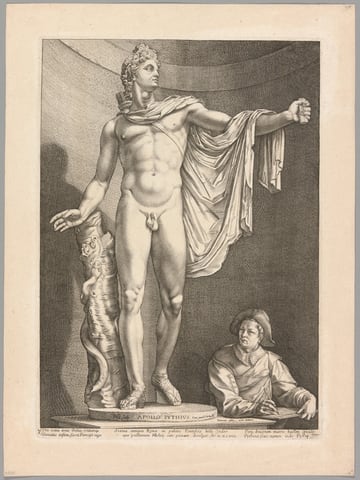
  3. A work made of engraving in black on cream laid paper.
    The Apollo Belvedere, plate 3 from Three Famous Antique SculpturesHendrick Goltzius, c. 1592, printed c. 1617Courtesy of the Art Institute of Chicago
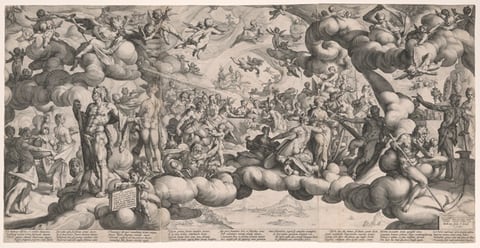
  4. A work made of engraving on three joined sheets of ivory laid paper.
    The Wedding of Cupid and PsycheHendrick Goltzius, 1587Courtesy of the Art Institute of Chicago

Second room, south wall
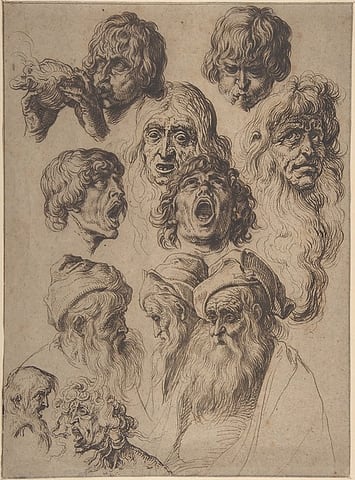
  1. Study of Eleven Heads, by Jacques de Gheyn II, late 16th–early 17th century
    Study of Eleven HeadsJacques de Gheyn II, late 16th–early 17th centuryCourtesy of The Metropolitan Museum of Art
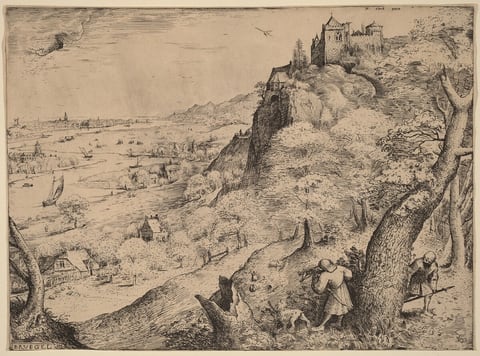
  2. The image shows a landscape with a city in the distance, a castle on a cliff, fields, forests, and two figures with a dog hunting. There are sailboats on water and houses on farmland. The style is detailed with etching lines in sepia tones.
    The Rabbit HuntersPieter Bruegel, 1560Courtesy National Gallery of Art, Washington
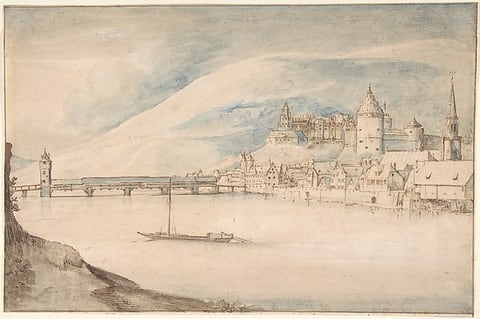
  3. View of Heidelberg, by Jan Brueghel the Elder, ca. 1588–89
    View of HeidelbergJan Brueghel the Elder, ca. 1588–89Courtesy of The Metropolitan Museum of Art
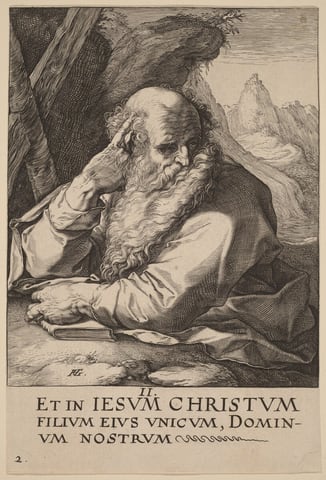
  4. The image shows an elderly man seated from the waist up. He is angled slightly away from the viewer, resting his head on one hand and leaning on the other arm. The man has a deeply lined face, a large beard, curly hair, and appears focused on something outside the frame. He wears flowing garments and a book is under his arm. In the background, there are rugged, mountainous rock formations. Ornate text frames the image at the bottom.
    Saint AndrewHendrick Goltzius, probably 1589Courtesy National Gallery of Art, Washington

Second room, north wall
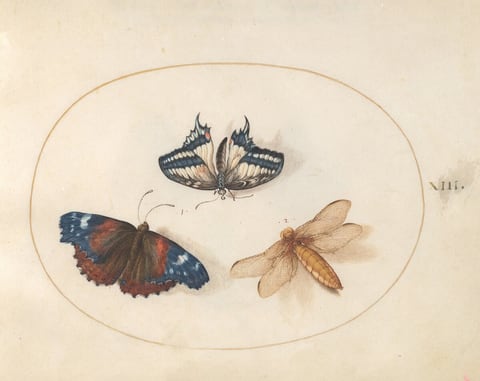
  1. Three insects are depicted in the image: a butterfly with dark blue and red wings on the bottom left, a larger butterfly with white, black, and blue patterns at the top center, and a dragonfly with brown and gold tones on the bottom right. The color palette includes rich blues, reds, browns, and golds against a neutral background. The central butterfly is positioned higher than the other two insects, with the left butterfly and right dragonfly symmetrically arranged below.
    Plate 13: Yellow Swallowtail and Red Admiral Butterflies with a Dragonfly (Broad-Bodied Chaser?)Joris Hoefnagel, c.1575/1590sCourtesy National Gallery of Art, Washington
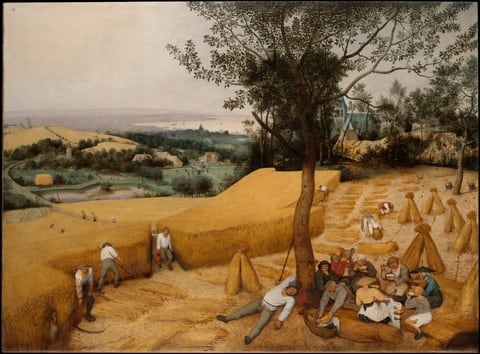
  2. The Harvesters, by Pieter Bruegel, 1565
    The HarvestersPieter Bruegel, 1565Courtesy of The Metropolitan Museum of Art

Third room, north wall
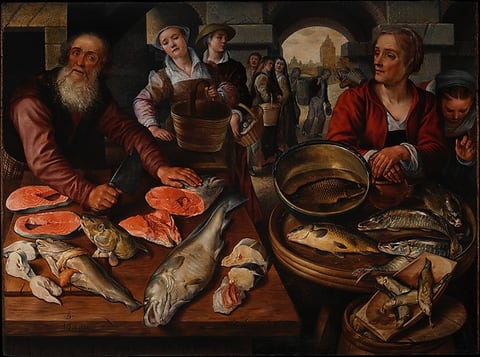
  1. Fish Market, by Joachim Beuckelaer, 1568
    Fish MarketJoachim Beuckelaer, 1568Courtesy of The Metropolitan Museum of Art
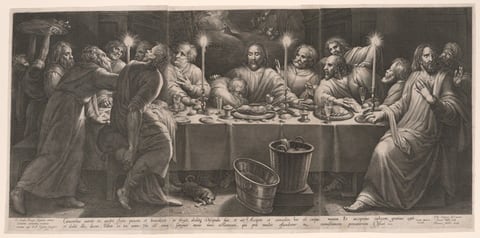
  2. A work made of engraving on three joined sheets of laid paper.
    The Last SupperJan Harmensz. Muller, 1594Courtesy of the Art Institute of Chicago

Walk on

  • 16th-century Netherlands, room 2
  • More by Jan Harmensz. Muller 4 works
  • More Dutch Golden Age 44 works
Ochre Editions

The world's museums, on your wall. Every work here is a reproduction of a public-domain original, credited to the museum that holds it.

Shop

All artCollectionsLimited dropsPrints and framing

Help

Find an orderShippingReturnsVerify a certificate

About

About Ochre EditionsMuseum creditsFor agentsDevelopers

Legal

Terms of UseTerms of SaleLimited Editions and CertificatesPrivacy PolicyCookie PolicyAcceptable Use PolicyAgent & API TermsCopyright and DMCA PolicyPrinting Your Own PhotoVulnerability Disclosure PolicyAccessibility StatementOpen-Access Credits
© 2026 Ochre EditionsPrices in US dollars. Prints ship within the United States.