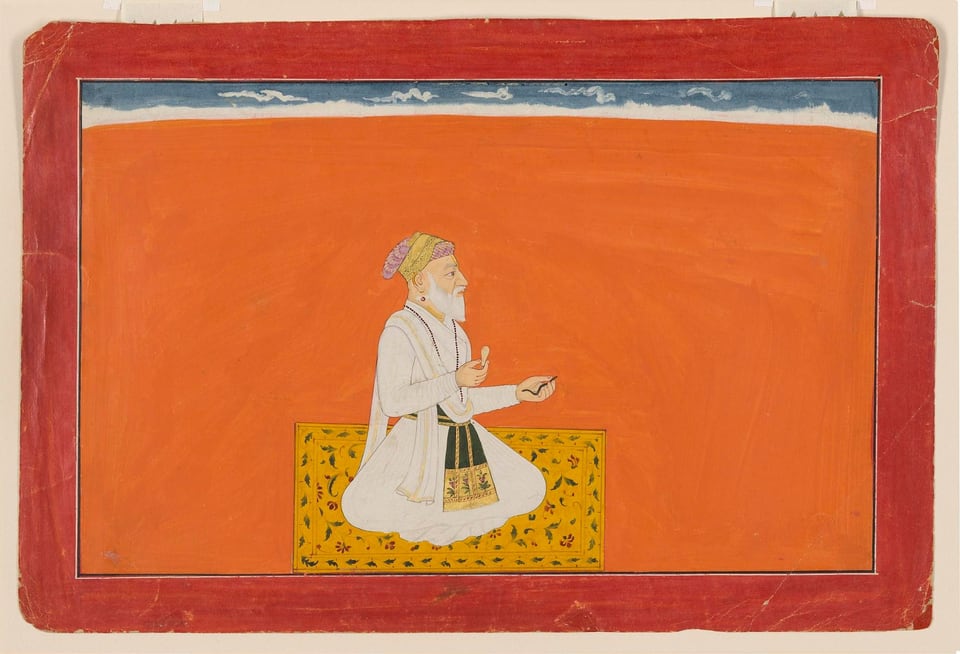
The sage-physician Dhanvantari, folio from the “Sixth” Bhagavata Purana series, also known as the “small” Guler-Basohli seriesca. 1735-1740
Dressed in the fashion of a nobleman at the court of Shah Jahan, the divine sage Dhanvantari wears a white jama and a gold-bordered patka (sash) adorned with a large flower motif. More about this work

About this work
Dressed in the fashion of a nobleman at the court of Shah Jahan, the divine sage Dhanvantari wears a white jama and a gold-bordered patka (sash) adorned with a large flower motif. His beard is white, his face wrinkled with age, and he wears a Vaishnava tilak mark on his forehead. He sits on a yellow carpet decorated with gray-green leaves and maroon flowers. A narrow strip of cloud-streaked sky borders the brilliant orange ground. He holds two objects that may be associated with medicine.
Text from the National Museum of Asian Art.
How it was made
- Opaque watercolour
- Watercolour made opaque with white or chalk and laid in flat, even layers. Persian and Indian painters ground their colours from minerals, applied them with the finest brushes and burnished the finished page.
- Watercolour
- Pigment in gum arabic, thinned with water and laid in transparent washes. Nothing white is painted: the light is the paper showing through.
Manaku
Manaku belonged to a family of painters from Guler in the Punjab Hills: he was the son of Pandit Seu and the elder brother of Nainsukh. His work, much of it for illustrated sets of religious texts, combines strong colour with lively narrative. A Gita Govinda series dated 1730 names him as its painter, and the large Ramayana series known as the Siege of Lanka is associated with him. His sons and nephews carried the family style into the next generation.
Written by Ochre Editions.
Rights and the museum’s record
Public domain. The National Museum of Asian Art has dedicated this image to the public domain under CC0, so anyone may copy, adapt and use it, for any purpose, without asking. Our prints and files are reproductions made from the museum’s image; the museum doesn’t endorse them.
- Object number
- S2018.1.7
- Credit
- Courtesy of the National Museum of Asian Art, Smithsonian Institution
- Type
- Painting
- Department
- National Museum of Asian Art
- Licence
- CC0 1.0 Universal
- Museum record
- See it on the museum’s site
Report this work
Close in colour