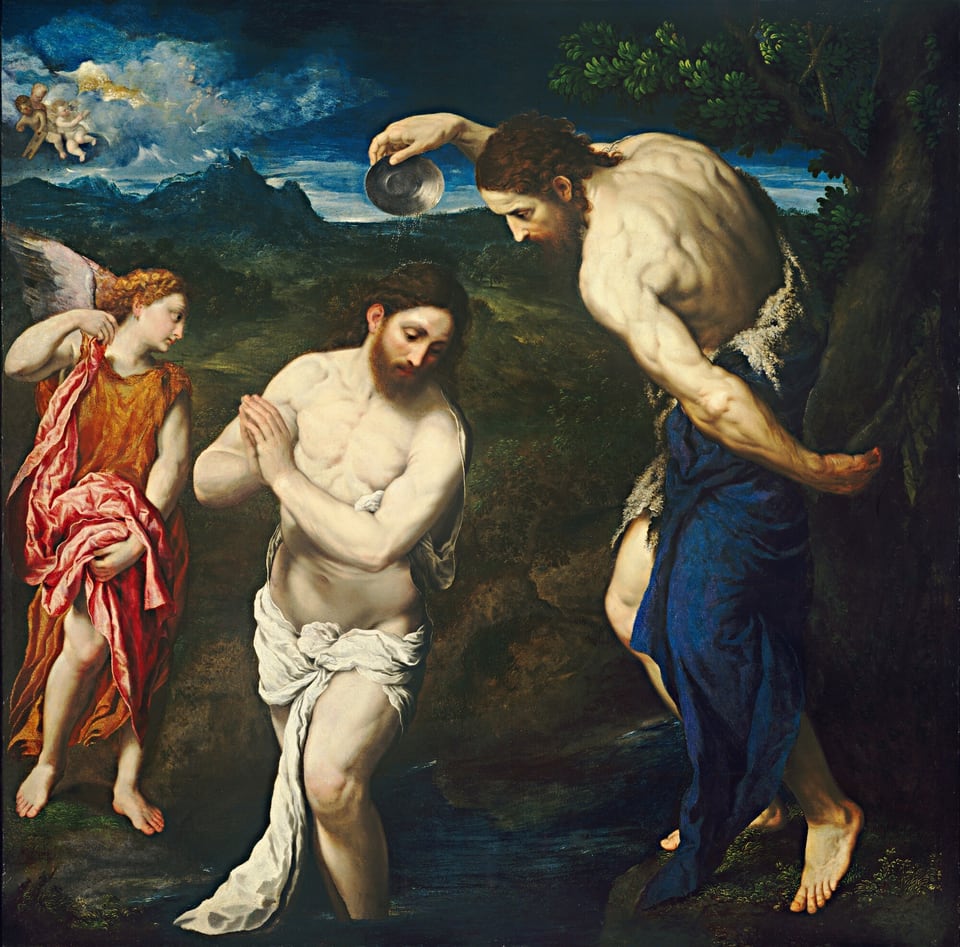
The Baptism of Christc. 1535/1540
John the Baptist, bracing himself against a tree on the riverbank, tips a shallow dish of water over the head of Christ, who stands ankle-deep in the stream with his hands joined in prayer. More about this work
About this work
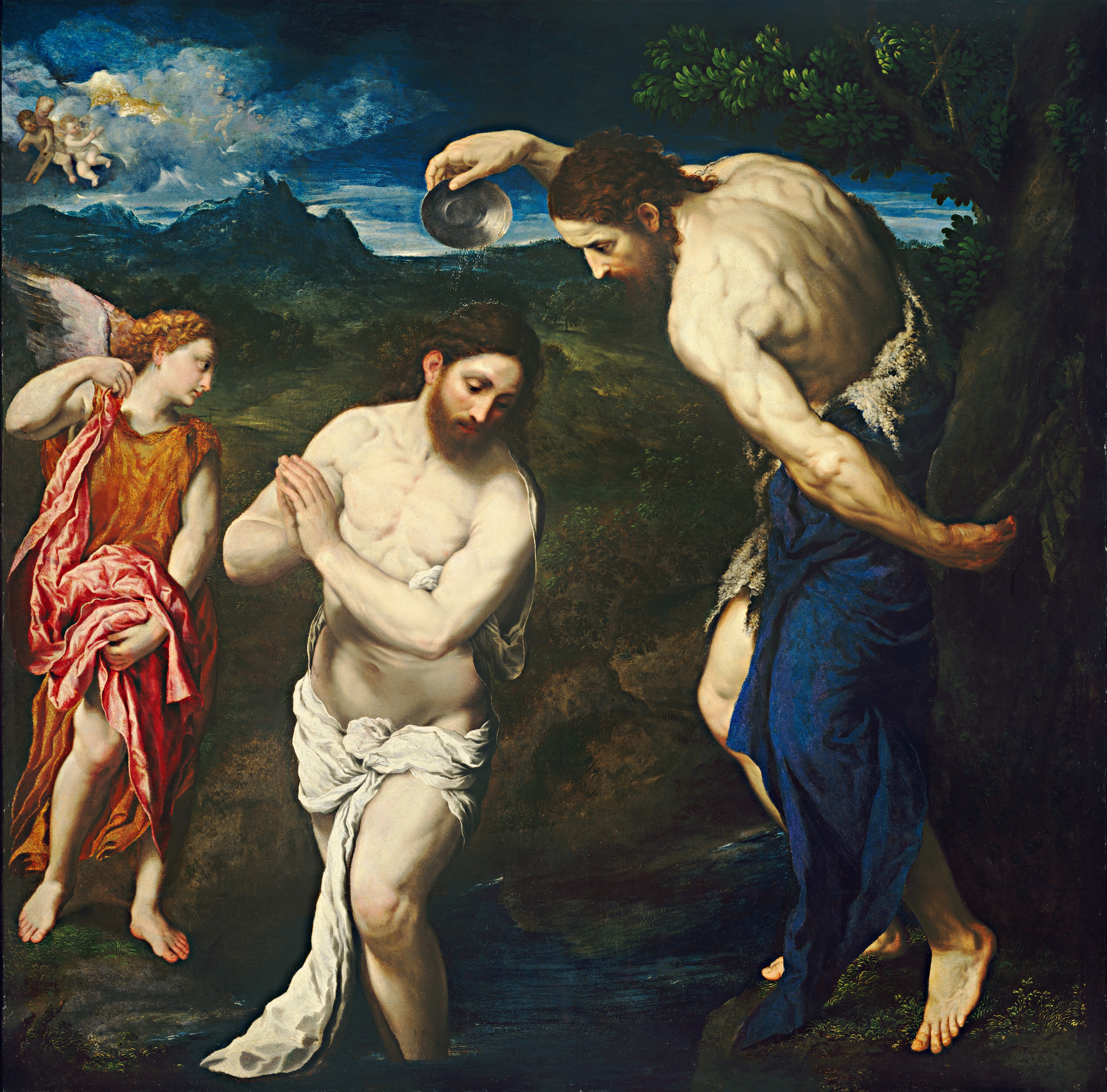
John the Baptist, bracing himself against a tree on the riverbank, tips a shallow dish of water over the head of Christ, who stands ankle-deep in the stream with his hands joined in prayer. On the opposite bank an angel in a pumpkin-orange robe and salmon-pink mantle looks on, and above, small winged putti float with musical instruments among blue clouds that part to reveal a glimpse of golden light. Paris Bordone, a Venetian who trained in the orbit of Titian, sets the pale, muscular figures against a darkening landscape that runs back to jagged blue mountains, so that the light falling from the upper left does the dramatic work.
Written by Ochre Editions.
What you’re looking at
Bright light from the upper left illuminates two muscular men and a winged angel against a dim landscape in this square painting. They all have pale skin, and the two men have dark brown hair and beards. One man, Jesus, stands ankle-deep in a rippling dark blue stream in the center of the composition facing us with downcast eyes. He is nude except for a white cloth that drapes over one shoulder and is tied around his hips. The other end of the cloth drops into the water. Jesus’s hands are pressed together in prayer at chest-height closer to his right shoulder, to our left. He leans his torso in the other direction and looks down at the water. The second man stands on the riverbank to our right. His body faces our left but his left shoulder, closer to us, dips down so his broad back is angled toward us. His lower body is wrapped in a cobalt-blue garment bordered with what looks like sheepskin. His near hand swings back to clutch the trunk of a tree growing immediately behind him. In his other hand, he holds up a pewter-grey dish that dribbles water onto Jesus’s head. On the left riverbank, the copper-haired angel looks on, facing our right in profile but the body faces us. The angel wears a sleeveless, pumpkin-orange robe with a shimmering salmon-pink mantle draped over the right shoulder, to our left. Petal-pink and dark grey wings extend from the shoulders, and the lower legs and feet are bare. The shadowy landscape has a dark green field stretching back to jagged, sapphire-blue mountains along the horizon, which comes four-fifths of the way up this composition. Pale blue clouds skim across the vivid blue sky, where three chubby, winged babies float. One holds a triangle and a rod with which to strike it, and another might hold a rectangular musical instrument. Blue clouds split nearby to show a sliver of golden yellow light, and possibly more angels.
Description from the National Gallery of Art.
How it was made
- Oil paint
- Pigment ground in a drying oil, usually linseed. It dries slowly, so painters could blend on the canvas, build up thin translucent glazes, and rework a picture over weeks. Canvas replaced wooden panels in the 1500s because it is lighter and can be rolled.
Paris Bordone
Venetian, 1500–1571
Paris Bordone was born in Treviso and trained in Venice, according to Vasari briefly in Titian’s studio. He became known for richly coloured religious paintings, mythologies and portraits, and for sensuous half-length images of women. His best-known work, The Fisherman Presenting the Ring to the Doge, was painted for the Scuola Grande di San Marco. He also received commissions from patrons outside Italy, notably in Augsburg.
Written by Ochre Editions.
Rights and the museum’s record
Public domain. The National Gallery of Art has dedicated this image to the public domain under CC0, so anyone may copy, adapt and use it, for any purpose, without asking. Our prints and files are reproductions made from the museum’s image; the museum doesn’t endorse them.
- Object number
- 1942.9.5
- Credit
- Courtesy National Gallery of Art, Washington
- Type
- Painting
- Licence
- CC0 1.0 Universal
- Museum record
- See it on the museum’s site
Report this work
Close in colour