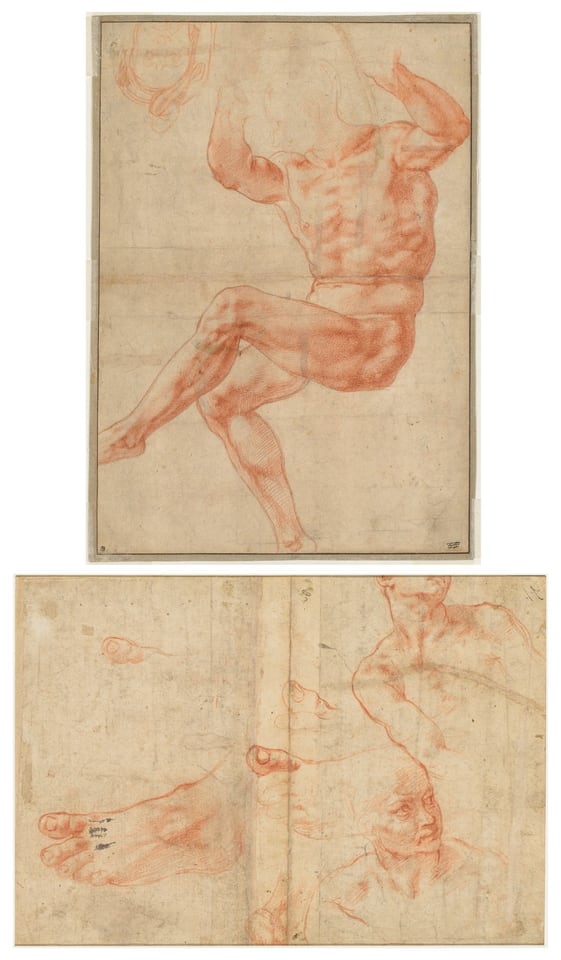
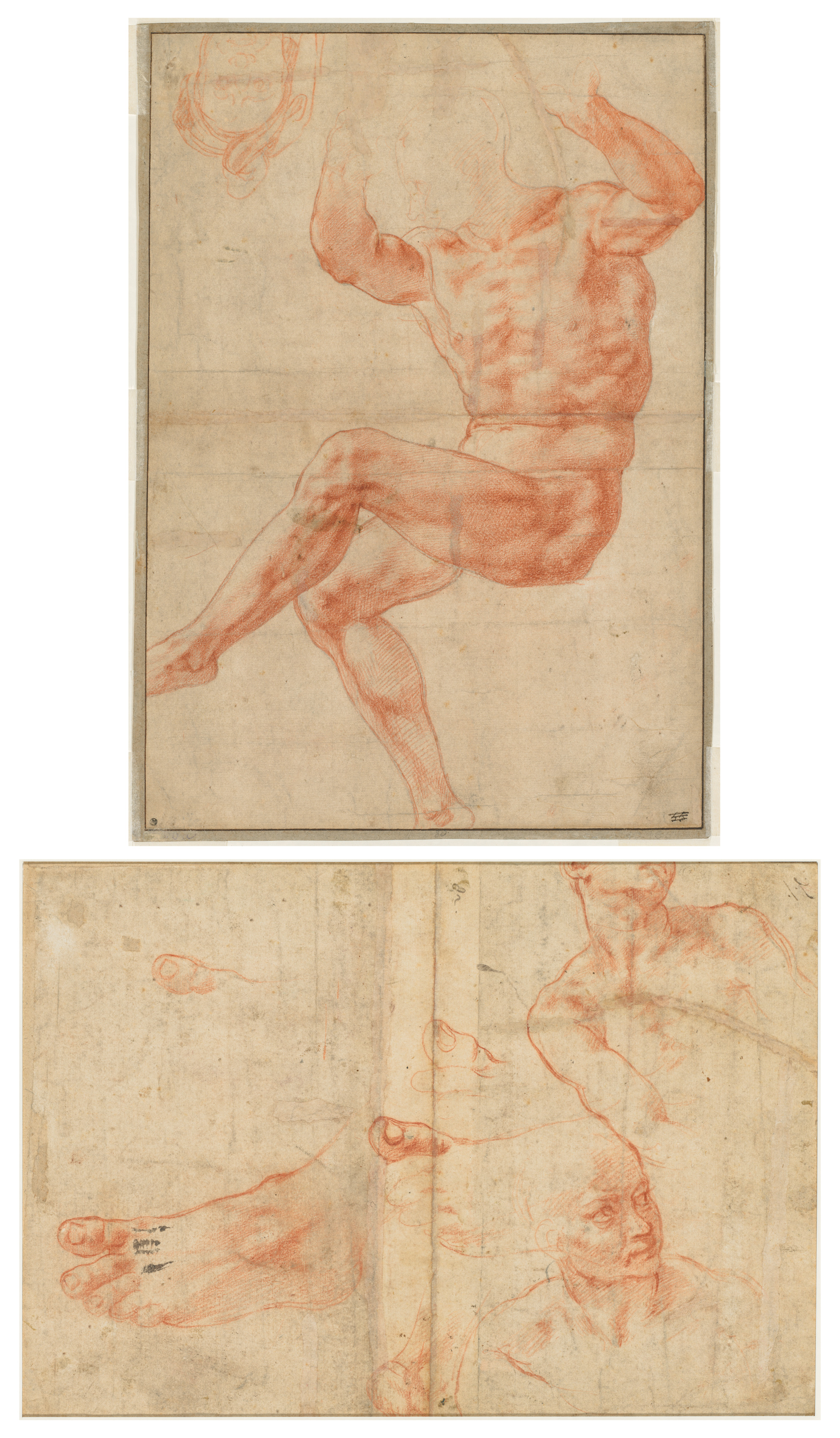
Study for the Nude Youth over the Prophet Daniel (recto); Figure Studies for the Sistine Ceiling (verso)1510–11
Universally considered one of the greatest artists of the Italian Renaissance, Michelangelo devoted four years to painting the vast ceiling fresco in the Sistine Chapel. More about this work
About this work
Universally considered one of the greatest artists of the Italian Renaissance, Michelangelo devoted four years to painting the vast ceiling fresco in the Sistine Chapel. This preparatory study portrays one of the 20 athletic male nudes, known as ignudi, who serve as supporting figures at each corner of the Old Testament scenes painted down the center of the ceiling. Michelangelo worked out the positioning of the ignudi in red chalk drawings before beginning to paint each section of wet plaster. The energy and monumentality of the figure in red chalk, whose body extends beyond the sheet, suggests the heroic athleticism of Michelangelo’s sculpture.
Text from the Cleveland Museum of Art.
How it was made
- Chalk
- Natural black, red and white chalks. Used together on toned paper they could give the warmth of flesh with very little effort, and they were favourites for studies from life.
- Charcoal
- Burnt willow or vine. It smudges and wipes away easily, which made it the natural tool for working out a composition.
Michelangelo Buonarroti
Italian, 1475–1564 · Born in Caprese; died in Rome.
Renaissance
European art from about 1400 to 1600, when painters rediscovered perspective and the classical past.
Rights and the museum’s record
Public domain. The Cleveland Museum of Art has dedicated this image to the public domain under CC0, so anyone may copy, adapt and use it, for any purpose, without asking. Our prints and files are reproductions made from the museum’s image; the museum doesn’t endorse them.
- Object number
- 1940.465
- Credit
- Courtesy of the Cleveland Museum of Art
- Type
- Drawing
- Department
- Drawings
- Licence
- CC0 1.0 Universal
- Museum record
- See it on the museum’s site
Report this work
More by Michelangelo Buonarroti
All their works
Close in colour