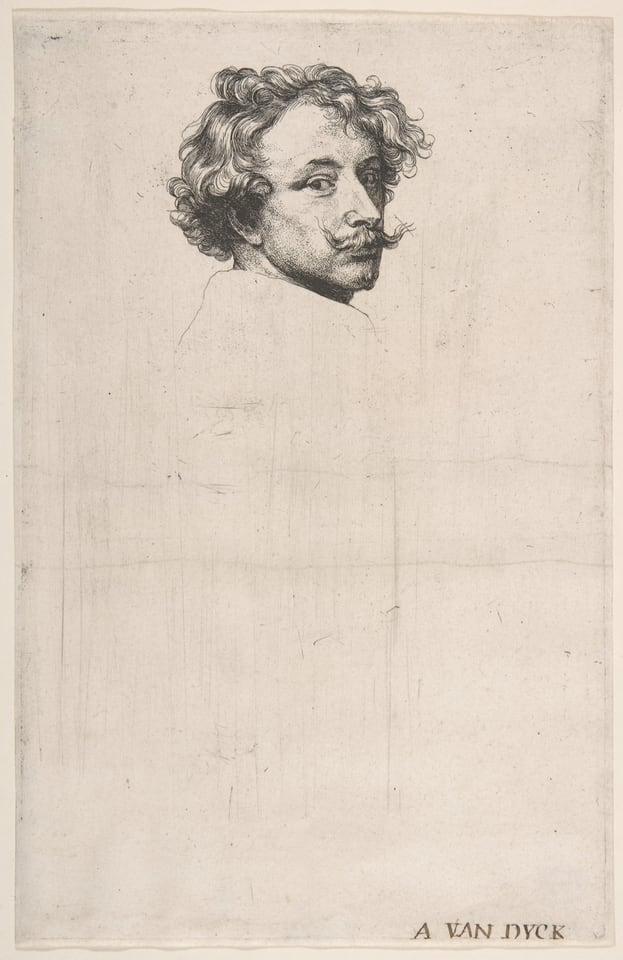
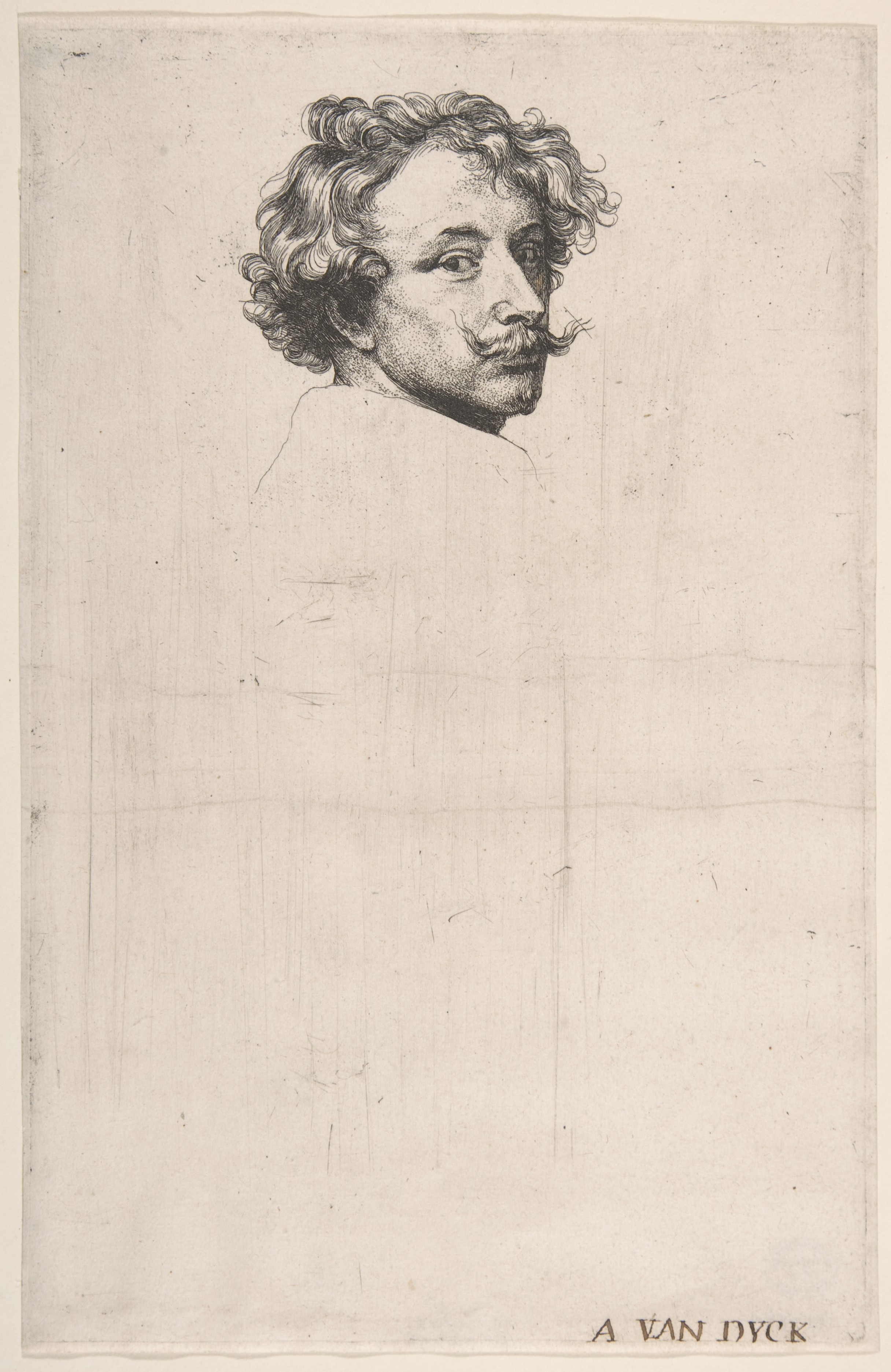
Self-Portrait, from "The Iconography"ca. 1640
Van Dyck etched only his own head on this plate, and in this first state the face seems to float on the bare paper, set down in quick, flickering lines. More about this work
About this work
Van Dyck etched only his own head on this plate, and in this first state the face seems to float on the bare paper, set down in quick, flickering lines. The plate was later used as the frontispiece of the Iconography, his celebrated series of portraits of princes, statesmen, scholars and fellow artists, and in later states another engraver added a pedestal and lettering around the head. Collectors have long prized early impressions like this one for showing the artist’s own hand at its most direct.
Written by Ochre Editions.
How it was made
- Etching
- The artist draws with a needle through a waxy coating on a copper plate, and acid bites the exposed lines. The plate is then inked, wiped and printed under pressure, so the line keeps the freedom of drawing.
Anthony van Dyck
Flemish, 1599–1641 · Born in Antwerp; died in London.
Van Dyck was the leading assistant in Rubens’s Antwerp studio before spending six years in Italy, chiefly in Genoa, where he painted the local aristocracy in elegant full-lengths. In 1632 he became principal painter to Charles I of England, and his portraits of the king, Queen Henrietta Maria and their court fixed the image of Caroline England and set the pattern for British portraiture for more than a century. He also conceived the Iconography, a series of etched portraits of notable contemporaries.
Written by Ochre Editions.
Rights and the museum’s record
Public domain. The Met has dedicated this image to the public domain under CC0, so anyone may copy, adapt and use it, for any purpose, without asking. Our prints and files are reproductions made from the museum’s image; the museum doesn’t endorse them.
- Object number
- 50.583.4
- Credit
- Courtesy of The Metropolitan Museum of Art
- Type
- Prints
- Department
- Drawings and Prints
- Licence
- CC0 1.0 Universal
- Museum record
- See it on the museum’s site
Report this work
More by Anthony van Dyck
All their works
Close in colour