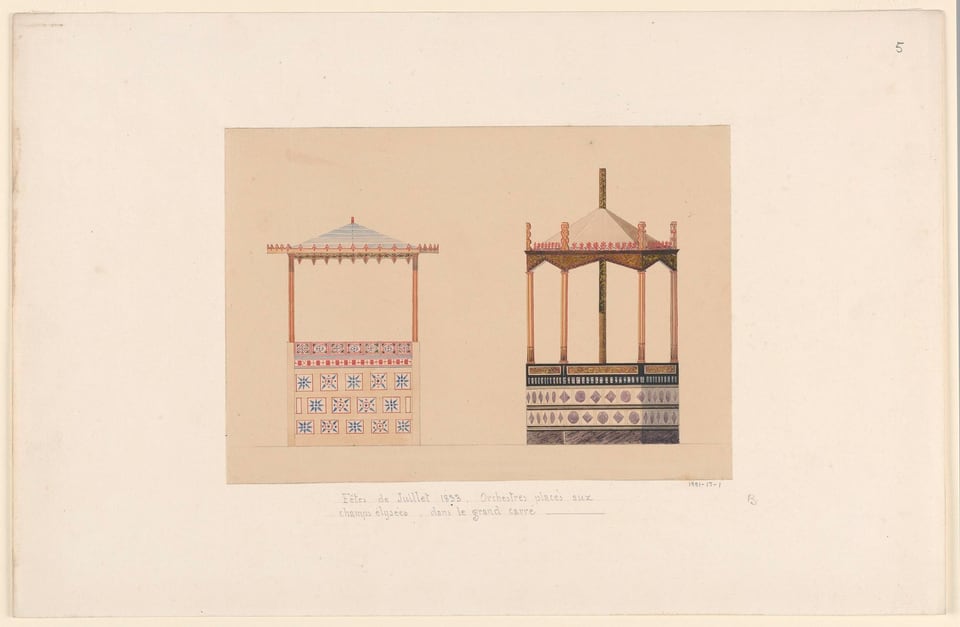
"Orchstres places aux Champs elysees, dans le gran carres"1833
Design for two open air pavilions. At right: A polyhedron pavilion structure with a white roof decorated at its edges with red palmettes. More about this work
About this work
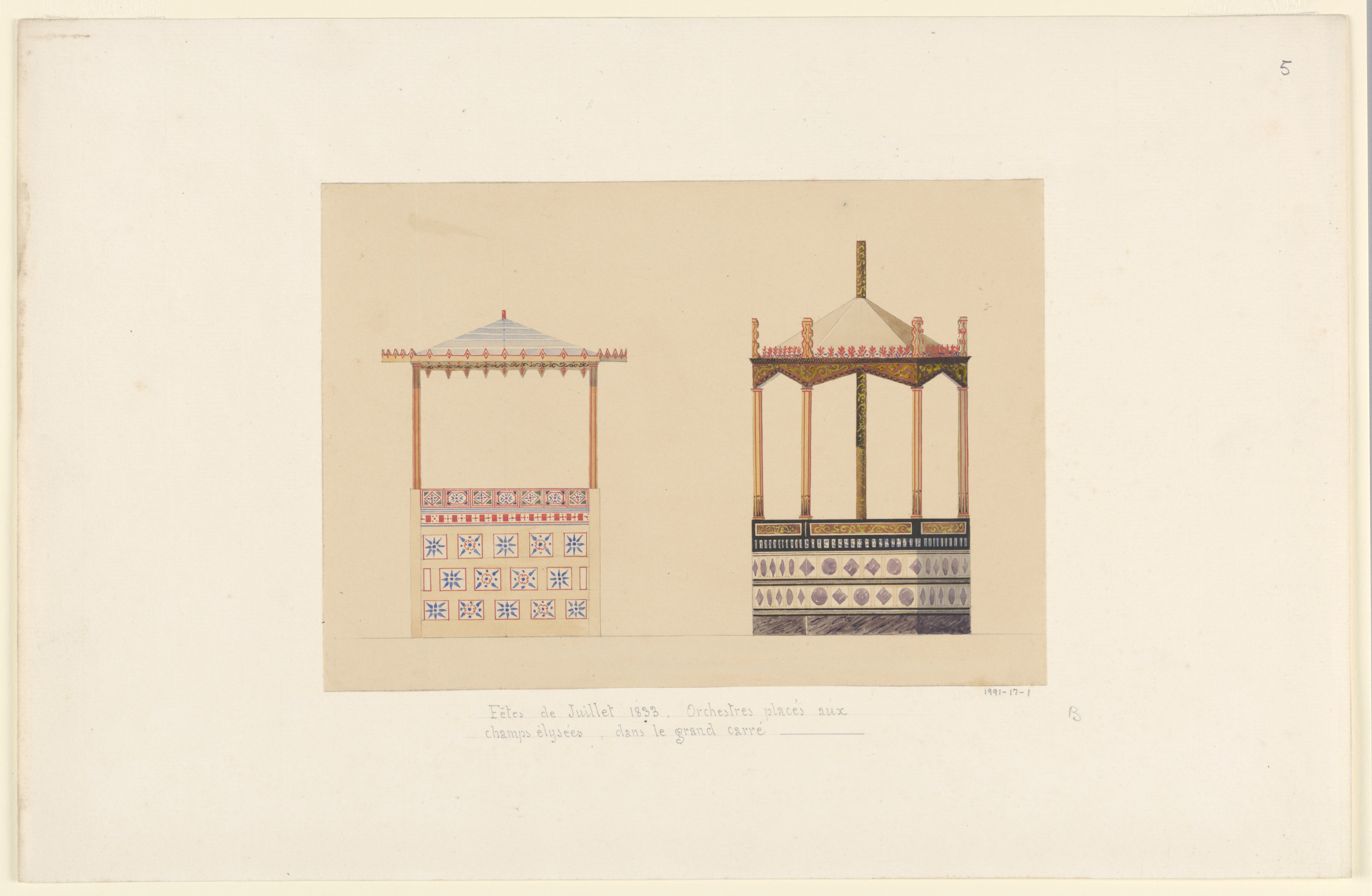
Design for two open air pavilions. At right: A polyhedron pavilion structure with a white roof decorated at its edges with red palmettes. Below is an irregular cornice colored brown and with bright green scrollwork designs, which supports four red and white striped columns with abstract black designs at their bases. A central pole runs through the structure and it is articulated with the same scrollwork design of the cornice. The closed lower portion of the structure is divided into several horizontal bands of decoration articulated with abstract and geometric forms. Left: A blue and white striped triangular roof pavilion with a red striped pole on each end. The closed lower portion of the structure is articulated with an upper band of geometric designs in red, white, and blue and rows of square plaques below with similar decorative schemes.
Text from Cooper Hewitt, Smithsonian Design Museum.
What you’re looking at
"ORCHSTRES PLACES AUX CHAMPS ELYSEES, DANS LE GRAN CARRES"
Description from Cooper Hewitt, Smithsonian Design Museum.
How it was made
- Watercolour
- Pigment in gum arabic, thinned with water and laid in transparent washes. Nothing white is painted: the light is the paper showing through.
- Graphite
- Pencil. Graphite has been used for drawing since the 1500s; in 1795 Nicolas-Jacques Conté mixed it with clay, so its hardness could be graded.
- Pen and ink
- Drawn with a quill or reed pen, often with wash added by brush to model light and shadow.
Félix Duban
French, 1797–1870
Rights and the museum’s record
Public domain. Cooper Hewitt, Smithsonian Design Museum has dedicated this image to the public domain under CC0, so anyone may copy, adapt and use it, for any purpose, without asking. Our prints and files are reproductions made from the museum’s image; the museum doesn’t endorse them.
- Object number
- 1991-17-1
- Credit
- Courtesy of Cooper Hewitt, Smithsonian Design Museum
- Type
- Drawing
- Department
- Cooper Hewitt, Smithsonian Design Museum
- Licence
- CC0 1.0 Universal
- Museum record
- See it on the museum’s site
Report this work
Close in colour