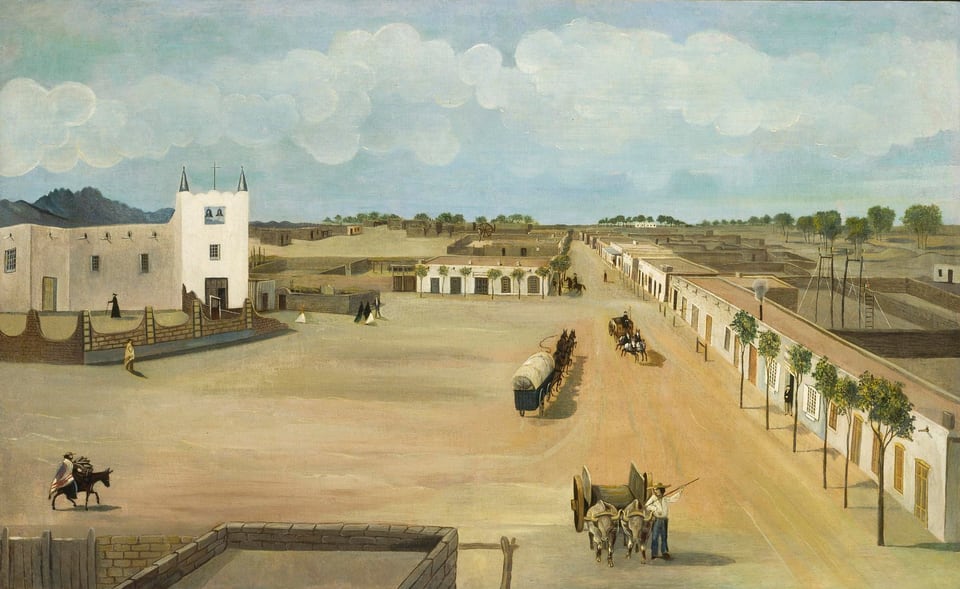
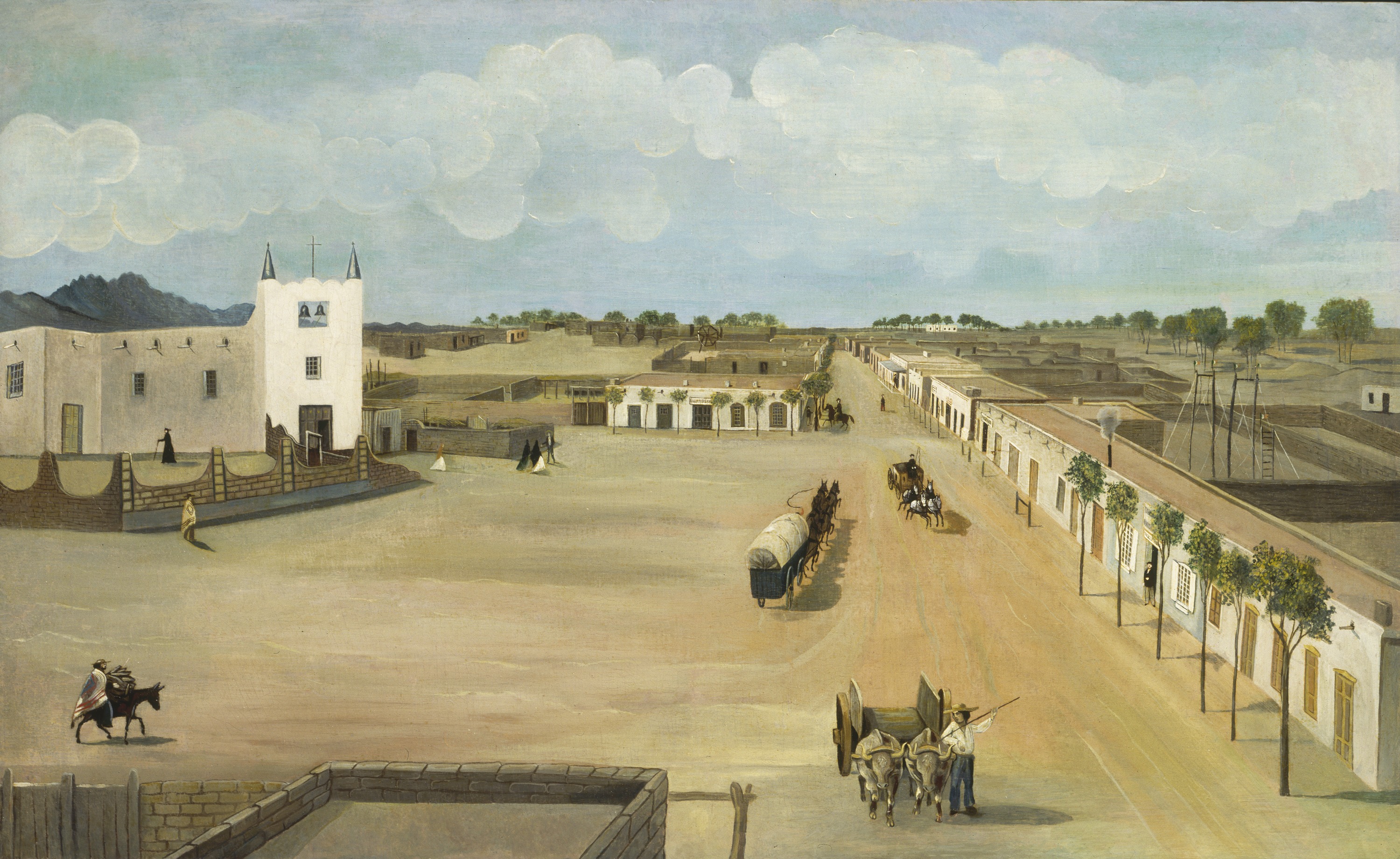
Old Mesilla Plazaca. 1885-1886
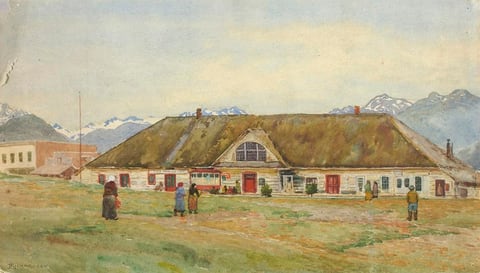
Leon Trousset's painting of Mesilla, near Las Cruces, New Mexico, takes us far into the past. More about this work
About this work
Leon Trousset's painting of Mesilla, near Las Cruces, New Mexico, takes us far into the past. Spain's King Philip II mandated the appearance of his colonial cities, where priests, tradesmen, and the king's army competed for influence. Priests often intervened between the soldiers and native peoples, and the church at left reflects their spiritual authority. Across the plaza lies a low-roofed building that likely housed the military commanders. A dirt road leading into the distance marks the town’s position on El Camino Real, the King's Highway connecting trade centers from Santa Fe to Mexico and beyond. Trousset painted this village after the territory had been ceded to the United States, but he included Mexico’s tricolored flags flying in the garrison courtyard. Mesilla’s plaza carried the history of two cultures—Spain and Mexico—even as a third power claimed the unassuming adobe settlement as its own.Exhibition Label, Smithsonian American Art Museum, 2006
Text from the Smithsonian American Art Museum.
How it was made
- Oil paint
- Pigment ground in a drying oil, usually linseed. It dries slowly, so painters could blend on the canvas, build up thin translucent glazes, and rework a picture over weeks. Canvas replaced wooden panels in the 1500s because it is lighter and can be rolled.
Leon Trousset
born France 1838-died Juarez, Mexico 1917
Rights and the museum’s record
Public domain. The Smithsonian American Art Museum has dedicated this image to the public domain under CC0, so anyone may copy, adapt and use it, for any purpose, without asking. Our prints and files are reproductions made from the museum’s image; the museum doesn’t endorse them.
- Object number
- 1951.13
- Credit
- Courtesy of the Smithsonian American Art Museum
- Type
- Painting
- Department
- Painting and Sculpture
- Licence
- CC0 1.0 Universal
- Museum record
- See it on the museum’s site
Report this work
Close in colour