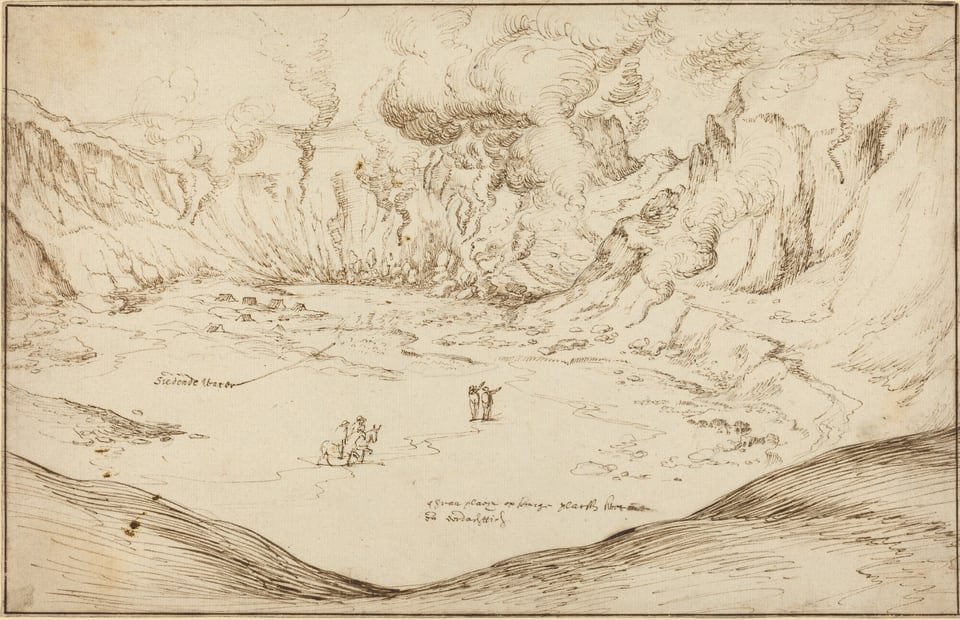
Forum Vulcani: The Hot Springs at Pozzuoli1578
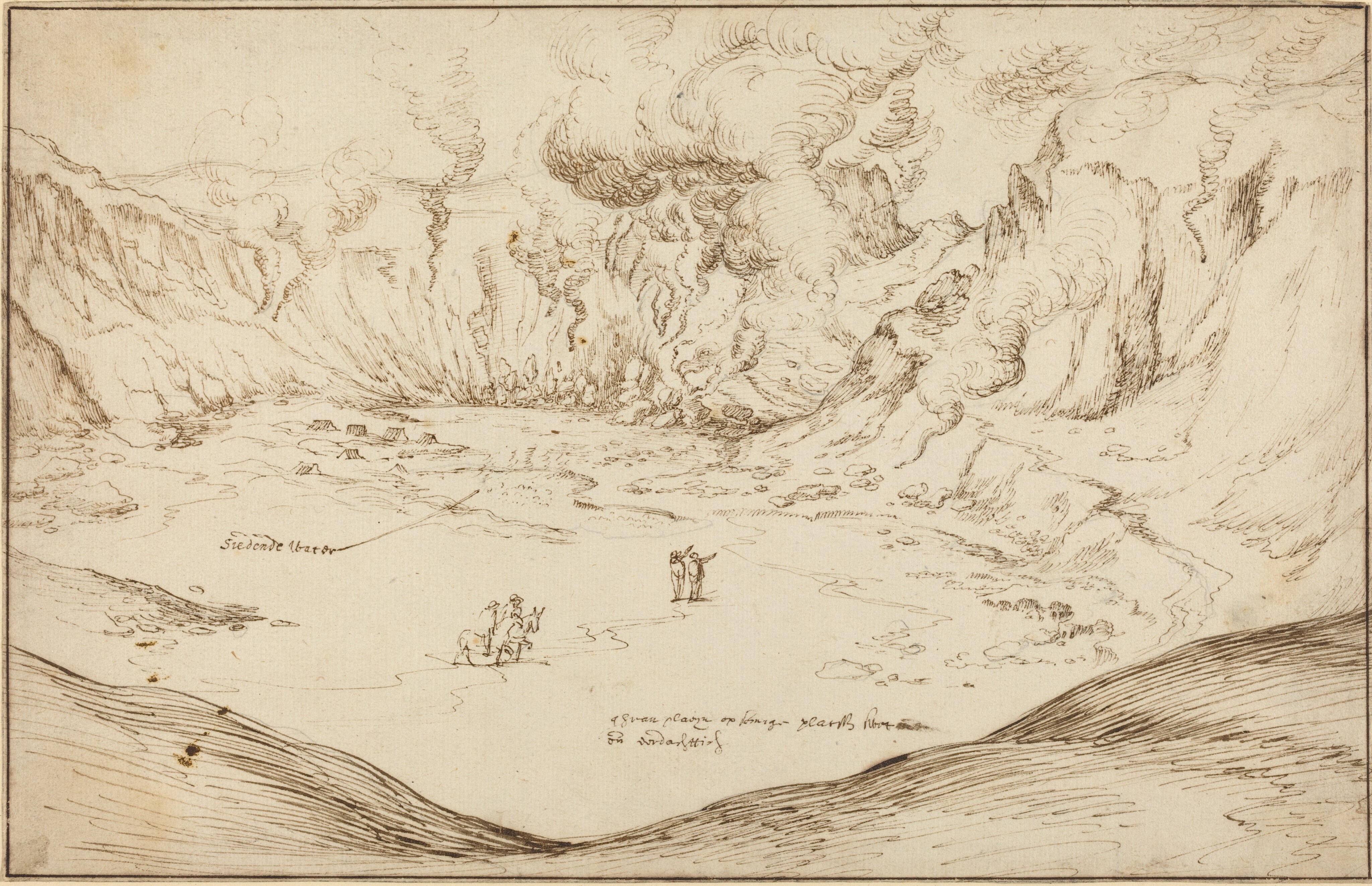
From a high vantage point we look down into the steaming crater of the Solfatara at Pozzuoli near Naples, known in antiquity as the Forum of Vulcan, where plumes of smoke rise among steep cliffs and two figures and a horse give the scene its scale. More about this work
About this work
From a high vantage point we look down into the steaming crater of the Solfatara at Pozzuoli near Naples, known in antiquity as the Forum of Vulcan, where plumes of smoke rise among steep cliffs and two figures and a horse give the scene its scale. Joris Hoefnagel travelled through Italy in the 1570s drawing towns and natural wonders, and many of his views were engraved for the Civitates Orbis Terrarum, the great atlas of the world’s cities. This pen drawing combines topographical record with fascination at the strange forces of nature.
Written by Ochre Editions.
What you’re looking at
The image shows an elevated view looking down into a crater-like landscape with steep surrounding cliffs. The horizon is high in the image, obscured by rocky formations and rising plumes of smoke. The detailed drawing has a sketch-like quality with fine lines depicting the cliffs and swirling smoke. The color palette is monochromatic, using shades of brown and beige. Two figures and a horse stand on a sloped terrain, providing scale. The crater's basin is visible, with smoke plumes and rock formations in the distance, stretching towards the horizon.
Description from the National Gallery of Art.
How it was made
- Chalk
- Natural black, red and white chalks. Used together on toned paper they could give the warmth of flesh with very little effort, and they were favourites for studies from life.
- Pen and ink
- Drawn with a quill or reed pen, often with wash added by brush to model light and shadow.
- Laid paper
- Handmade on a mould of close-set wires, which leave fine parallel lines you can see when the sheet is held to the light.
Joris Hoefnagel
Netherlandish, 1542–1600 · Born in Antwerp; died in Vienna.
Hoefnagel, the son of an Antwerp diamond merchant, travelled widely through Europe, making topographical drawings that were engraved for the city atlas Civitates orbis terrarum. He became court miniaturist first to Duke Albrecht V of Bavaria and later to Emperor Rudolf II. His meticulous watercolours of insects, flowers and animals on vellum, made with scientific precision, mark an early high point of natural history illustration and anticipate the Netherlandish flower still life.
Written by Ochre Editions.
Rights and the museum’s record
Public domain. The National Gallery of Art has dedicated this image to the public domain under CC0, so anyone may copy, adapt and use it, for any purpose, without asking. Our prints and files are reproductions made from the museum’s image; the museum doesn’t endorse them.
- Object number
- 1974.21.1
- Credit
- Courtesy National Gallery of Art, Washington
- Type
- Drawing
- Licence
- CC0 1.0 Universal
- Museum record
- See it on the museum’s site
Report this work
More by Joris Hoefnagel
All their works
Close in colour