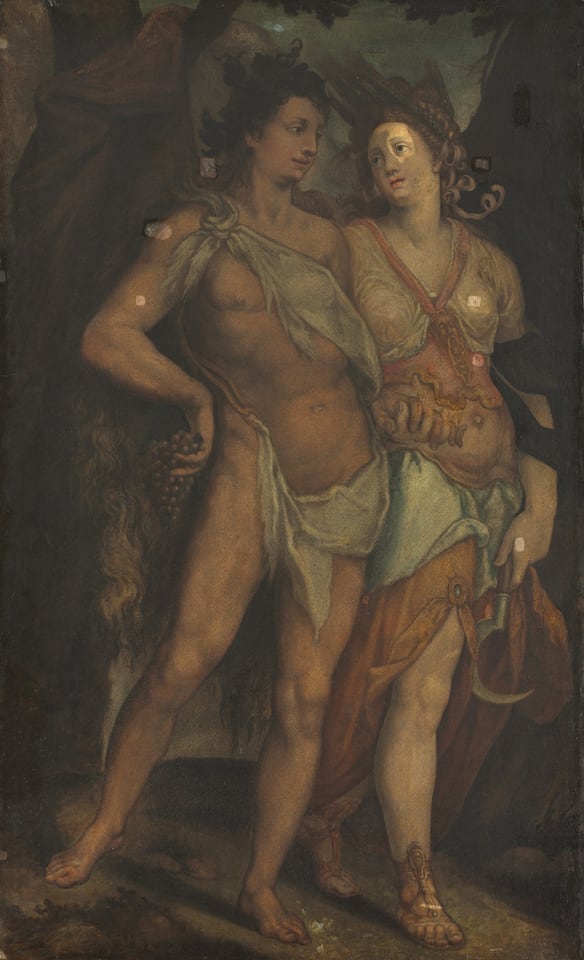
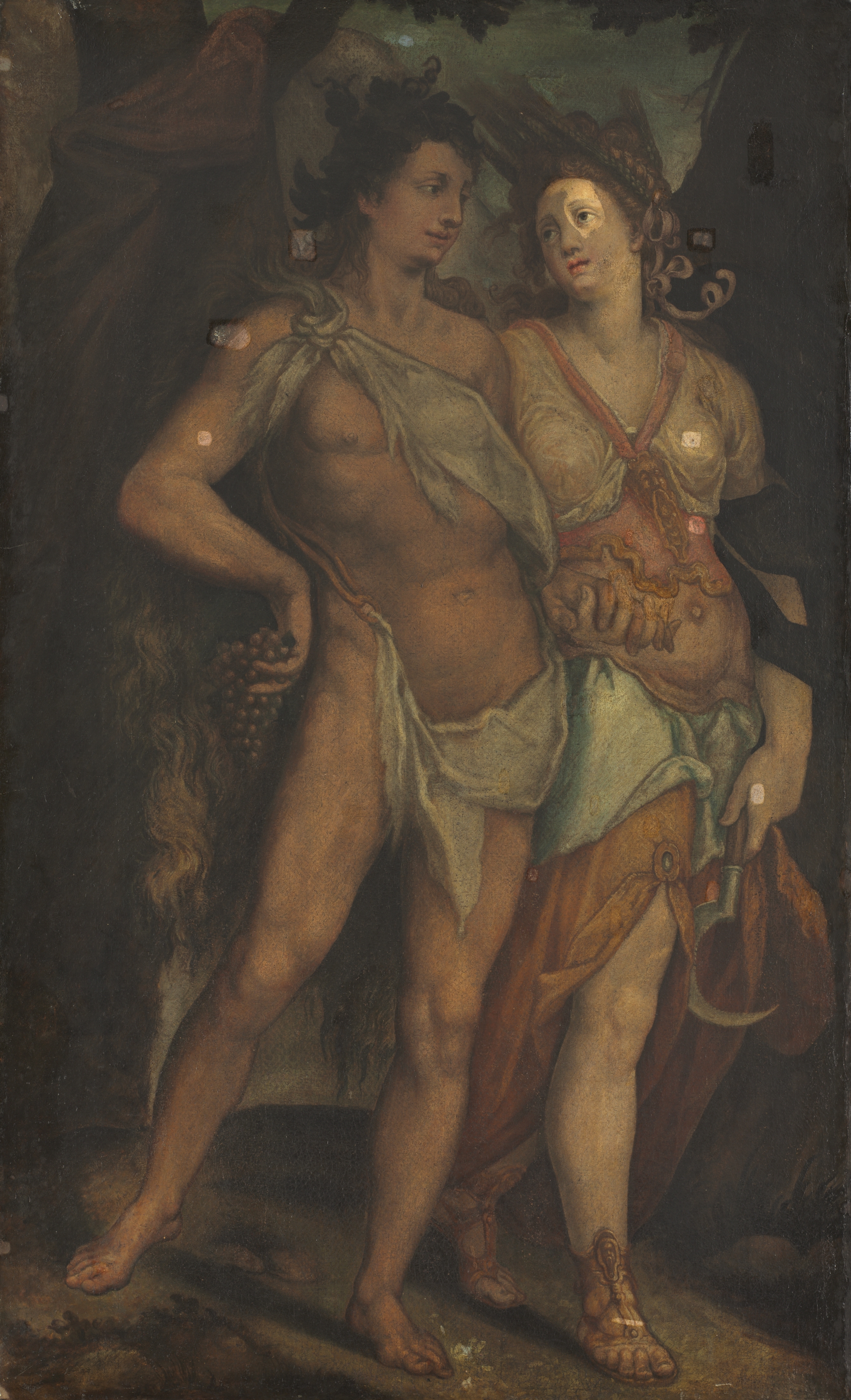
Ceres and Bacchus1600s
This painting is a copy of a print by Jan Harmensz Muller (Dutch, 1571–1628), originally based on a painting by Spranger. More about this work
About this work
This painting is a copy of a print by Jan Harmensz Muller (Dutch, 1571–1628), originally based on a painting by Spranger. Spranger often used the iconography of Ceres and Bacchus, two important agricultural deities. Muller's print has the Latin inscription Sine Cerere et Bacchio friget Venus , which translates to "without Ceres and Bacchus, Venus grows cold." The motto indicates that Love, represented by Venus, is impossible without the nourishment of food and drink, as the deities of grain and wine walk hand in hand.
Text from the Cleveland Museum of Art.
How it was made
- Oil paint
- Pigment ground in a drying oil, usually linseed. It dries slowly, so painters could blend on the canvas, build up thin translucent glazes, and rework a picture over weeks. Canvas replaced wooden panels in the 1500s because it is lighter and can be rolled.
Rights and the museum’s record
Public domain. The Cleveland Museum of Art has dedicated this image to the public domain under CC0, so anyone may copy, adapt and use it, for any purpose, without asking. Our prints and files are reproductions made from the museum’s image; the museum doesn’t endorse them.
- Object number
- 1916.805
- Credit
- Courtesy of the Cleveland Museum of Art
- Type
- Painting
- Department
- European Painting and Sculpture
- Licence
- CC0 1.0 Universal
- Museum record
- See it on the museum’s site
Report this work
More by Bartholomaeus Spranger
All their works
Close in colour