Skip to content
Ochre Editions
ArtArtistsCollectionsGalleriesDrops
SearchSign inCart (0)
The galleries · Time and place

The 20th century

Works made in the 20th century, anywhere in the world.

189 works · hang 8911 ·

Share The 20th century, in the galleries

The rooms are imagined; every work on their walls is real.

Walk this roomRehang this room

Section 1, north wall

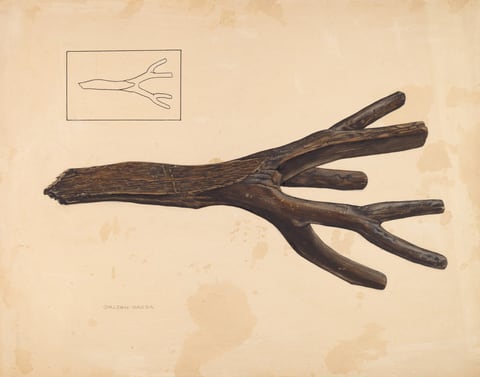
  1. A brown tree branch with several thick, bifurcated limbs is central in the image. The background is a muted beige with aged discoloration marks. The branch is oriented horizontally, with its thicker end on the left and split limbs extending to the right. In the top left corner, there is a rectangular inset with a simplified line drawing of the branch's shape.
    BootjackLloyd A. Davidson, c. 1942Courtesy National Gallery of Art, Washington
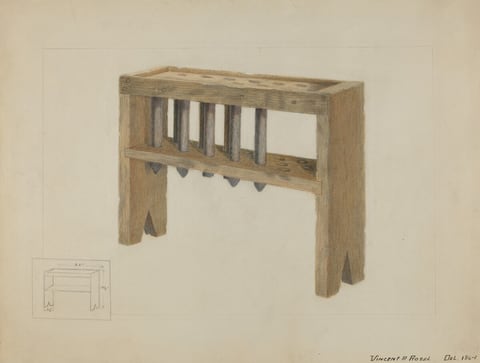
  2. The image shows a wooden frame with six vertical cylindrical pegs evenly spaced. The color palette consists of light and medium brown tones. The structure is angled to the right with four visible legs. In the bottom left corner, there is a smaller sketched diagram with measurements.
    Candle MoldVincent P. Rosel, c. 1936Courtesy National Gallery of Art, Washington
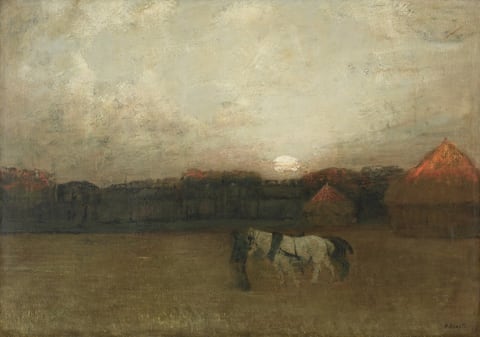
  3. The Stubble Field, by Henry Golden Dearth, c. 1909
    The Stubble FieldHenry Golden Dearth, c. 1909Courtesy of the Cleveland Museum of Art
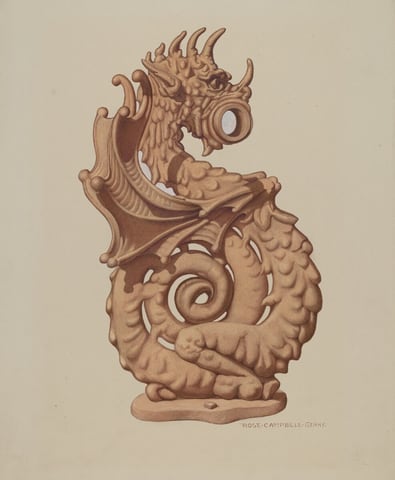
  4. The sculpture depicts a mythical creature resembling a dragon. It has a long spiraled body and an intricate head with spiky protrusions. The sculpture is a warm brown color. The dragon has bat-like wings, an open mouth, detailed texture with scales, and is standing on a small base.
    FenceRose Campbell-Gerke, c. 1941Courtesy National Gallery of Art, Washington

Section 1, south wall
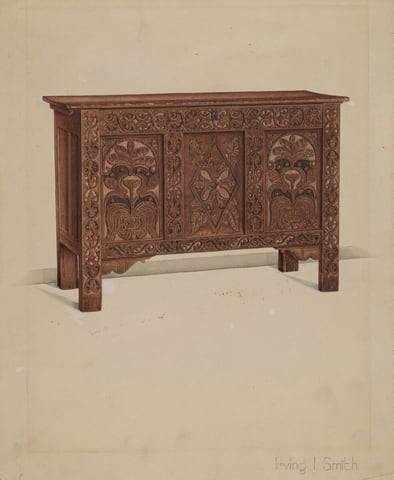
  1. The image shows a large wooden chest with intricate floral patterns on the front panels. The color palette consists of various shades of brown, emphasizing the natural wood tones. The chest is centrally positioned on a plain background with subtle shadows indicating it is slightly elevated.
    ChestIrving I. Smith, c. 1936Courtesy National Gallery of Art, Washington
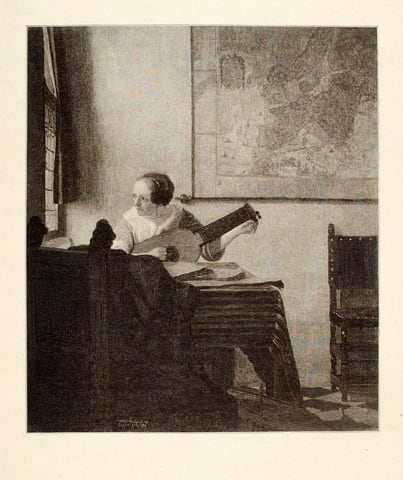
  2. Lady with the Lute, by Henry Wolf, 1909
    Lady with the LuteHenry Wolf, 1909Courtesy of the Smithsonian American Art Museum
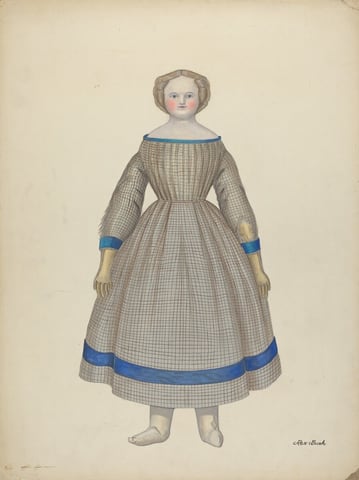
  3. The image depicts a person standing upright. The person has a round face with a small mouth and rosy cheeks, and their hair is styled smoothly with a middle part. They are wearing a long-sleeved dress with a checkered pattern in subdued colors, highlighted with blue bands around the sleeves and hem. The dress has a fitted bodice and a full skirt. Bare feet are visible under the dress. The background is plain and neutral, and there is a signature in the lower right corner.
    Doll - "Emily"Rex F. Bush, c. 1938Courtesy National Gallery of Art, Washington
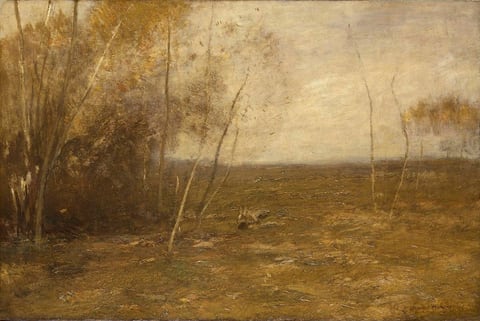
  4. The Sprout Lot, by J. Francis Murphy, 1915
    The Sprout LotJ. Francis Murphy, 1915Courtesy of the Smithsonian American Art Museum

Section 2, south wall
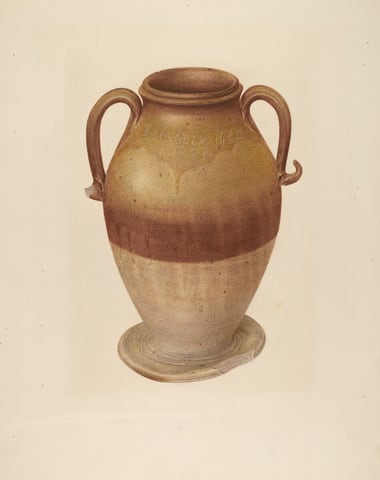
  1. The image shows a large ceramic vase with two curved handles positioned near the top on either side. The vase has an earthy color palette with shades of brown, beige, and a subtle hint of reddish-brown forming a band around its middle. The vase is centrally placed on a flat surface, and both handles extend outward at the top.
    VaseIsadore Goldberg, c. 1939Courtesy National Gallery of Art, Washington
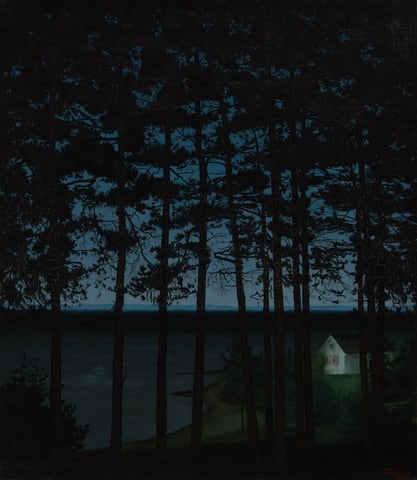
  2. Dark twilight scene of a a brightly illuminated white cottage along the shore of an expansive body of water, seen through a thick of silhouetted trees.
    Fisherman's CottageHarald Oscar Sohlberg, 1906Courtesy of the Art Institute of Chicago
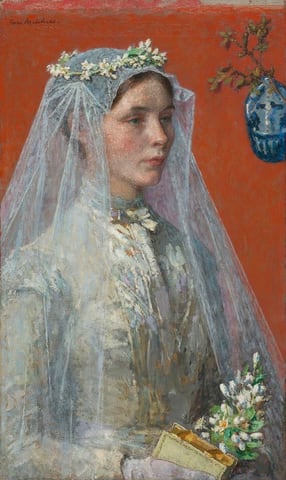
  3. The Bride, by Gari Melchers, ca. 1907
    The BrideGari Melchers, ca. 1907Courtesy of the Smithsonian American Art Museum
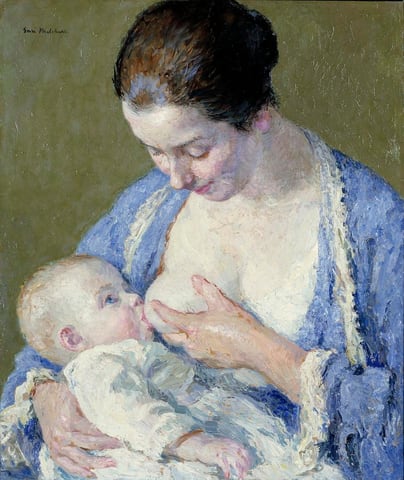
  4. Mother and Child, by Gari Melchers, ca. 1920
    Mother and ChildGari Melchers, ca. 1920Courtesy of the Smithsonian American Art Museum

Section 2, north wall
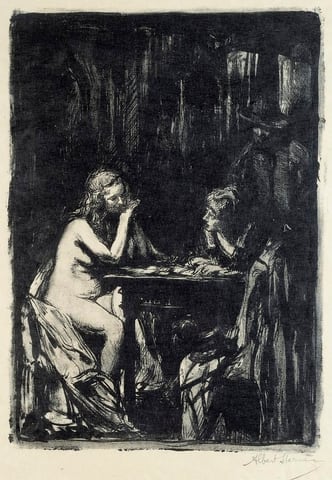
  1. The Stranger, by Albert Sterner, 1916
    The StrangerAlbert Sterner, 1916Courtesy of the Smithsonian American Art Museum
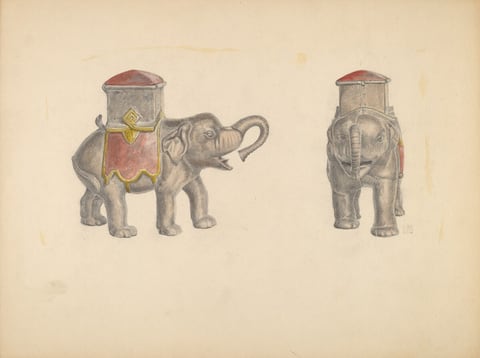
  2. This is a drawing of two ornate elephants. The image depicts two stylized elephants, each adorned with decorative elements. Both elephants are shown carrying a structure on their backs, resembling a small tower or box with a red domed top. The left elephant is turned to the side, its trunk raised. The right elephant faces forward. Each structure on their backs is detailed with intricate designs, including a diamond shape on the side. The overall composition suggests a ceremonial or regal theme. The subtle use of colors like red and gold enhances the ornate appearance. The coloring and shading indicate an attention to detail typical of deliberately crafted illustrations.
    Iron Bank ElephantZ.S. Lupus, c. 1938Courtesy National Gallery of Art, Washington
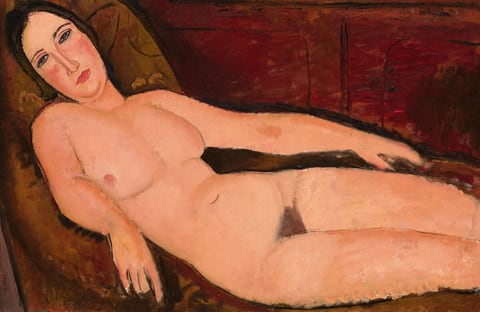
  3. A nude woman lying across a brown divan in front of a russet-red wall is loosely painted with areas of mottled color in this horizontal composition. The woman fills the wide canvas so her head is angled into the upper left corner, and her legs extend off the right edge of the composition below the knees. Her long, oval face rests back against the couch, and she looks at us with slitted, almond-shaped eyes under dark, shallowly arched brows. She has a long, straight nose, flushed cheeks, a double chin, and her pink lips are closed. Her breasts fall to each side so we only see the pink nipple closer to us. She has a rounded belly and a triangle of brown hair at her groin. Her arms rest alongside her body. The couch has a low, upholstered arms sweeping down the sides. Black lines in the red wall behind the couch suggest molding or cabinetry. The artist signed the painting in the upper right corner, “modigliani.”
    Nude on a DivanAmedeo Modigliani, 1918Courtesy National Gallery of Art, Washington
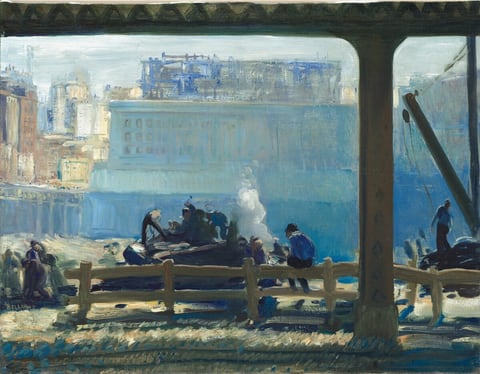
  4. From under an elevated train track, we look at a cluster of people hammering and working on the far side of a wooden fence, all against a silvery-blue building that fills most of the background in this horizontal painting. The scene is loosely painted mostly in tones of hazy and saturated blues, so many of the details are indistinct. About a quarter of the way in from the right edge of the composition, a thin iron column holds up the train platform. The column nearly spans the height of the painting, and the track it supports runs across the top edge of the canvas. At the foot of the column, along the bottom edge, are two parallel tracks embedded in an area otherwise painted with short, diagonal strokes in topaz blue, olive green, and straw yellow. Just beyond the tracks, the split-rail wooden fence runs across most of the painting, though there is an opening at the left edge of the canvas. A man sits with his back to us on the railing to our right of center. He wears a dark cap, a lapis-blue shirt, and navy-blue pants. Several men work on or near a mound-shaped form, perhaps a piece of machinery, just beyond the fence, near the center of the painting. One man holds a hammer high overhead while another reaches down or strikes the mound with his feet planted wide. More people work together to our left, and a man to our right stands near a crane. The people and these areas are painted with broad strokes and touches of cobalt blue, charcoal gray, khaki brown, and a few swipes of shell pink and bright white. A puff of white smoke billows up behind the central group, before the land drops precipitously away. The chasm is painted with shimmering tones of aquamarine and cerulean blue. A sky-blue, rectangular building perches at the far edge. A few windows are outlined in royal blue to our left but the rest of the building is loosely painted with long, vertical strokes so no architectural details can be made out. Behind this structure are more city buildings, suggested with strokes of muted rust red, parchment and bright white, and cobalt blue. The ice-blue sky fills the band between the top of the buildings and the train track running overhead. The artist signed his name near the lower left corner, “BELLOWS.”
    Blue MorningGeorge Bellows, 1909Courtesy National Gallery of Art, Washington

Walk on

  • The 20th century, room 2
  • More by George Bellows 6 works
  • More American Gilded Age 67 works
Ochre Editions

The world's museums, on your wall. Every work here is a reproduction of a public-domain original, credited to the museum that holds it.

Shop

All artCollectionsLimited dropsPrints and framing

Help

Find an orderShippingReturnsVerify a certificate

About

About Ochre EditionsMuseum creditsFor agentsDevelopers

Legal

Terms of UseTerms of SaleLimited Editions and CertificatesPrivacy PolicyCookie PolicyAcceptable Use PolicyAgent & API TermsCopyright and DMCA PolicyPrinting Your Own PhotoVulnerability Disclosure PolicyAccessibility StatementOpen-Access Credits
© 2026 Ochre EditionsPrices in US dollars. Prints ship within the United States.