Skip to content
Ochre Editions
ArtArtistsCollectionsGalleriesDrops
SearchSign inCart (0)
The galleries · Time and place

The 20th century

Works made in the 20th century, anywhere in the world.

189 works · hang 640 ·

Share The 20th century, in the galleries

The rooms are imagined; every work on their walls is real.

Walk this roomRehang this room

Section 1, north wall

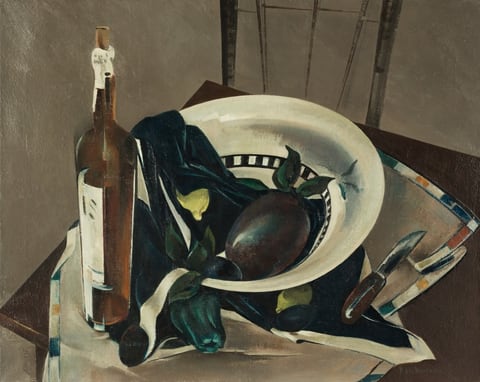
  1. Still Life, by Preston Dickinson, c. 1924
    Still LifePreston Dickinson, c. 1924Courtesy of the Cleveland Museum of Art
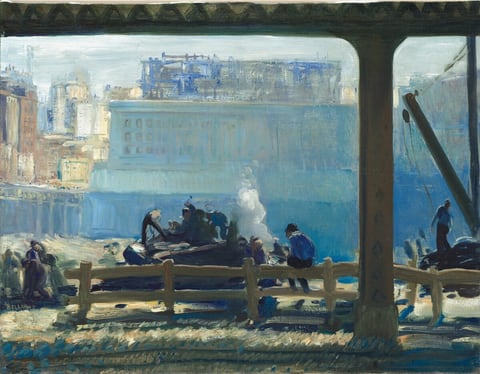
  2. From under an elevated train track, we look at a cluster of people hammering and working on the far side of a wooden fence, all against a silvery-blue building that fills most of the background in this horizontal painting. The scene is loosely painted mostly in tones of hazy and saturated blues, so many of the details are indistinct. About a quarter of the way in from the right edge of the composition, a thin iron column holds up the train platform. The column nearly spans the height of the painting, and the track it supports runs across the top edge of the canvas. At the foot of the column, along the bottom edge, are two parallel tracks embedded in an area otherwise painted with short, diagonal strokes in topaz blue, olive green, and straw yellow. Just beyond the tracks, the split-rail wooden fence runs across most of the painting, though there is an opening at the left edge of the canvas. A man sits with his back to us on the railing to our right of center. He wears a dark cap, a lapis-blue shirt, and navy-blue pants. Several men work on or near a mound-shaped form, perhaps a piece of machinery, just beyond the fence, near the center of the painting. One man holds a hammer high overhead while another reaches down or strikes the mound with his feet planted wide. More people work together to our left, and a man to our right stands near a crane. The people and these areas are painted with broad strokes and touches of cobalt blue, charcoal gray, khaki brown, and a few swipes of shell pink and bright white. A puff of white smoke billows up behind the central group, before the land drops precipitously away. The chasm is painted with shimmering tones of aquamarine and cerulean blue. A sky-blue, rectangular building perches at the far edge. A few windows are outlined in royal blue to our left but the rest of the building is loosely painted with long, vertical strokes so no architectural details can be made out. Behind this structure are more city buildings, suggested with strokes of muted rust red, parchment and bright white, and cobalt blue. The ice-blue sky fills the band between the top of the buildings and the train track running overhead. The artist signed his name near the lower left corner, “BELLOWS.”
    Blue MorningGeorge Bellows, 1909Courtesy National Gallery of Art, Washington
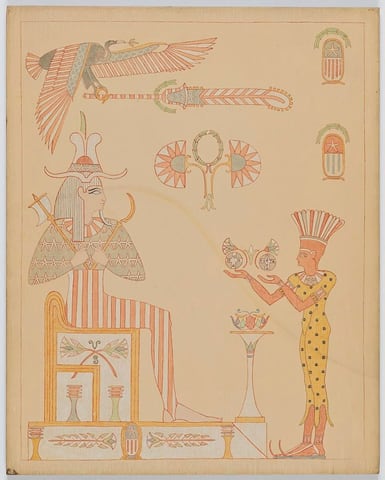
  3. THE TRIUMPH OF UNCLE SAM
    The Triumph of Uncle SamVictor Wilbour, 1917Courtesy of Cooper Hewitt, Smithsonian Design Museum
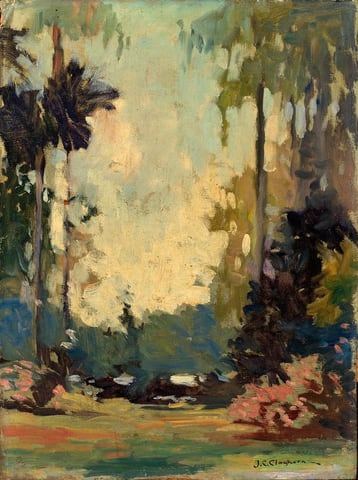
  4. A Florida Park, by Joseph C. Claghorn, before 1935
    A Florida ParkJoseph C. Claghorn, before 1935Courtesy of the Smithsonian American Art Museum

Section 1, south wall
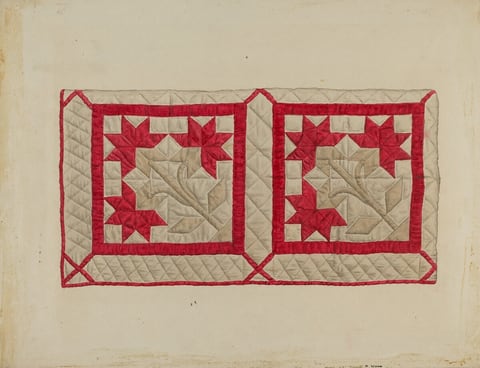
  1. The image shows two large quilt blocks with a matching design, side by side. Each block consists of red and beige fabric with quilted stitching creating a textured appearance. The color palette includes primarily red, beige, and dark stitching outlining the patterns. The quilt blocks are placed centrally on a light-colored surface.
    Patchwork QuiltPaul Ward, c. 1936Courtesy National Gallery of Art, Washington
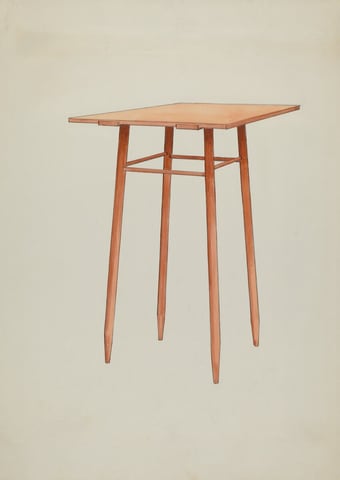
  2. The image shows a tall, narrow wooden table with a square top and four long, slender legs. The color palette is warm with shades of light brown and reddish-brown on the table. Positioned centrally, the table stands against a plain, light-colored background.
    Shaker StandRay Holden, c. 1936Courtesy National Gallery of Art, Washington
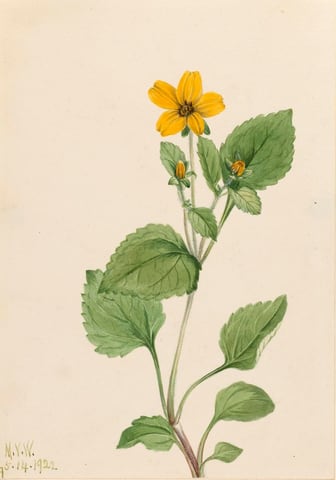
  3. Golden Star (Chrysogonum virginianum), by Mary Vaux Walcott, 1922
    Golden Star (Chrysogonum virginianum)Mary Vaux Walcott, 1922Courtesy of the Smithsonian American Art Museum
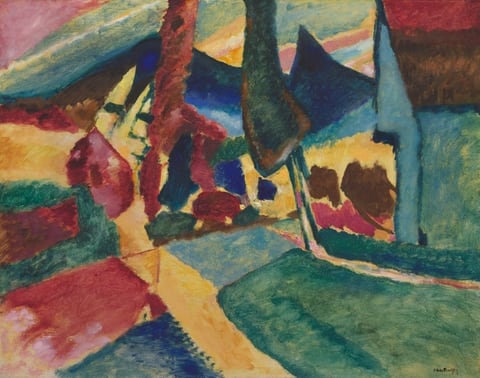
  4. Vibrant yellow, red, blue, and green painting of landscape with trees and mountains.
    Landscape with Two PoplarsVasily Kandinsky, 1912Courtesy of the Art Institute of Chicago

Section 2, south wall
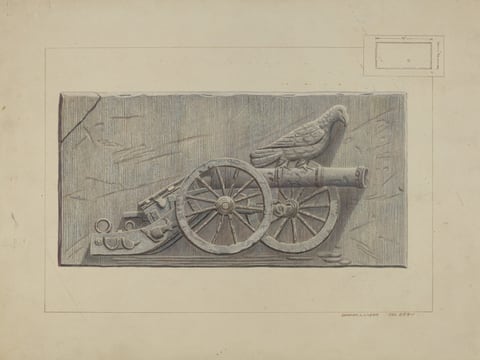
  1. This image shows an engraved design featuring a cannon with large wheels next to an eagle perched on top, situated on the left side of a rectangular stone slab. The color scheme is predominantly grayscale with subtle hints of blue and gray tones throughout the stone surface. The cannon is positioned slightly to the left in the composition, with its barrel pointing to the right, while the eagle is perched on the cannon barrel facing forward, wings tucked close to its body. To accompany the cannon, a stack of cannonballs is carved on the lower left, further anchoring the scene within the carved rectangle.
    Bas ReliefEdward L. Loper, c. 1938Courtesy National Gallery of Art, Washington
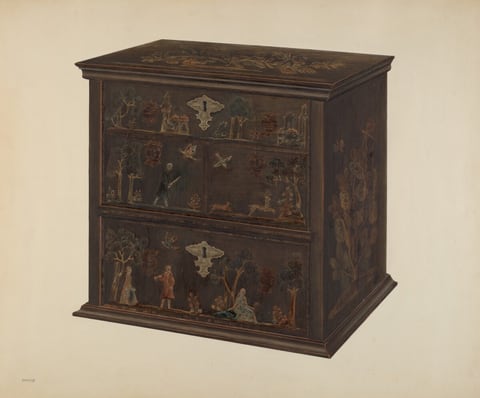
  2. This is a painting of a decorative wooden chest. The chest has intricate designs, such as painted figures, trees, and animals, creating a narrative scene on its front side, and floral motifs on its sides. The craftsmanship suggests it is an ornate object, potentially used for storage or as an ornamental piece. The painting focuses on the texture and details of the wood and decoration with precision, in a traditional arts and crafts or folk art style, emphasizing fine detail and storytelling through imagery on functional furniture.
    Jewel CabinetCharles Henning, c. 1939Courtesy National Gallery of Art, Washington
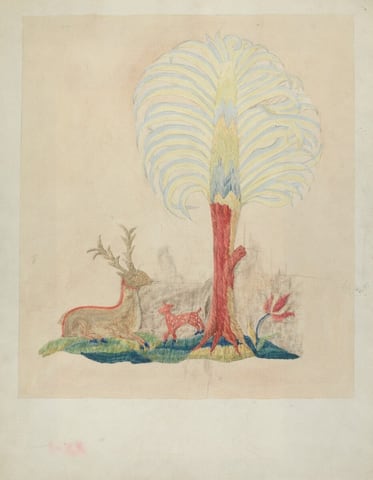
  3. This is a painting of two deer under a tree. The larger deer has antlers and is resting next to a smaller deer. They are depicted with red and brown strokes. The background shows a patch of earth and grass in green and blue. Beside the deer is a tree with colorful leaves or a feather-like structure and a red trunk. A pink flower is near the tree's base. The background is neutral. This painting is in the style of Henri Rousseau.
    Crewel EmbroideryHelen Dana, 1935/1942Courtesy National Gallery of Art, Washington
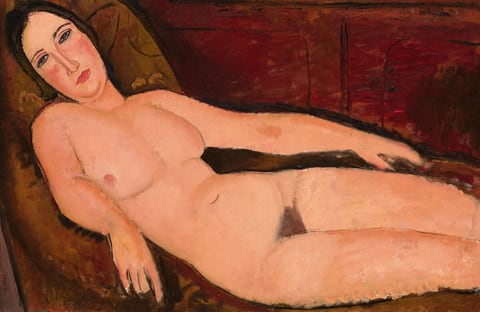
  4. A nude woman lying across a brown divan in front of a russet-red wall is loosely painted with areas of mottled color in this horizontal composition. The woman fills the wide canvas so her head is angled into the upper left corner, and her legs extend off the right edge of the composition below the knees. Her long, oval face rests back against the couch, and she looks at us with slitted, almond-shaped eyes under dark, shallowly arched brows. She has a long, straight nose, flushed cheeks, a double chin, and her pink lips are closed. Her breasts fall to each side so we only see the pink nipple closer to us. She has a rounded belly and a triangle of brown hair at her groin. Her arms rest alongside her body. The couch has a low, upholstered arms sweeping down the sides. Black lines in the red wall behind the couch suggest molding or cabinetry. The artist signed the painting in the upper right corner, “modigliani.”
    Nude on a DivanAmedeo Modigliani, 1918Courtesy National Gallery of Art, Washington

Section 2, north wall
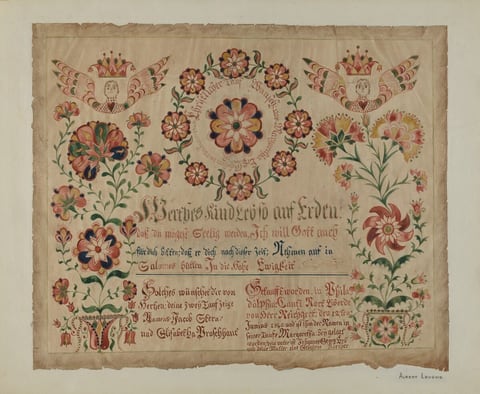
  1. This is a painting of a colorful floral design with text. The artwork features stylized flowers in shades of red, green, and yellow scattered across the page. In the center, there is calligraphic text in varying boldness and fonts, likely in German. Two symmetrical bird-like figures with human faces and crowns are above the text. The piece combines imagery with artistic lettering in a style reminiscent of traditional Pennsylvania German fraktur. The artwork is bordered by a thin line, suggesting it's part of a larger artifact or document.
    Pa. German Birth CertificateAlbert Levone, c. 1940Courtesy National Gallery of Art, Washington
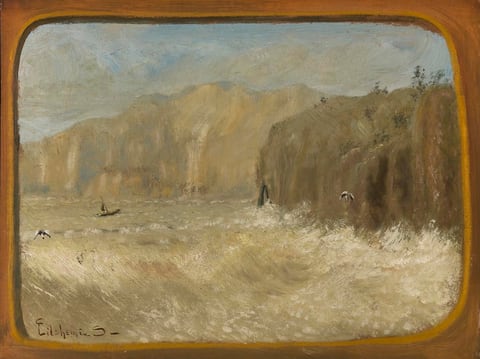
  2. Two Gulls and Cliffs, by Louis M. Eilshemius, ca. 1913-1921
    Two Gulls and CliffsLouis M. Eilshemius, ca. 1913-1921Courtesy of the Smithsonian American Art Museum
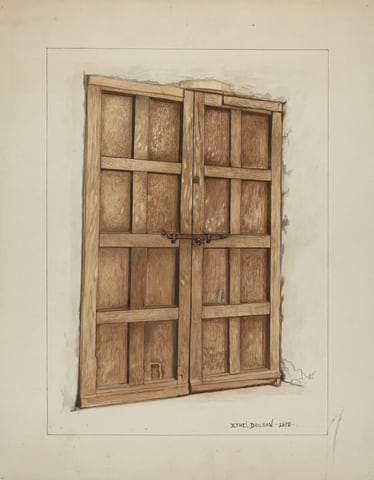
  3. This is a drawing of a wooden window shutter in a light-colored wall. The detailed study shows the craftsmanship of the shutter, with a focus on texture, form, wood grain, and panels. The aged and weathered texture suggests exposure to the elements. The shutter is secured with a metal latch in the center. The wall is subtly shaded to imply depth and setting, with slight distress marks adding to the aged ambiance of the scene.
    Sacristy Door at Mission San Juan BautistaEthel Dougan, 1938Courtesy National Gallery of Art, Washington
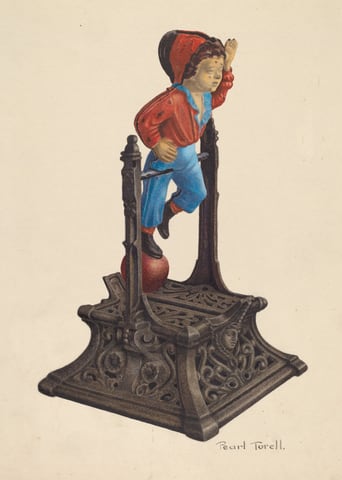
  4. The sculpture depicts a young boy dressed in a bright red coat, blue shirt, and blue pants, with black shoes. He is wearing a black hat with a red rim and has curly hair. The boy is balanced on one foot atop a red ball, with one leg lifted behind him and one hand held high above his head. The sculpture is made of painted, cast metal with intricate designs and textures. The boy stands on an ornately decorated dark pedestal.
    Toy BankPearl Torell, c. 1939Courtesy National Gallery of Art, Washington

Walk on

  • The 20th century, room 2
  • Pearl Torell's contemporaries 8 works
  • More American folk and design 90 works
Ochre Editions

The world's museums, on your wall. Every work here is a reproduction of a public-domain original, credited to the museum that holds it.

Shop

All artCollectionsLimited dropsPrints and framing

Help

Find an orderShippingReturnsVerify a certificate

About

About Ochre EditionsMuseum creditsFor agentsDevelopers

Legal

Terms of UseTerms of SaleLimited Editions and CertificatesPrivacy PolicyCookie PolicyAcceptable Use PolicyAgent & API TermsCopyright and DMCA PolicyPrinting Your Own PhotoVulnerability Disclosure PolicyAccessibility StatementOpen-Access Credits
© 2026 Ochre EditionsPrices in US dollars. Prints ship within the United States.