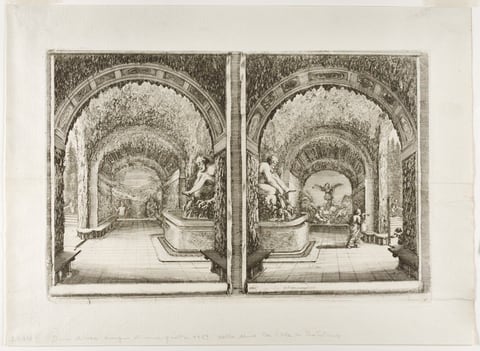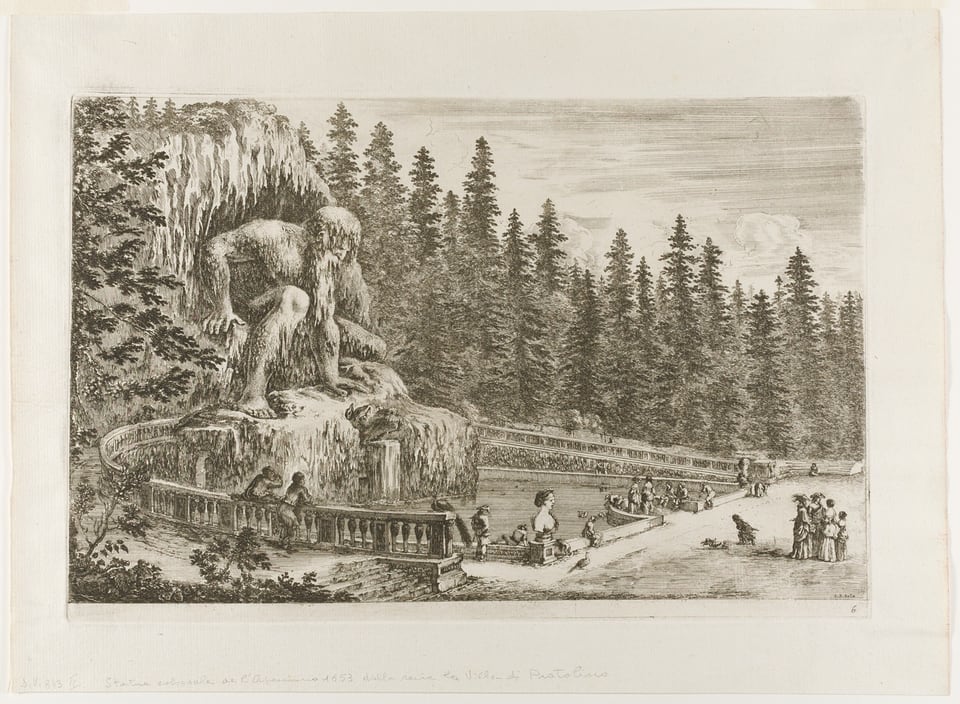
The Colossal Statue of the Apennines, from Views of Villa di Pratolinoc. 1653
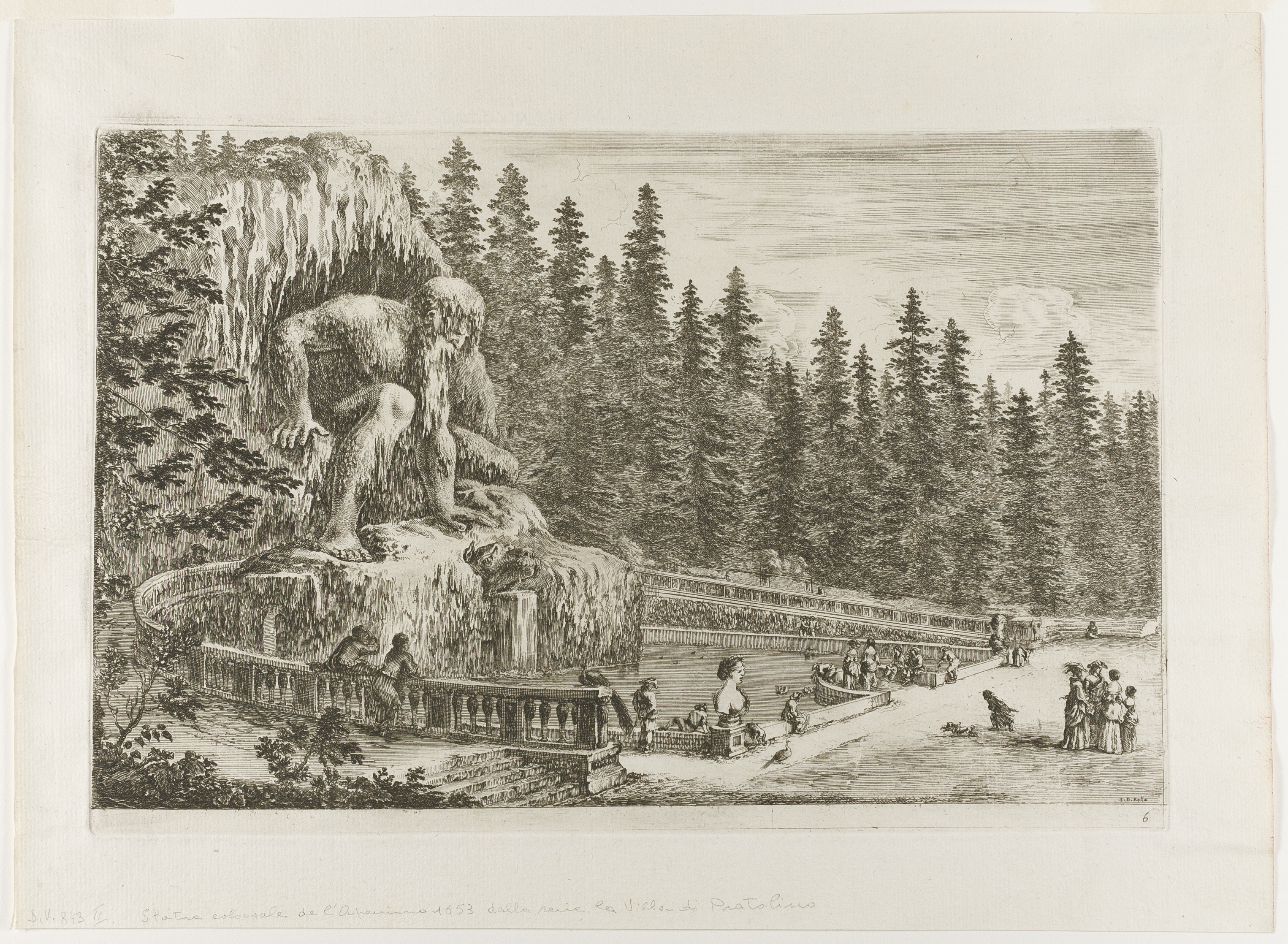
The Colosso dell’Appennino, a giant crouching figure personifying the Apennine mountains, created by the sculptor Giambologna around 1580 for the Medici villa at Pratolino near Florence, rises beside its pool in this etching by Stefano della Bella. More about this work
About this work
The Colosso dell’Appennino, a giant crouching figure personifying the Apennine mountains, created by the sculptor Giambologna around 1580 for the Medici villa at Pratolino near Florence, rises beside its pool in this etching by Stefano della Bella. The Florentine printmaker made a series of views of the Pratolino gardens around 1653, recording their fountains, grottoes and marvels. His light, lively line captures the play of water and foliage around the colossal stone figure.
Written by Ochre Editions.
What you’re looking at
A work made of etching in black on ivory laid paper.
Description from the Art Institute of Chicago.
How it was made
- Etching
- The artist draws with a needle through a waxy coating on a copper plate, and acid bites the exposed lines. The plate is then inked, wiped and printed under pressure, so the line keeps the freedom of drawing.
- Laid paper
- Handmade on a mould of close-set wires, which leave fine parallel lines you can see when the sheet is held to the light.
Stefano della Bella
Italian, 1610–1664
Della Bella trained in Florence and became one of the finest etchers of the seventeenth century, working for the Medici and drawing inspiration from Jacques Callot. He spent about ten years in Paris from 1639, working for publishers and the court, before returning to Florence. His more than a thousand etchings range from festivals and theatre spectacles to landscapes, animals and ornament, drawn with a light, lively needle.
Written by Ochre Editions.
Rights and the museum’s record
Public domain. The Art Institute of Chicago has dedicated this image to the public domain under CC0, so anyone may copy, adapt and use it, for any purpose, without asking. Our prints and files are reproductions made from the museum’s image; the museum doesn’t endorse them.
- Object number
- 1990.501.6
- Credit
- Courtesy of the Art Institute of Chicago
- Type
- Department
- Prints and Drawings
- Licence
- CC0 1.0 Universal
- Museum record
- See it on the museum’s site
Report this work
More by Stefano della Bella
All their works
Close in colour