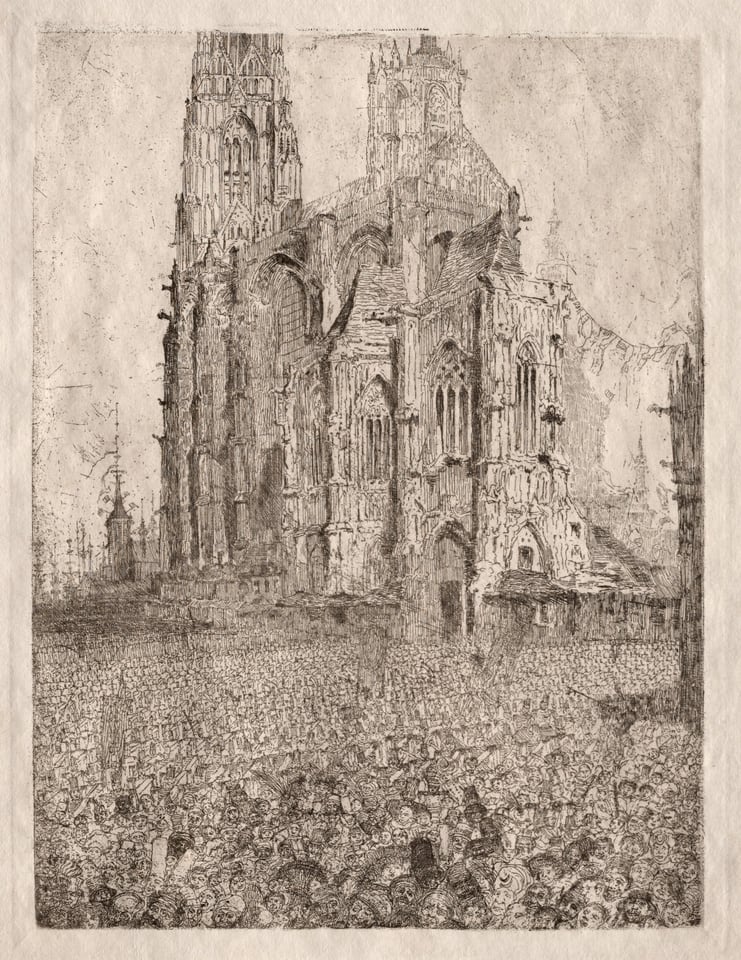
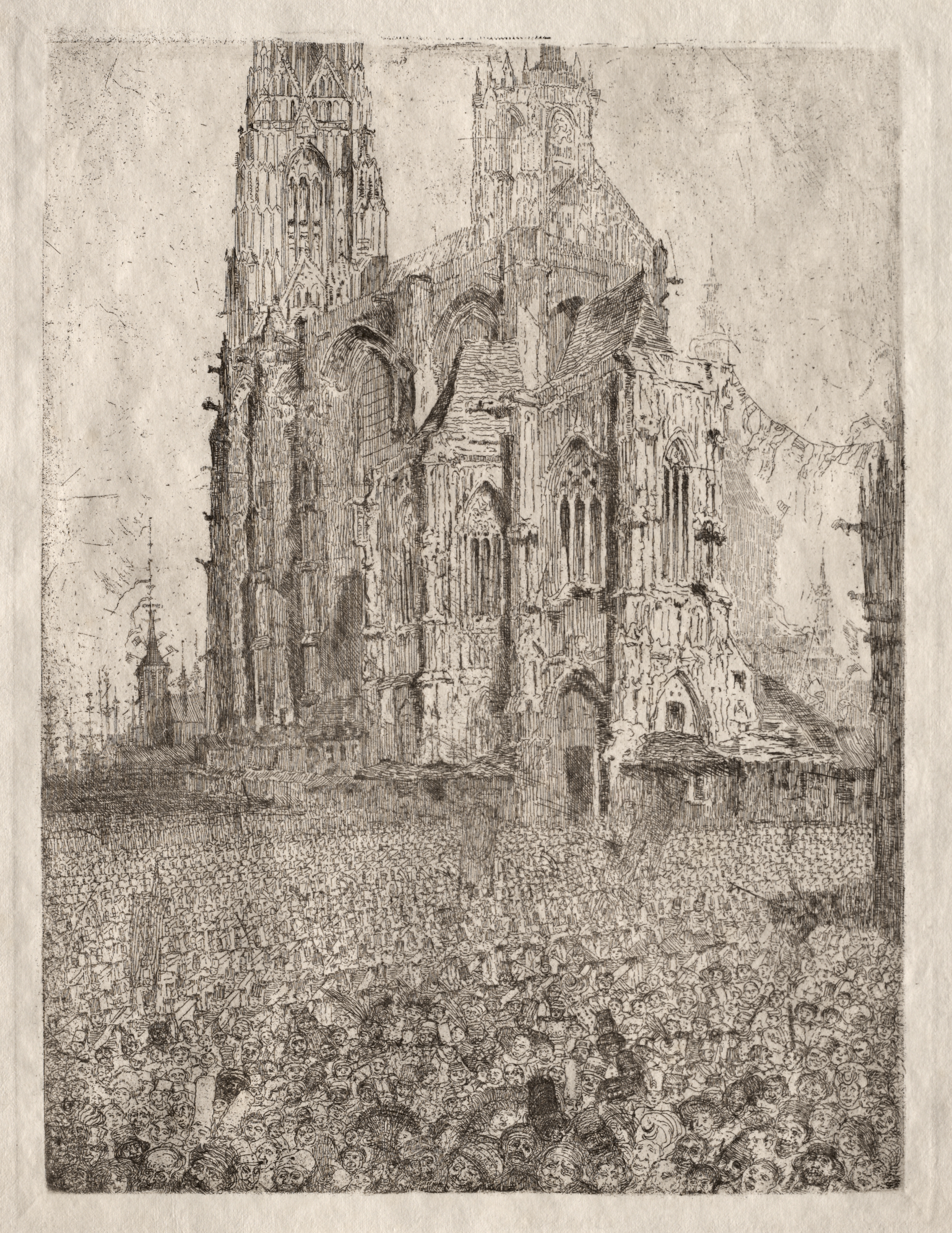
The Cathedral1886
James Ensor used tiny, repetitive marks possible with etching to develop a new, expressive style that contrasted with that of most of his contemporaries. More about this work
About this work
James Ensor used tiny, repetitive marks possible with etching to develop a new, expressive style that contrasted with that of most of his contemporaries. The Gothic architecture, worn facade, and overwhelming scale of the cathedral seen here in exacting detail show that it has withstood the test of time. Ensor juxtaposed the building with a dense crowd of grotesque figures that push forward seemingly irrationally, presenting a symbolic contrast between their whims and the permanence of both the church and the past.
Text from the Cleveland Museum of Art.
How it was made
- Etching
- The artist draws with a needle through a waxy coating on a copper plate, and acid bites the exposed lines. The plate is then inked, wiped and printed under pressure, so the line keeps the freedom of drawing.
James Ensor
Belgian, 1860–1949
Rights and the museum’s record
Public domain. The Cleveland Museum of Art has dedicated this image to the public domain under CC0, so anyone may copy, adapt and use it, for any purpose, without asking. Our prints and files are reproductions made from the museum’s image; the museum doesn’t endorse them.
- Object number
- 2003.46
- Credit
- Courtesy of the Cleveland Museum of Art
- Type
- Department
- Prints
- Licence
- CC0 1.0 Universal
- Museum record
- See it on the museum’s site
Report this work
Close in colour