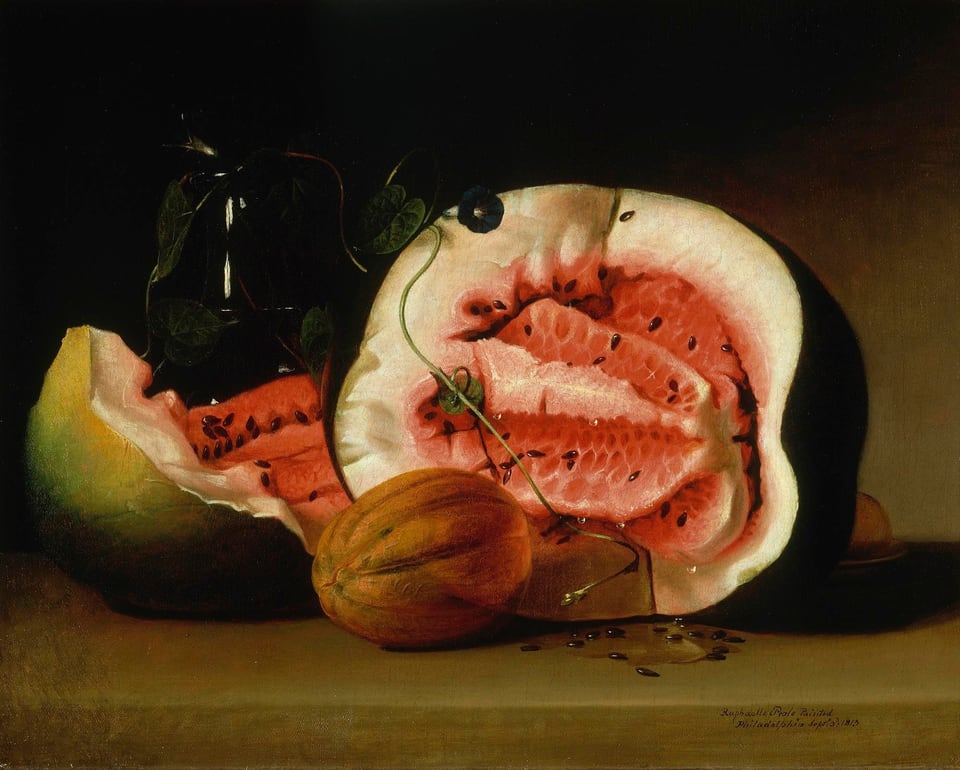
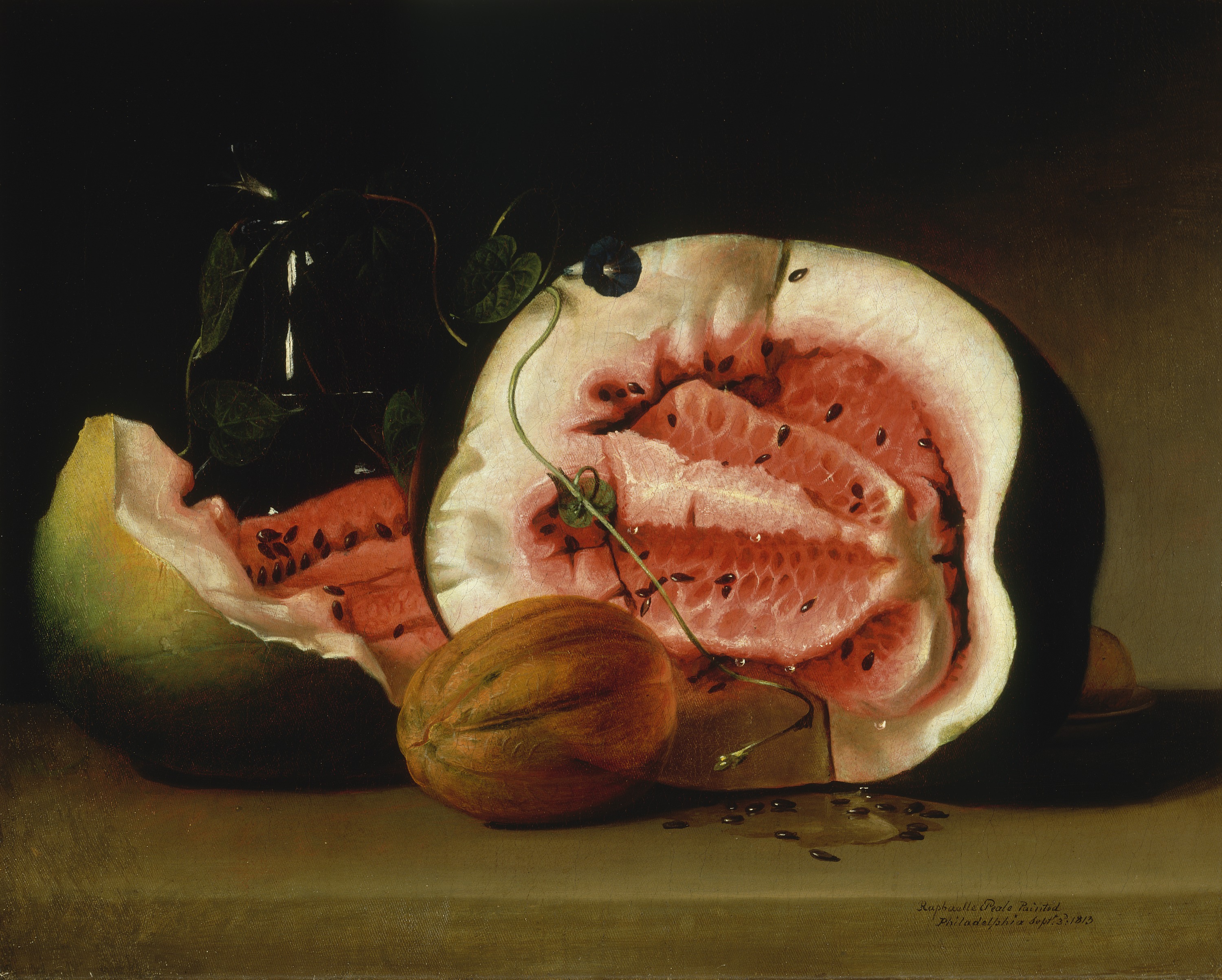
Melons and Morning Glories1813
Raphaelle Peale's father, Charles Willson Peale, urged his son to paint portraits instead of still lifes, which brought an artist less prestige and fewer commissions. More about this work
About this work
Raphaelle Peale's father, Charles Willson Peale, urged his son to paint portraits instead of still lifes, which brought an artist less prestige and fewer commissions. But still lifes suited Raphaelle, who also worked as a taxidermist. He painted this melon as if it were a body opened up for examination, detailing its fluids and flesh so that the painting suggests life, fertility, and death, all at once.Exhibition Label, Smithsonian American Art Museum, 2006
Text from the Smithsonian American Art Museum.
How it was made
- Oil paint
- Pigment ground in a drying oil, usually linseed. It dries slowly, so painters could blend on the canvas, build up thin translucent glazes, and rework a picture over weeks. Canvas replaced wooden panels in the 1500s because it is lighter and can be rolled.
Raphaelle Peale
born Annapolis, MD 1774-died Philadelphia, PA 1825
Rights and the museum’s record
Public domain. The Smithsonian American Art Museum has dedicated this image to the public domain under CC0, so anyone may copy, adapt and use it, for any purpose, without asking. Our prints and files are reproductions made from the museum’s image; the museum doesn’t endorse them.
- Object number
- 1967.39.2
- Credit
- Courtesy of the Smithsonian American Art Museum
- Type
- Painting
- Department
- Painting and Sculpture
- Licence
- CC0 1.0 Universal
- Museum record
- See it on the museum’s site
Report this work
Close in colour